GALLUP NEWS SERVICE
PRINCETON, NJ -- Following the election of Hamas as the Palestinian Authority's ruling party, Americans have grown more pessimistic that peace will ever be achieved in the Middle East, and increasingly sympathetic toward the Israelis. American opinions of the Palestinians had been improving in recent years, but now are among the worst Gallup has ever measured. Most Americans do not believe the United States should give any financial assistance to the Palestinian Authority -- regardless of its stance toward Israel -- and most say the United States should conduct diplomatic relations with the Palestinians if they recognize Israel as a nation.
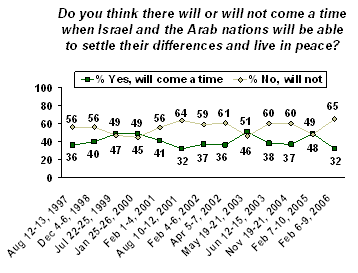
Hamas secured a majority of seats in the latest Palestinian parliament, raising worldwide concerns about what the militant organization, considered by many nations to be a terrorist group, might do with governing power. By a 2-1 margin, Americans now say there will never come a time when Israel and the Arab nations will live in peace, according to the annual Gallup Poll on World Affairs, conducted Feb. 6-9. The 65% to 32% split compares with a roughly 50-50 split last year. The current reading on this "future peace" measure, along with one other reading from August 2001, represents the most pessimistic Americans have been since the question was first asked in 1997.
U.S. Policy Toward the Palestinians
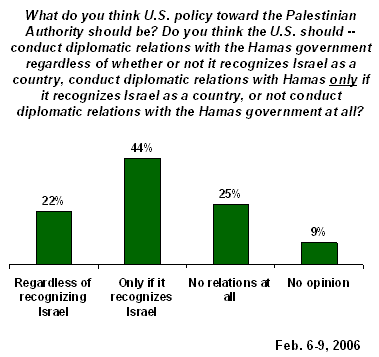
The poll asked Americans what U.S. policy toward the Palestinians should be now that Hamas has political power. The U.S. government is currently reassessing its policies and has threatened to suspend aid to the Palestinians unless they renounce violence and recognize Israel.
Most Americans believe the United States should conduct diplomatic relations with the Palestinians, but of that group, the majority says relations should be continued only if Hamas recognizes Israel. All in all, 22% of Americans say the United States should deal with the Palestinians regardless of their stance toward Israel, and another 44% say the United States should engage in diplomacy with the Palestinians if the Hamas-led government recognizes Israel. One in four Americans say the United States should not conduct any relations with the Palestinians regardless of their official policy toward Israel.
Americans are much less willing to favor financial assistance toward the Palestinians than they are to favor a diplomatic relationship. Fifty-seven percent of Americans oppose giving any financial aid to the Palestinians while Hamas is in power, while 30% would give aid if the Palestinians recognize Israel. Five percent say the United States should give aid even if the Palestinians do not recognize Israel.

The more negative stance toward foreign aid for the Palestinians is consistent with Americans' general views on the subject. Sixty-four percent of Americans say the United States spends "too much" on foreign aid, 23% say "about the right amount," and 9% "too little."
Increased Sympathy for the Israelis
Gallup's long-standing trend question on the Middle East, first measured in 1988, asks Americans whether their sympathies in the conflict lie more with the Israelis or the Palestinians. As has typically been the case, Americans are much more likely to sympathize with the Israelis (59%) than with the Palestinians (15%), with the remaining 26% not taking either side or not having an opinion. The current figures represent one of the most lopsided margins in favor of the Israelis ever recorded by Gallup. The only other times sympathy has been this high were during the first Persian Gulf War in February 1991 (when Iraq was launching Scud missiles into Israeli territory) and shortly before the start of the second war with Iraq, in February 2003 (58%). In 2004 and 2005, sympathy toward the Palestinians, though still low, was as high as it has been historically (18%).
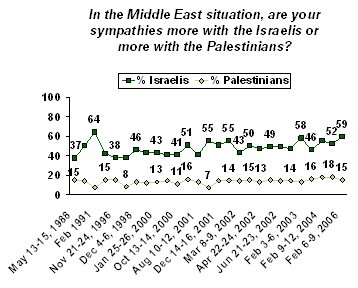
Republicans (77%) are significantly more likely to sympathize with the Israelis than are Democrats (50%) or independents (50%). Gallup also finds that Americans who say they follow news about world affairs "very closely" are more likely to sympathize with the Israelis (66%) than Americans who follow foreign news only somewhat closely (59%) or who do not follow it closely (52%).
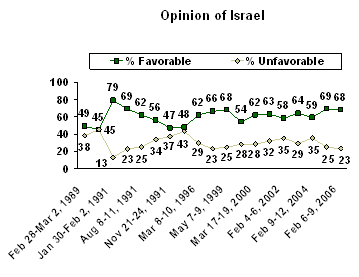
Gallup's World Affairs Poll also obtains basic favorable ratings of a variety of countries each year, including Israel and the Palestinian Authority. The new poll finds 68% of Americans saying they have a favorable opinion of Israel, including 21% who are "very favorable" toward it. Twenty-three percent view Israel unfavorably. Those numbers are essentially unchanged from last year, and are the most positive for Israel aside from a 79% favorable rating in February 1991 during the first Persian Gulf War.
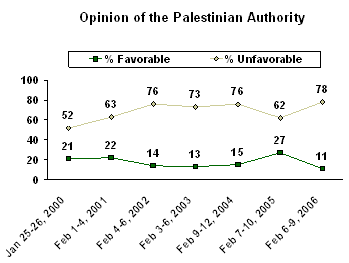
In stark contrast, just 11% of Americans have a favorable opinion of the Palestinian Authority, while 78% have an unfavorable view (29% say their view is "very unfavorable"). Last year, opinion was considerably more positive, with 27% favorable and 62% unfavorable. In fact, the current readings are the most negative Gallup has found since it began asking about the Palestinian Authority in 2000, while last year's were the most positive.
Many Americans Aware of Hamas Win
Many Americans are not closely tuned in to the happenings in the Middle East, but nearly half are aware that Hamas won the recent Palestinian elections. Forty-eight percent of Americans correctly identified Hamas as the winner, with 2% incorrectly identifying the former ruling party Fatah as the victor, and 50% not providing an answer.
Those who pay close attention to international news are more knowledgeable than less-attentive Americans about the Palestinian election outcome. Seventy-three percent of those who closely follow world affairs knew Hamas won, compared with 46% who follow world affairs only somewhat closely, and 22% who do not follow these issues closely.
Those who were aware of the Hamas victory are no more nor less optimistic about Middle East peace than those who were unaware of it. However, the more basic attitudes toward Israel and the Palestinians do vary significantly by knowledge of the Hamas victory.
|
Opinion of Israelis and Palestinians, |
||
|
Know |
Unsure/ |
|
|
Sympathies are more with the Israelis |
67% |
52% |
|
Think peace will be achieved |
31% |
33% |
|
Favorable view of Israel |
77% |
60% |
|
Favorable view of Palestinian Authority |
8% |
15% |
Survey Methods
These results are based on telephone interviews with a randomly selected national sample of 1,002 adults, aged 18 and older, conducted Feb. 6-9, 2006. For results based on this sample, one can say with 95% confidence that the maximum error attributable to sampling and other random effects is ±3 percentage points. In addition to sampling error, question wording and practical difficulties in conducting surveys can introduce error or bias into the findings of public opinion polls.
22. Next, I'd like your overall opinion of some foreign countries. First, is your overall opinion of [RANDOM ORDER] very favorable, mostly favorable, mostly unfavorable, or very unfavorable? How about -- [INSERT NEXT ITEM]?
L. Israel
|
Very |
Most- |
Most- |
Very |
No |
Total |
Total |
|
|
% |
% |
% |
% |
% |
% |
% |
|
|
2006 Feb 6-9 |
21 |
47 |
18 |
5 |
9 |
68 |
23 |
|
2005 Feb 7-10 |
19 |
50 |
20 |
5 |
6 |
69 |
25 |
|
2004 Feb 9-12 |
14 |
45 |
25 |
10 |
6 |
59 |
35 |
|
2003 Feb 3-6 |
22 |
42 |
23 |
6 |
7 |
64 |
29 |
|
2002 Feb 4-6 |
16 |
42 |
25 |
10 |
7 |
58 |
35 |
|
2001 Feb 1-4 ^ |
18 |
45 |
20 |
12 |
5 |
63 |
32 |
|
2000 Mar 17-19 |
16 |
46 |
20 |
8 |
10 |
62 |
28 |
|
2000 Jan 25-26 |
11 |
43 |
21 |
7 |
18 |
54 |
28 |
|
1999 May 7-9 |
15 |
53 |
19 |
6 |
7 |
68 |
25 |
|
1999 Feb 8-9 |
18 |
48 |
16 |
7 |
11 |
66 |
23 |
|
1996 Mar 8-10 |
17 |
45 |
18 |
11 |
9 |
62 |
29 |
|
1992 Feb 6-9 |
12 |
36 |
27 |
16 |
9 |
48 |
43 |
|
1991 Nov 21-24 |
11 |
36 |
26 |
11 |
16 |
47 |
37 |
|
1991 Sep 26-29 |
11 |
45 |
25 |
9 |
10 |
56 |
34 |
|
1991 Aug 8-11 |
15 |
47 |
19 |
6 |
12 |
62 |
25 |
|
1991 Mar 14-17 |
20 |
49 |
16 |
7 |
8 |
69 |
23 |
|
1991 Jan 30-Feb 2 |
28 |
51 |
10 |
3 |
8 |
79 |
13 |
|
1989 Aug 10-13 |
11 |
34 |
29 |
16 |
10 |
45 |
45 |
|
1989 Feb 28-Mar 2 |
8 |
41 |
25 |
13 |
13 |
49 |
38 |
|
^ Asked of a half sample |
|||||||
U. The Palestinian Authority
|
|
Very |
Most- |
Most- |
Very |
No |
Total |
Total |
|||||||||
|
2006 Feb 6-9 |
% |
% |
% |
% |
% |
% |
% |
|||||||||
|
2006 Feb 6-9 |
1 |
10 |
49 |
29 |
10 |
11 |
78 |
|||||||||
|
2005 Feb 7-10 |
3 |
24 |
43 |
19 |
11 |
27 |
62 |
|||||||||
|
2004 Feb 9-12 |
2 |
13 |
44 |
32 |
9 |
15 |
76 |
|||||||||
|
2003 Feb 3-6 |
1 |
12 |
44 |
29 |
14 |
13 |
73 |
|||||||||
|
2002 Feb 4-6 |
3 |
11 |
44 |
32 |
10 |
14 |
76 |
|||||||||
|
2001 Feb 1-4 ^ |
4 |
18 |
39 |
24 |
15 |
22 |
63 |
|||||||||
|
2000 Jan 25-26 |
3 |
18 |
36 |
16 |
27 |
21 |
52 |
|||||||||
|
^ Asked of a half sample |
||||||||||||||||
On a different topic,
24. In the Middle East situation, are your sympathies more with the Israelis or more with the Palestinians?
|
Israelis |
Palestinians |
BOTH |
NEITHER |
No |
|
|
% |
% |
% |
% |
% |
|
|
2006 Feb 6-9 |
59 |
15 |
5 |
13 |
8 |
|
|
|
|
|
|
|
|
2005 Feb 7-10 |
52 |
18 |
7 |
12 |
11 |
|
2004 Feb 9-12 |
55 |
18 |
7 |
12 |
8 |
|
2003 May 19-21 |
46 |
16 |
12 |
14 |
12 |
|
2003 Feb 3-6 |
58 |
13 |
6 |
11 |
12 |
|
2002 Sep 2-4 |
47 |
14 |
6 |
19 |
14 |
|
2002 Jun 21-23 |
49 |
14 |
8 |
19 |
10 |
|
2002 May 20-22 |
49 |
15 |
7 |
19 |
10 |
|
2002 Apr 22-24 |
47 |
13 |
9 |
18 |
13 |
|
2002 Apr 5-7 |
50 |
15 |
9 |
17 |
9 |
|
2002 Mar 8-9 |
43 |
14 |
6 |
20 |
17 |
|
2002 Feb 4-6 |
55 |
14 |
6 |
14 |
11 |
|
2001 Dec 14-16 |
51 |
14 |
5 |
17 |
13 |
|
2001 Sep 14-15 |
55 |
7 |
4 |
20 |
14 |
|
2001 Aug 10-12 |
41 |
13 |
7 |
18 |
21 |
|
2001 Feb 1-4 |
51 |
16 |
7 |
14 |
12 |
|
2000 Oct 13-14 |
41 |
11 |
9 |
18 |
21 |
|
2000 Jul 6-9 |
41 |
14 |
5 |
18 |
22 |
|
2000 Jan 25-26 |
43 |
13 |
5 |
21 |
18 |
|
1999 Jul 22-25 |
43 |
12 |
11 |
19 |
15 |
|
1998 Dec 4-6 |
46 |
13 |
5 |
22 |
14 |
|
1997 Aug 12-13 |
38 |
8 |
5 |
19 |
30 |
|
1996 Nov 21-24 |
38 |
15 |
6 |
14 |
27 |
|
1993 Sep 10-12 |
42 |
15 |
6 |
17 |
20 |
|
1991 Feb |
64 |
7 |
19 |
-- |
10 |
|
1989 Aug |
50 |
14 |
15 |
-- |
21 |
|
1988 May 13-15 |
37 |
15 |
22 |
-- |
27 |
|
(vol.) = Volunteered response |
|||||
|
May 1988-April 2002 and February 3-6, 2003, WORDING: |
|||||
25. Do you think there will or will not come a time when Israel and the Arab nations will be able to settle their differences and live in peace?
|
|
Yes, there |
No, there |
No |
|
% |
% |
% |
|
|
2006 Feb 6-9 |
32 |
65 |
3 |
|
|
|
|
|
|
2005 Feb 7-10 |
49 |
48 |
3 |
|
2004 Nov 19-21 |
37 |
60 |
3 |
|
2003 Jun 12-15 ^ |
38 |
60 |
2 |
|
2003 May 19-21 |
51 |
46 |
3 |
|
2002 Apr 5-7 |
36 |
61 |
3 |
|
2002 Feb 4-6 |
37 |
59 |
4 |
|
2001 Aug 10-12 |
32 |
64 |
4 |
|
2001 Feb 1-4 |
41 |
56 |
3 |
|
2000 Jan 25-26 |
49 |
45 |
6 |
|
1999 Jul 22-25 |
49 |
47 |
4 |
|
1998 Dec 4-6 |
40 |
56 |
4 |
|
1997 Aug 12-13 |
36 |
56 |
8 |
|
^ Asked of a half sample |
|||
26. As you may know, the Palestinians recently held elections to elect a new government. Do you happen to know which political party won those elections -- [ROTATED: Hamas (or) Fatah] -- or are you unsure?
|
|
Hamas |
Fatah |
Unsure |
No answer |
|
|
|
|
|
|
|
2006 Feb 6-9 |
48% |
2 |
49 |
1 |
In fact, the Hamas party won the elections. Now, thinking ahead,
Q.27-28 SPLIT SAMPLED
27. What do you think U.S. policy toward the Palestinian Authority should be? Do you think the U.S. should -- [ROTATED: conduct diplomatic relations with the Hamas government regardless of whether or not it recognizes Israel as a country, conduct diplomatic relations with Hamas only if it recognizes Israel as a country, or not conduct diplomatic relations with the Hamas government at all]?
BASED ON 500 NATIONAL ADULTS IN FORM A
|
Regardless of |
Only if |
|
|
|
|
|
|
|
|
|
|
2006 Feb 6-9 |
22% |
44 |
25 |
9 |
28. What do you think U.S. policy toward the Palestinian Authority should be? Do you think the U.S. should -- [ROTATED: give financial aid to the Palestinian Authority regardless of whether or not the Hamas government recognizes Israel as a country, give financial aid to the Palestinian Authority only if Hamas recognizes Israel as a country, or not give any financial aid to the Palestinian Authority while the Hamas government is in power]?
BASED ON 502 NATIONAL ADULTS IN FORM B
|
|
Regardless of |
Only if |
No aid |
No |
|
|
|
|
|
|
|
2006 Feb 6-9 |
5% |
30 |
57 |
9 |