GALLUP NEWS SERVICE
PRINCETON, NJ -- The latest monthly UBS/Gallup Index of Investor Optimism declined to 80 in February, down 13 points from January, but still higher than it was during most of last year.
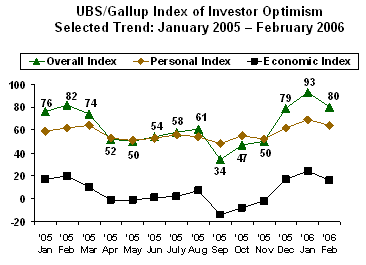
The Personal Dimension and the Economic Dimension -- which comprise the overall Index -- declined by 5 points and 8 points respectively, to 64 and 16.
The survey of investors was conducted Feb. 1-16, with interviewing completed before the latest surge in stock prices. The timing is significant because the Index's decline was due mostly to less positive feelings about the performance of the stock market, which also affected investor optimism about their short- and long-term investments. Fifty-one percent of investors are optimistic about the market this month, compared with 59% last month.
After surging to a 19-month high in January, the Index is now at the same level it was in December 2005, and 46 points higher than last September. The Index had a baseline score of 124 when it was launched in October 1996.
Many Investors Expect a Shortfall in Retirement
The survey of investors also found that 28% expect they will not have enough money to live on for the rest of their lives once they retire. Another 51% expect to have about the right amount of money, and 20% will have more than enough.
Taking into account all your retirement funds, including Social Security and other such sources of retirement income, do you think you will have MORE than enough money to live for the rest of your life, will you have just about ENOUGH money, or will you probably NEED MORE money than you will have when you retire?
|
Will probably need more money |
Will have about enough money |
Will have more than enough money |
No opinion |
|
|
|
|
|
||
|
06 Feb |
28% |
51 |
20 |
1 |
Among investors expecting a retirement shortfall, 65% say they will just tighten their belts and spend less in retirement, 63% will work longer before they actually retire, and 51% will do more part-time work once they do retire. A smaller number of these investors say they will pursue a more aggressive investment strategy to make up the deficit (29%) or increase the amount of money they save (31%). About 18% are "very" likely to do nothing and hope that things will just get better.
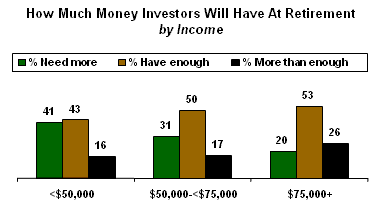
Not surprisingly, investors with lower incomes are more likely to expect a retirement shortfall than are higher income investors. Among investors with annual household incomes of less than $50,000, 41% expect they will not have enough money when they retire. That percentage declines to 31% among investors in the $50,000-to-$75,000 range, and is just 20% among investors with incomes of $75,000 or more.
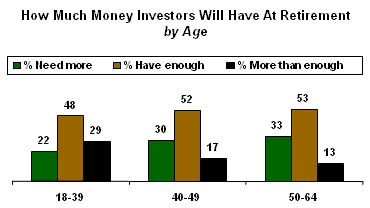
Perceiving a retirement shortfall is only slightly related to age. Twenty-two percent of investors under age 40 say they probably will be short of money, compared with 30% of those aged 40-49, and 33% in the 50- to 64-year-old pre-retirement group.
Survey Methods
Results are based on telephone interviews with 802 investors (people with at least $10,000 in investable assets), aged 18 and older, conducted Feb. 1-16, 2006. For results based on the total sample, the maximum margin of sampling error is ±4 percentage points.
In addition to sampling error, question wording and practical difficulties in conducting surveys can introduce error or bias into the findings of public opinion polls.