GALLUP NEWS SERVICE
PRINCETON, NJ -- When Americans are asked, without prompting, to name "the most important financial problem facing your family today," energy costs, healthcare costs, and lack of money or low wages are mentioned most frequently. But, people from varying income groups answer the question differently. Those in lower-income households are more likely to identify basic problems that affect their day-to-day existence, such as a lack of money or paying off debts, as most important. Those in higher-income households more often mention longer-term issues such as college expenses or retirement.
In order to provide a large enough sample base for an in-depth analysis of the differences in personal financial problems among various income and racial groups, Gallup combined the results of six surveys, conducted from August 2005 through February 2006.
Over this period, the most important financial problems facing American families have been energy costs, mentioned by 14% of respondents, healthcare costs, mentioned by 13%, and lack of money or low wages, mentioned by 11%. High levels of debt (7%), college expenses (7%), unemployment (7%), and the high cost of living or inflation (6%) were also mentioned frequently.
|
What is the most important financial problem facing your family today? |
|
|
Aug 2005-Feb 2006 |
|
|
% |
|
|
Energy costs (oil and gas prices) |
14 |
|
Healthcare costs |
13 |
|
Lack of money/Low wages |
11 |
|
Not enough money to pay debts |
7 |
|
College expenses |
7 |
|
Unemployment/Loss of jobs |
7 |
|
High cost of living/inflation |
6 |
|
Cost of owning/renting a home |
5 |
|
Retirement savings |
5 |
|
Taxes |
4 |
|
Lack of savings |
2 |
|
Interest rates |
1 |
|
Social Security |
1 |
|
Transportation costs |
1 |
|
State of the economy |
1 |
|
Stock market/Investments |
1 |
|
Controlling spending |
1 |
|
|
|
|
None |
16 |
|
Other/No opinion |
8 |
This wide variety of problems can be grouped into two categories: 1) day-to-day, basic survival needs ("first-tier" problems), and 2) longer-term financial issues that are not directly related to basic survival needs ("second-tier" problems).
The first-tier category includes financial issues that are for the most part direct, necessary and not subject to much discretion: lack of money or low wages, not enough money to pay debts, unemployment or job loss, inflation or high cost of living, the cost of owning or renting a home, transportation costs, and controlling spending. The second-tier category includes financial issues that are more likely to be at least somewhat discretionary and under the control of the individual: energy costs, healthcare costs, college expenses, retirement savings, taxes, lack of savings, interest rates, Social Security, the general state of the economy, and the stock market.
Overall, 38% of Americans mention first-tier problems as the most important financial issue facing their families, while a higher percentage, 49%, mention second-tier issues.
Lower- Versus Higher-Income Households
Data analysis clearly shows how different financial realities are for higher- and lower-income households. Those in lower-income households are much more likely to say that they confront basic survival issues on a daily basis, while those in higher-income households are much less concerned with basic financial concerns and more focused on second-tier, quality-of-life, long-term concerns.
For example, more than half (52%) of those living in households earning less than $30,000 per year say their most pressing financial concerns are the first-tier or day-to-day money matters such as having enough money to get by or having too much debt. The percentage of those with these first-tier concerns drops steadily as income increases, to 39% among those earning between $30,000 and $75,000, and to only 26% among those earning $75,000 or more.
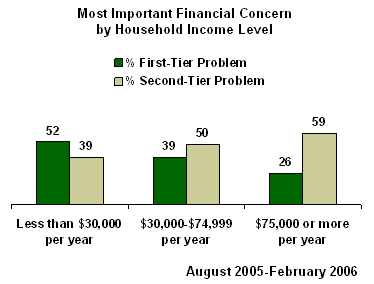
Here are the detailed results by income level:
- Those earning less than $30,000 per year are most likely to say lack of money and low wages is their families' top financial problem, mentioned by 19% of respondents, followed by healthcare costs (15%), energy costs (13%), and paying off debts (10%).
- The most important financial problems for those earning between $30,000 and $75,000 per year include energy costs (17%), healthcare costs (15%), and lack of money or low wages (10%).
- Among those earning $75,000 or more per year, the top economic concerns are college expenses (15%), energy costs (13%), healthcare costs (10%), and retirement savings (9%).
|
Most Important Financial Problem by Household Income |
|||
|
August 2005-February 2006 |
|||
|
|
Less than |
|
|
|
% |
% |
% |
|
|
Lack of money/Low wages |
19 |
10 |
6 |
|
Healthcare costs |
15 |
15 |
10 |
|
Energy costs (oil and gas prices) |
13 |
17 |
13 |
|
Not enough money to pay debts |
10 |
7 |
6 |
|
Unemployment/Loss of jobs |
9 |
7 |
4 |
|
Cost of owning/renting a home |
6 |
6 |
5 |
|
High cost of living/inflation |
6 |
7 |
4 |
|
College expenses |
3 |
5 |
15 |
|
Retirement savings |
2 |
4 |
9 |
|
Taxes |
2 |
4 |
5 |
|
Social Security |
2 |
1 |
* |
|
Transportation costs |
2 |
1 |
* |
|
Lack of savings |
1 |
2 |
3 |
|
State of the economy |
1 |
* |
1 |
|
Interest rates |
* |
1 |
2 |
|
Stock market/Investments |
* |
1 |
1 |
|
Controlling spending |
* |
1 |
1 |
|
|
|
|
|
|
None |
12 |
15 |
17 |
|
Other/No opinion |
9 |
6 |
5 |
|
*Less than 0.5% |
|
|
|
Blacks Versus Whites
Black households in America have significantly lower average incomes than white households, so it is not surprising to find blacks are more likely than whites to mention first-tier financial problems. Sixty percent of blacks mention these first-tier issues when asked about the most important financial problem facing their families, compared with just 36% of whites. These findings highlight the degree to which blacks in the United States have significantly different concerns and orientations than do whites when it comes to financial issues.
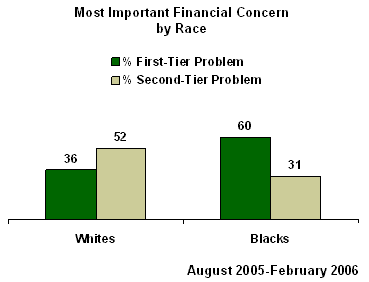
A more detailed look at the results show that energy costs and healthcare costs top the list of problems among whites, each mentioned by 15%. Lack of money or wages (10%), debt (7%), and college expenses (7%) follow.
The predominant problem among blacks is lack of money or low wages, with 21% of blacks mentioning this problem, followed by energy costs (12%), paying off debts (12%), and unemployment (12%).
|
Most Important Financial Problem by Race |
||
|
August 2005-February 2006 |
||
|
Whites |
Blacks |
|
|
% |
% |
|
|
Energy costs (oil and gas prices) |
15 |
12 |
|
Healthcare costs |
15 |
6 |
|
Lack of money/Low wages |
10 |
21 |
|
Not enough money to pay debts |
7 |
12 |
|
College expenses |
7 |
5 |
|
Unemployment/Loss of jobs |
6 |
12 |
|
High cost of living/inflation |
6 |
6 |
|
Cost of owning/renting a home |
5 |
8 |
|
Retirement savings |
5 |
2 |
|
Taxes |
4 |
3 |
|
Lack of savings |
2 |
1 |
|
Social Security |
1 |
1 |
|
Transportation costs |
1 |
1 |
|
Stock market/Investments |
1 |
1 |
|
Interest rates |
1 |
* |
|
State of the economy |
1 |
* |
|
Controlling spending |
1 |
-- |
|
|
|
|
|
None |
16 |
10 |
|
Other/No opinion |
7 |
9 |
|
*Less than 0.5% |
|
|
Younger Versus Older Americans
Americans under age 50 are more likely than those over age 50 to mention first-tier problems as the most important economic issue facing their families now. Roughly 4 in 10 adults under age 50 (43% of 18- to 29-year-olds and 42% of 30- to 49-year-olds) mention a first-tier problem. This compares with about a third of adults aged 50 and older who mention a first-tier problem.
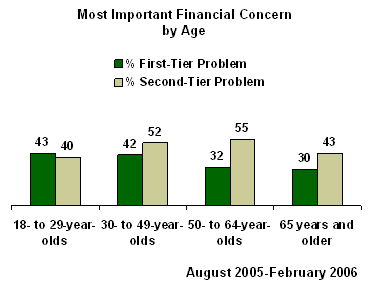
A more in-depth look at the results to this question shows a steady increase in the frequency with which healthcare costs are mentioned as the top problem as Americans grow older. Paying for college and paying off debts are mentioned most frequently by the younger adults in the country.
- 18- to 29-year-olds. The top financial problems for the families of younger Americans include energy costs (18%), not having enough money to pay debts (12%), lacking money or having low wages (9%), and paying for college (9%).
- 30- to 49-year-olds. Among Americans in this age group, energy costs (16%), money and wages (13%), healthcare costs (11%), and college expenses (10%) are the most important problems.
- 50- to 64-year-olds. Healthcare costs, at 18%, are the top financial problem for Americans aged 50 to 64, followed by energy costs (13%), and money and wages (10%). More Americans in the 50 to 64 age group mention retirement savings as the top financial problem than in any other age group.
- 65 years and older. The most important financial problem for seniors is healthcare costs, mentioned by 19% of respondents aged 65 and older. Energy costs and lack of money follow, each mentioned by 10% of adults in this age group. Those aged 65 and older are the most likely age group to not mention any problem as the most important.
|
Most Important Financial Problem by Age |
||||
|
August 2005-February 2006 |
||||
|
|
|
|
65 years |
|
|
% |
% |
% |
% |
|
|
Energy costs (oil and gas prices) |
18 |
16 |
13 |
10 |
|
Not enough money to pay debts |
12 |
8 |
5 |
4 |
|
Lack of money/Low wages |
9 |
13 |
10 |
10 |
|
College expenses |
9 |
10 |
5 |
1 |
|
Unemployment/Loss of jobs |
8 |
7 |
6 |
4 |
|
Healthcare costs |
7 |
11 |
18 |
19 |
|
High cost of living/inflation |
6 |
6 |
4 |
7 |
|
Cost of owning/renting a home |
6 |
6 |
5 |
3 |
|
Taxes |
2 |
4 |
5 |
4 |
|
Lack of savings |
2 |
2 |
1 |
1 |
|
Transportation costs |
2 |
1 |
1 |
1 |
|
Retirement savings |
1 |
5 |
9 |
3 |
|
Interest rates |
1 |
1 |
1 |
1 |
|
Social Security |
* |
1 |
1 |
2 |
|
State of the economy |
* |
1 |
1 |
1 |
|
Stock market/Investments |
* |
1 |
1 |
1 |
|
Controlling spending |
* |
1 |
1 |
1 |
|
|
|
|
|
|
|
None |
12 |
11 |
14 |
29 |
|
Other/No opinion |
9 |
6 |
6 |
5 |
|
*Less than 0.5% |
|
|
|
|
Survey Methods
These results are based on telephone interviews with a randomly selected national sample of 5,862 national adults, aged 18 and older, conducted across six polls from August 2005 through February 2006. For results based on this sample, one can say with 95% confidence that the maximum error attributable to sampling and other random effects is ±2 percentage points.
In addition to sampling error, question wording and practical difficulties in conducting surveys can introduce error or bias into the findings of public opinion polls.
