GALLUP NEWS SERVICE
PRINCETON, NJ -- The first USA Today/Gallup Poll following the killing of al Qaeda terrorist mastermind Abu Musab al-Zarqawi suggests Americans are heeding President George W. Bush's caution that the Iraqi insurgency will continue without Zarqawi leading it. Certainly the poll is not detecting the kind of public optimism about the broader war on terror recorded at the outset of the United States' military operations in Iraq or Afghanistan, or following the capture of Saddam Hussein.
The poll, conducted June 9-11, 2006, finds little change compared with earlier this year in Americans' assessment of the United States' progress in the war on terror, or in the importance Americans attach to capturing al Qaeda leader Osama bin Laden.
Despite the evident success of U.S. intelligence and military forces in tracking and killing Zarqawi, Americans are not much more optimistic than they have been about the chances the United States will eventually find bin Laden. Also, Bush's approval rating for his handling of terrorism is only slightly higher today than it was in April.
Only Minority Believes U.S. is Winning
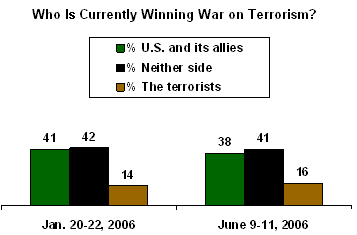
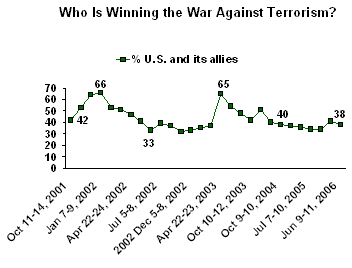
The percentage of Americans saying the United States and its allies are winning the war on terrorism has averaged about 37% for the past two years, and it continues at that level today. The latest poll finds 38% saying the United States is winning the war on terror and 16% saying the terrorists are winning, while the plurality, 41%, say neither side is winning. These results are similar to the previous reading from January 2006.
In fact, current public opinion about the United States' progress in the war on terror is similar to opinions given since the 9/11 terrorist attacks. The few times a majority of Americans have perceived the United States as winning were following the capture of Saddam Hussein in December 2003, after the fall of Baghdad and end of major combat in Iraq in April and May 2003, and spanning the U.S.-led invasion of Afghanistan in 2001 and 2002 in which the Taliban was removed from power.
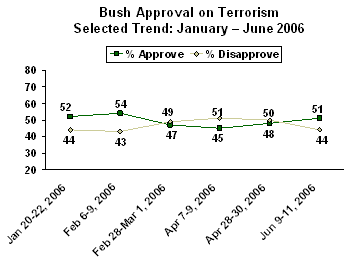
Reinforcing the idea that Americans don't perceive Zarqawi's death as a major event in the war on terror, Bush's approval rating for his handling of terrorism is only slightly higher today than it was two months ago, and remains below where it was in January and February.
Osama bin Laden Next?
President Bush has described Zarqawi's death as a "severe blow" to al Qaeda and the "ideology of terror." At the same time, he warns that the military mission in Iraq remains difficult, and that the Iraqi insurgency will carry on under new leadership.
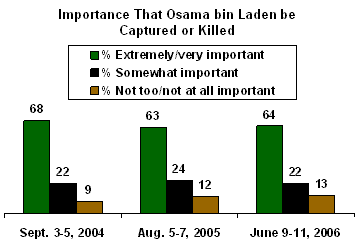
It appears that Zarqawi's death and Bush's reaction to it has done nothing to change Americans' view of the importance of a similar end for bin Laden. Sixty-four percent of Americans say that tracking down bin Laden is either extremely or very important to U.S. interests. Another 22% say it is only somewhat important, while just 13% say it is either not too or not at all important. These results are nearly identical to the previous two readings on this measure from 2004 and 2005.
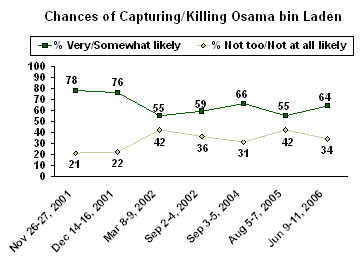
Americans are a bit more certain than they were last summer that the United States will eventually capture or kill bin Laden, but they are not extraordinarily more positive. Close to two-thirds (64%) believe it is very or somewhat likely bin Laden will be captured, including 25% who say this is very likely.
The current level of optimism on this measure is similar to September 2004 (following the terrorism-focused 2004 Republican national convention), but still below where it was in the first few months after the 9/11 attacks.
Partisanship of Attitudes
Perceptions of who is winning the war on terrorism are highly related to political party affiliation. A majority of Republicans (66%) say the United States is winning, compared with only 27% of independents and 20% of Democrats. However, Democrats are more likely than independents to perceive that the terrorists are winning, making Democrats significantly more negative about the effort to combat terrorism.
|
Who is Winning War on Terrorism? |
|||
|
Republicans |
Independents |
Democrats |
|
|
U.S. and allies are winning |
66% |
27 |
20 |
|
Terrorists are winning |
6% |
15 |
25 |
|
Net U.S. winning |
+60 |
+12 |
-5 |
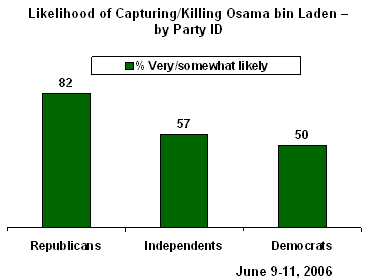
Predictions about the likelihood that bin Laden will be captured are less partisan. At least half of all three political groups believe this is at least somewhat likely, although Republicans are much more inclined than independents or Democrats to believe it will.
Majorities of each group also say it important that this be accomplished -- although Republicans (72%) are more likely than independents (57%) and Democrats (63%) to say it is extremely or very important.
Survey Methods
These results are based on telephone interviews with a randomly selected national sample of 1,002 adults, aged 18 and older, conducted June 9-11, 2006. For results based on this sample, one can say with 95% confidence that the maximum error attributable to sampling and other random effects is ±3 percentage points.
In addition to sampling error, question wording and practical difficulties in conducting surveys can introduce error or bias into the findings of public opinion polls.