GALLUP NEWS SERVICE
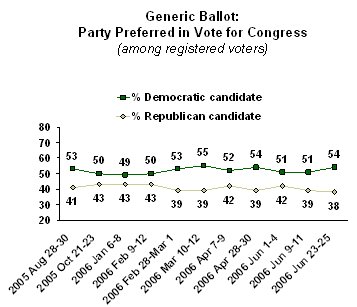
PRINCETON, NJ - According to the latest USA Today/Gallup poll, conducted June 23-25, 2006, the Democrats now lead the Republicans 54% to 38% as the preferred party of registered voters in this fall's congressional elections.
This 16-point Democratic advantage ties with a mid-March Gallup survey for the widest Democratic lead in the 2006 elections for Congress since Gallup started measuring voter support last fall. It is slightly greater than the average 12-point lead the Democrats have held across the nine Gallup "generic ballot" measures conducted since the start of the year.
The difficulties ahead for the GOP in this election are underscored by voters' sour reaction to rewarding the current membership of Congress with another term. Only 38% of registered voters today say that most members of Congress deserve to be reelected. This is down from 42% in January, and is the lowest level of support for incumbents seen on this measure since November 1994 -- just before the transformational election which swept the Democratic majority out of power. From 1998-2004, at least a majority of Americans have believed most members deserved to be re-elected.
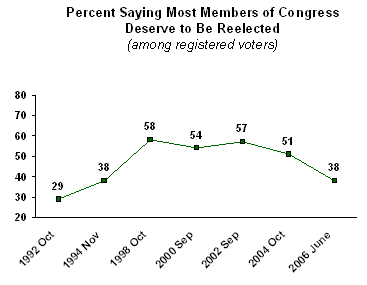
As the 1992 election indicates, a low number on this measure does not necessarily spell disaster for the incumbent party. That year, only 29% of registered voters said most members of Congress deserved reelection, and yet Democrats rode Bill Clinton's coattails and retained their majority power in the U.S. House of Representatives that year by an 82 seat margin. However, the election of 1992 still produced a rather dramatic change in the composition of Congress as an unusually high number of incumbents declined to run for re-election. Also, the fact that 1992 was a presidential election year helped to shift the campaign focus away from Congress.
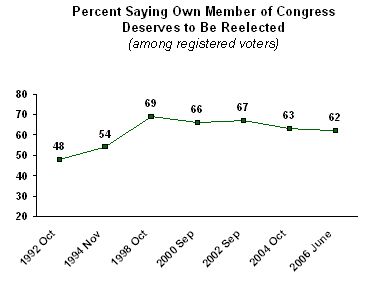
Potentially comforting for the Republicans is the fact that the percentage of registered voters saying their own member of Congress deserves to be reelected remains little changed from previous years, and is well above the 54% recorded in 1994.
The Intensity Factor
Come Election Day, voter turnout will help Republicans narrow any Democratic advantage seen in pre-election polls based on all registered voters. But whether the Republicans' usually higher turnout rate relative to the Democrats' is capable of overcoming a double-digit Democratic lead among the larger electorate (such as the 16-points seen today) is doubtful, according to previous election trends.
Gallup polls closer to the election will enable a more accurate forecast by identifying the subset of "likely voters" among the larger sample of registered voters. For now, we must look at some less precise indications of voter intensity on each side.
The latest poll included three questions which tap voter interest in the election. The Democrats have an unusual advantage on two of these and are even with the Republicans on the third.
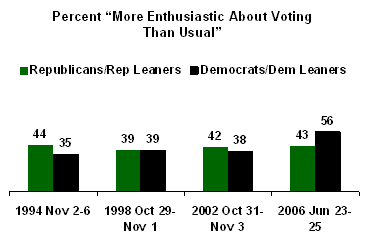
A question asked each midterm election year since 1994 finds the Democrats with a strong advantage in expressed enthusiasm for voting. A majority of Democrats (56%), compared with just 43% of Republicans, say they are more enthusiastic about voting this year than usual. Democratic enthusiasm is up from 50% in April and is substantially higher than their recorded enthusiasm in any of the previous three midterm elections.
Republicans' enthusiasm has rebounded from 33% in April, but is still only about average for the party compared with recent elections.
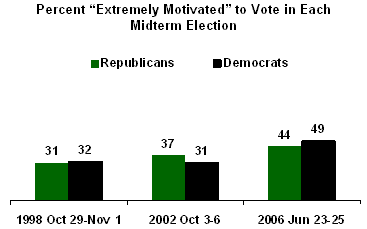
A different question asked each midterm election since 1998 measures the degree of motivation Americans feel about voting. Overall, 44% of national adults today say they are extremely motivated "to get out and vote" this year. Another 27% say they are very motivated and 19% are "somewhat motivated," while 10% are not too or not at all motivated.
Democrats have a slight edge over the Republicans today in the percentage saying they are extremely motivated to vote: 49% to 44%. In the previous two midterm elections they did no better than tie the Republicans in expressed motivation.
One key variable in Gallup's multi-question likely voter turnout scale is a question that asks voters how much thought they have given to the upcoming election. The answer can be a useful discriminator between people who will actually vote and those who will not. How well it works this far in advance of the election is unclear. But at this point, the Democrats and the Republicans are reporting equal levels of attention to the election. Just under half of both groups (45% of Democrats and 44% of Republicans) say they have given quite a lot or some thought to the election.
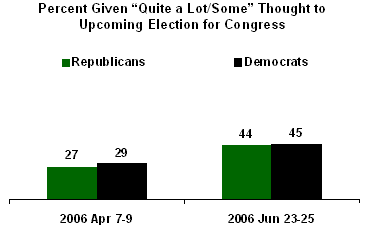
In the most recent midterm election (2002) Gallup found the two parties at parity early on in the year on this important turnout indicator, as they are now. But by the final pre-election poll, the Republicans had a 10-point advantage, 54% vs. 44%.
A High-Turnout Year?
Aside from the pro-Democratic tilt to many of the current indicators, there seems to be unusually high interest in the 2006 congressional elections for this early in the year. Although it is only June, the 44% currently saying they are extremely motivated to vote is substantially higher than the 30% who felt this way in October 2002, and the 28% who said so just before the 1998 elections. Similarly, the 50% feeling more enthusiastic about voting today is markedly higher than the 37%-38% range registering this just prior to the 1994, 1998 and 2002 elections. The 41% of Americans giving quite a lot or some thought to the election today is significantly higher than the 24% saying this in June 1998.
While Republicans are more likely to say they are motivated to vote than they were in previous years, their level of enthusiasm and thought given to the election is about average. At the same time, Democratic responses are elevated on all three indicators. If this keeps up, not only will it be a high turnout year, but it will be even harder for the Republican Party to overcome a major deficit in the party preferences of registered voters nationally.
Survey Methods
These results are based on telephone interviews with a randomly selected national sample of 1,000 adults, aged 18 and older, conducted June 23-25, 2006. For results based on this sample, one can say with 95% confidence that the maximum error attributable to sampling and other random effects is ±3 percentage points. For results based on the sample of -- 908-- registered voters, the maximum margin of sampling error is ±4 percentage points.
In addition to sampling error, question wording and practical difficulties in conducting surveys can introduce error or bias into the findings of public opinion polls.