GALLUP NEWS SERVICE
PRINCETON, NJ -- A majority of Americans would like Congress to pass a resolution addressing the withdrawal of U.S. troops from Iraq, but Americans are split down the middle over whether that withdrawal should be based on a dated timetable, or left open-ended. Meanwhile, a majority of Americans continue to believe that U.S. involvement in Iraq was a mistake.
There has been a great deal of congressional activity surrounding a "timetable" for withdrawal of U.S. troops from Iraq. Two separate resolutions were defeated in the Senate last week. One would have specified an explicit timetable for withdrawal and the other would have specified that the United States begin to withdraw troops, but with no specific timetable. Opponents of the resolutions argued that decisions on withdrawal of troops from a combat zone need to be made by the administration and its military advisors rather than by Congress sitting in Washington, D.C.
Responses to a new poll question asked over the June 23-25 weekend show no precise guidance from the American public on this issue. It is clear that Americans do like the idea of Congress passing some type of resolution on the issue of troop withdrawal, but there is no clear-cut majority sentiment that troops should be withdrawn either immediately or within one year.
Underlying these results is the rather obvious fact that almost everyone -- including both proponents and opponents of the war in Iraq -- agrees that troops should eventually be withdrawn from Iraq. The two issues involved are thus: 1) When should troops be withdrawn, and 2) who should decide the timetable for withdrawal?
In terms of the latter question, the new Gallup poll shows that a majority appears to favor Congress getting involved rather than leaving the issue totally up to the administration:
Which comes closer to your view -- [ROTATED: Congress should pass a resolution that outlines a plan for withdrawal of U.S. troops from Iraq (or) decisions about withdrawing U.S. troops from Iraq should be left to the president and his advisers]?
|
Congress should outline a plan |
Leave decision to president/advisers |
No opinion |
|
|
2006 Jun 23-25 |
57% |
39 |
4 |
Note that this question does not indicate that Congress would specify a precise timetable -- but only that Congress would pass a resolution outlining a plan. With this wording, a clear majority of Americans favor the idea. This suggests resistance on the part of the American public to the idea that the issue of withdrawal be left just to the administration. Americans apparently do like the idea of congressional involvement.
(A Gallup poll question in October 2002, also showed that a majority of Americans believed that Congress, rather than President Bush, should have the final authority for deciding whether the United States should invade Iraq with ground troops, suggesting that Americans in general believe decisions on war should reside with the legislative branch.)
In terms of the first question -- when should troops be withdrawn -- the data reflect a sharp division of Americans on the issue of extracting the U.S. troops from involvement in Iraq.
Here are four different plans the U.S. could follow in dealing with the war in Iraq. Which ONE do you prefer -- [ROTATED: withdraw all troops from Iraq immediately, withdraw all troops by July 2007 -- that is, in 12 months' time, withdraw troops, but take as many years to do this as are needed to turn control over to the Iraqis, (or) send more troops to Iraq]?
|
Withdraw immediately |
Withdraw in 12 months' time |
Withdraw, take as many years as needed |
Send more troops |
No opinion |
|
|
% |
% |
% |
% |
% |
|
|
2006 Jun 23-25 |
17 |
33 |
41 |
8 |
1 |
|
2006 Jun 9-11 |
17 |
32 |
42 |
6 |
3 |
|
2006 Mar 10-12 |
19 |
35 |
39 |
4 |
3 |
|
2005 Nov 11-13 |
19 |
33 |
38 |
7 |
3 |
Exactly half of Americans say that troops should be withdrawn immediately or within 12 months' time, leaving half who say that the United States. should take as much time as needed, should send in more troops, or who have no opinion on the issue.
It would appear that there is a modest mandate from the public for Congress to get involved in the withdrawal decision, but the public is not giving their elected representatives a strong directive about what to include in that decision.
At the same time, Americans are less convinced that Democrats in Congress have a clear plan for handing the situation in Iraq than President Bush. Thus, the fact that a majority of Americans would seem to welcome congressional involvement does not stem from a belief that Congress is better prepared than Bush to deal with the issue. Also, given that Americans consider Iraq to be the most important problem facing the nation at the moment, it is probable that the public would like to see as much debate and discussion about the situation as possible -- perhaps coupled with the belief that it requires more government input to help solve it.
Do you think George W. Bush does -- or does not -- have a clear plan for handling the situation in Iraq?
|
Yes, does |
No, does not |
No opinion |
|
|
% |
% |
% |
|
|
2006 Jun 23-25 |
31 |
67 |
2 |
|
2006 Mar 10-12 |
32 |
67 |
2 |
|
2005 Jun 29-30 |
38 |
58 |
4 |
|
2005 Jun 24-26 |
37 |
61 |
2 |
|
2005 Jan 14-16 ^ |
49 |
50 |
1 |
|
2004 Oct 1-3 |
49 |
49 |
2 |
|
2004 Sep 24-26 |
52 |
44 |
4 |
|
2004 Jul 30-Aug 1 |
42 |
56 |
2 |
|
2004 Jul 19-21 |
45 |
54 |
1 |
|
2003 Dec 15-16 † |
51 |
45 |
4 |
|
2003 Sep 8-10 † |
40 |
59 |
1 |
|
2003 Aug 25-26 † |
44 |
54 |
2 |
|
^ Asked in a rotation with other issues. |
|||
|
† WORDING: Do you think the Bush administration does -- or does not -- have a clear plan for handling the situation in Iraq? |
|||
Do you think the Democrats in Congress do -- or do not -- have a clear plan for handling the situation in Iraq?
|
Yes, do |
No, do not |
No opinion |
|
|
% |
% |
% |
|
|
2006 Jun 23-25 |
25 |
68 |
7 |
|
2006 Mar 10-12 |
25 |
68 |
7 |
Mistake?
The new poll also shows that a majority of Americans remain convinced that the initial deployment of U.S. troops to Iraq was a mistake.
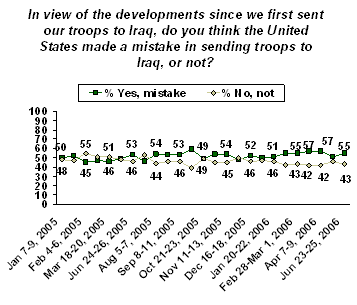
There was a slight dip in this "mistake" trend in early June, but the current 55% is essentially where it has been since mid-February.
Survey Methods
Results are based on telephone interviews with 1,000 national adults, aged 18 and older, conducted June 23-25, 2006. For results based on the total sample of national adults, one can say with 95% confidence that the maximum margin of sampling error is ±3 percentage points. In addition to sampling error, question wording and practical difficulties in conducting surveys can introduce error or bias into the findings of public opinion polls.