GALLUP NEWS SERVICE
PRINCETON, NJ -- Public confidence that the United States and its allies are winning the war against terrorism does not appear to have been boosted by the recently thwarted terrorist attack in London. Only about a third of Americans say the United States is winning, with the majority of the rest saying neither the United States nor the terrorists are winning the "war", a pattern similar to that which has been found for much of the last two years.
An analysis of the recent history of Americans' attitudes about the war against terror shows that optimism about winning against terrorism is highly related to major military offensives. When the United States invaded Afghanistan in October 2001, and when the United States invaded Iraq in March 2003, the perception that the United States and its allies were winning the war against terrorism shot up well above the 50% mark. In both instances, however, this high level of optimism soon dissipated, and the data from Gallup's most recent update show that less than half of Americans say the United States and its allies are winning, more typical of the pattern found since 9/11.
Three Options
Gallup has been asking Americans since shortly after the terrorist attacks of Sept. 11, 2001, who is winning the war against terrorism, giving respondent three choices: The United States and its allies, the terrorists, or neither side. The latest data are as follows:
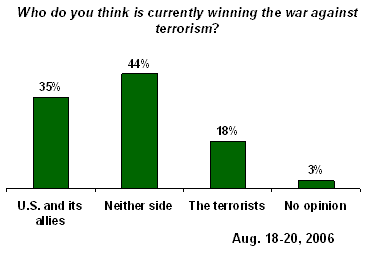
This basic pattern is little changed over the last two years. In particular, despite the fact that a potential terrorist attack was thwarted by authorities in London in recent weeks, the poll shows no signs that Americans have become more convinced that the United States and its allies are winning the war against terrorism.
There have been several distinct phases of the attitudes about the war against terrorism over the last five years.
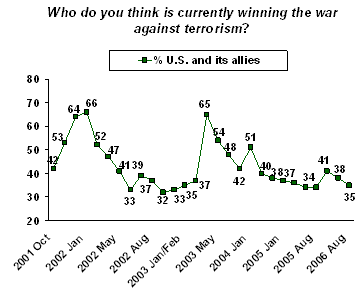
1. Americans became much more convinced that the United States and its allies were winning the war against terrorism when the United States began its military offensive against the Taliban regime in Afghanistan in October 2001, with 66% saying that the United States and its allies were winning by January 2002.
2. This surge in optimism was short-lived, however, and Americans became more pessimistic as 2002 wore on, with the percentage believing that the United States and its allies were winning dropping to as low as 32% in October 2002.
3. The perception that the United States and its allies were winning the war against terrorism jumped back up as the U.S. initiated its invasion of Iraq in March 2003, reaching a near high point of 65% in April of that year.
4. This optimism too began to fade later in 2003 and into 2004 as it became evident that the war in Iraq would not conclude quickly or demonstrably fix problems with terrorism. Conviction that the United States and its allies are winning the war against terrorism have stayed low since that point, with the current 35% being one of the lowest ratings on record, just a few points above the all time low of 32%.
5. Americans have never been strongly convinced that the terrorists are winning the war against terror, with at most 23% (in August 2005) saying that was the case. The current poll shows only 18% saying that the terrorists are winning.
Partisan Differences
There are predictable differences in views on the war against terrorism by partisanship. More than half of Republicans believe the United States and its allies are winning the war against terrorism, compared to just about one quarter of independents and Democrats:
|
Who do you think is currently winning the war against terrorism? |
|||
|
Republicans |
Independents |
Democrats |
|
|
U.S. and its allies |
57% |
25% |
24% |
|
Neither side |
33 |
50 |
48 |
|
The terrorists |
8 |
23 |
24 |
Survey Methods
The latest results are based on telephone interviews with a randomly selected national sample of 1,001 adults, aged 18 and older, conducted August 18-20, 2006. For results based on this sample, one can say with 95% confidence that the maximum error attributable to sampling and other random effects is ±3 percentage points. In addition to sampling error, question wording and practical difficulties in conducting surveys can introduce error or bias into the findings of public opinion polls.
Who do you think is currently winning the war against terrorism -- [ROTATED: the U.S. and its allies, neither side, or the terrorists]?
|
U.S. and |
Neither |
The |
No |
||
|
% |
% |
% |
% |
||
|
2006 Aug 18-20 |
35 |
44 |
18 |
3 |
|
|
|
|
|
|
||
|
2006 Jun 9-11 |
38 |
41 |
16 |
4 |
|
|
2006 Jan 20-22 |
41 |
42 |
14 |
3 |
|
|
2005 Aug 28-30 ^ |
34 |
42 |
23 |
1 |
|
|
2005 Jul 7-10 |
34 |
44 |
21 |
1 |
|
|
2005 Jun 24-26 |
36 |
41 |
20 |
3 |
|
|
2005 Jan 7-9 |
37 |
42 |
20 |
1 |
|
|
2004 Oct 9-10 ^ |
38 |
41 |
19 |
2 |
|
|
2004 Jul 19-21 ^ |
40 |
41 |
16 |
3 |
|
|
2004 Jan 12-15 ^ |
51 |
35 |
14 |
* |
|
|
2003 Oct 10-12 |
42 |
42 |
13 |
3 |
|
|
2003 Jul 18-20 |
48 |
34 |
15 |
3 |
|
|
2003 May 19-21 |
54 |
32 |
11 |
3 |
|
|
2003 Apr 22-23 |
65 |
28 |
5 |
2 |
|
|
2003 Mar 3-5 ^ |
37 |
43 |
17 |
3 |
|
|
2003 Jan 31-Feb 2 ^ |
35 |
44 |
16 |
5 |
|
|
2002 Dec 5-8 ^ |
33 |
46 |
19 |
2 |
|
|
2002 Oct 14-17 ^ |
32 |
44 |
21 |
3 |
|
|
2002 Aug 5-8 ^ |
37 |
46 |
14 |
3 |
|
|
2002 Jul 5-8 |
39 |
43 |
16 |
2 |
|
|
2002 Jun 21-23 |
33 |
49 |
14 |
4 |
|
|
2002 May 28-29 |
41 |
35 |
15 |
9 |
|
|
2002 Apr 22-24 |
47 |
39 |
10 |
4 |
|
|
2002 Mar 22-24 |
51 |
35 |
12 |
2 |
|
|
2002 Mar 4-7 |
53 |
34 |
10 |
3 |
|
|
2002 Jan 7-9 ^ |
66 |
25 |
7 |
2 |
|
|
2001 Dec 6-9 |
64 |
28 |
5 |
3 |
|
|
2001 Nov 8-11 ^ |
53 |
33 |
11 |
3 |
|
|
2001 Oct 11-14 |
42 |
44 |
11 |
3 |
|
|
|
|
|
|
||
|
^ |
Asked of a half sample. |
||||