GALLUP NEWS SERVICE
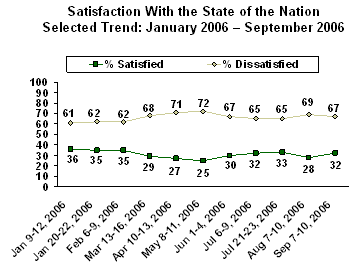
PRINCETON, NJ -- A new Gallup poll finds little change in the public's approval ratings of President George W. Bush and Congress, along with Americans' overall satisfaction with the course of the nation. About 4 in 10 Americans currently approve of the job Bush is doing, 29% of Americans approve of the way Congress is handling its job, and 32% of Americans say they are satisfied with the way things are going in the country at the present time.
All three ratings are low from a historical perspective, creating an environment which bodes well for Democrats' chances in the November midterm elections given the historic tendency for the incumbent party to suffer seat losses when voters are dissatisfied with the way the government is performing and with the overall state of the nation.
Presidential Job Approval
The poll, conducted Sept. 7-10, finds that 39% of Americans approve of the way Bush is handling his job as president, while 56% disapprove. Bush's approval ratings have averaged 39% over the last six Gallup polls conducted since early July, fluctuating between 37% and 42%. From a longer term perspective, Bush's ratings averaged 43% in January of this year but dropped to 31% in an early May poll, which is a low point for the Bush administration.

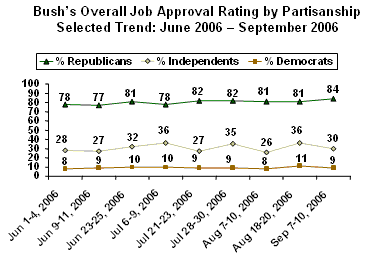
The president's approval ratings continue to be sharply polarized along partisan lines. Eighty-four percent of Republicans approve of Bush, compared with 30% of independents and just 9% of Democrats. Bush's ratings among Republicans and Democrats have shown little change since June. There has been greater fluctuation among independents over this period, ranging from 26% to 36%.
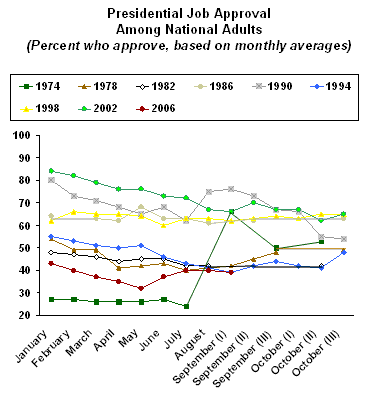
Bush's 39% approval rating is among the lowest for a president in September of a midterm election year. It is the same as Bill Clinton's job approval in 1994, when the Republican landslide allowed the GOP to take majority control from the Democrats in the House of Representatives and Senate. Bush's current rating is also similar to that of Ronald Reagan in 1982, when the Democrats gained 26 seats. More generally, Bush's ratings over the course of this year have been lower than the other presidents in midterm election years, with the exception of Richard Nixon in 1974, who resigned in August of that year for his role in the Watergate scandal. (So far this year, Gallup polling has shown Democratic candidates faring better than Republican candidates on Gallup's generic ballot, which measures Americans' voting intentions for the U.S. House of Representatives. Gallup's Sept. 7-10 generic ballot measure shows Democrats with a 12-percentage point lead over Republicans.)
Congressional Job Approval
The current poll finds little change in the public's assessment of Congress -- 29% approve of the job Congress is doing and 63% disapprove. Congressional job approval ratings have been quite low over the course of the entire year, averaging just 26% and ranging between a low of 21% in May and a high of 29% in the current poll. Congressional job approval ratings have been stable since June.
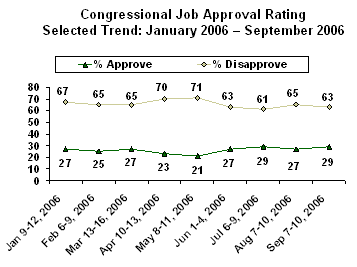
Congressional job approval ratings have been below 30% since October 2005. Prior to that, ratings of Congress had not been this low since 1994. Just before the incumbent party lost 53 seats in the 1994 November election, Congress approval was in the low-20% range. The low point for Congress' approval rating was 18% in a 1992 Gallup poll.
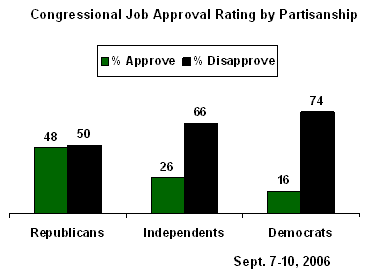
Like ratings of the president, ratings of the Republican-controlled Congress also diverge along party lines. Republicans (48%) are much more positive about Congress' performance than independents (26%) and Democrats (16%), but even Republicans are divided as to whether Congress is doing a good or poor job.
Mood of the Nation
Thirty-two percent of Americans say they are satisfied with the way things are going in the country right now, while the majority of Americans, 67%, say they are dissatisfied. The current results are similar to the 31% satisfaction average since the start of the year. At that time, 36% of Americans expressed satisfaction with the state of the nation. Satisfaction remained at this level in February before it started to decline; public satisfaction was 29% in March, 27% in April, and 25% in May. Americans' satisfaction began to improve in June and has fluctuated between 28% and 33% since that time.
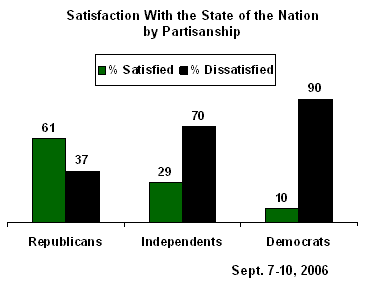
Satisfaction ratings typically differ by party groups. Currently, 61% of Republicans say they are satisfied with the way things are going, compared with 29% of independents and only 10% of Democrats.
From a historical perspective, the current 32% satisfaction reading is quite low. Since 1979, the average percentage of Americans saying they are satisfied is 43%. One of the earliest surveys of this measure, conducted in July 1979, found satisfaction at 12%, the lowest ever measured, although not much below the 14% measured in June 1992.
The current reading of 32% is very similar to the satisfaction levels in 1994 (33% in July, 31% in October). This again reinforces the conclusion that the election environment this year is similar to that in 1994, when the incumbent Democratic Party suffered significant seat losses in the House.
Survey Methods
The latest results are based on telephone interviews with a randomly selected national sample of 1,002 adults, aged 18 and older, conducted Sept. 7-10, 2006. For results based on this sample, one can say with 95% confidence that the maximum error attributable to sampling and other random effects is ±3 percentage points. In addition to sampling error, question wording and practical difficulties in conducting surveys can introduce error or bias into the findings of public opinion polls.