GALLUP NEWS SERVICE
PRINCETON, NJ -- The Bush administration has spent the last several weeks carrying out a political strategy designed to stress the reality of the threat of terrorism in the United States today, while concomitantly emphasizing the GOP's perceived superiority in handling terrorism. The administration's strategy has also included a continued emphasis on the connection between the war in Iraq and the war on terror.
New USA Today/Gallup poll data provide suggestive evidence that this strategy may be having an effect. President George W. Bush's job approval rating has risen to its highest level in about a year, 44%. Americans are more positive about the war on terror and voters are more likely to vote for a candidate who supports Bush on terrorism rather than one who opposes him. By a slight margin, Americans tend to think that the country will be safer from terrorism if the GOP retains control of the House, rather than if the Democrats take control. And voters are now as likely to say that the war in Iraq is a part of the war on terror as say it is not.
Here are the key findings from the new survey, conducted Sept. 15-17:
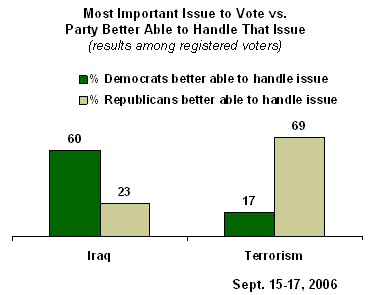
1. While Iraq remains the top issue (out of six alternatives offered) voters say they are thinking about as they ponder the elections this fall, voters who say terrorism is most important overwhelmingly favor the GOP as better able to handle it.
Sixty-nine percent of registered voters who say terrorism is the most important issue to their vote this November say Republicans would better handle that issue; 17% say Democrats would do a better job. The results are essentially reversed among those who say Iraq is the top issue -- 60% of registered voters say the Democrats would better handle that issue and 23% say the Republicans.
Not surprisingly, there is a major gap in registered voters' choice of top issue by their intended vote choice this fall.
Among those registered voters who say Iraq is most important to them when they think about their vote for Congress, 68% say they are voting for the Democratic candidate in their district this fall, compared with 28% who are voting for the Republican. Among registered voters who say terrorism is most important to them, 71% are going to vote for the Republican candidate in their district, compared with 19% who intend to vote for the Democrat.
This correlation between issue importance and vote choice provides supportive evidence for the potential efficacy of a strategy that attempts to change voters' minds about what's important in the election. Convincing more voters to focus on terrorism as the pivotal issue in the fall campaign -- as the Bush administration is attempting to do -- could benefit the Republicans, just as convincing voters to focus on Iraq -- as the Democrats are doing -- could benefit them.
2. It is clear that congressional candidates who support Bush on the terror issue may have an advantage over those who don't. By a 19-point margin, registered voters say they are more likely to vote for a candidate for Congress who supports Bush on terrorism (43%), rather than a candidate who opposes him (24%). This is especially important given that, in the overall sample of registered voters in this survey, the Democratic candidate is favored over the Republican candidate by nine points.
By way of comparison, American voters are divided as to whether they would vote for a candidate who supports Bush (34%) on the war in Iraq versus someone who opposes him (37%).
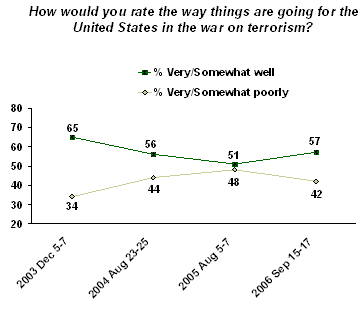
3. The percentage of Americans who believe that the war on terrorism is going well has increased from a year ago. Gallup has asked the public to assess the war on terrorism four times over the last three years. In December 2003, just before Saddam Hussein was captured, 65% said the war on terrorism was going very or somewhat well. That number dropped to 56% by August 2004, and to 51% by August 2005, but it is now back to 57%.
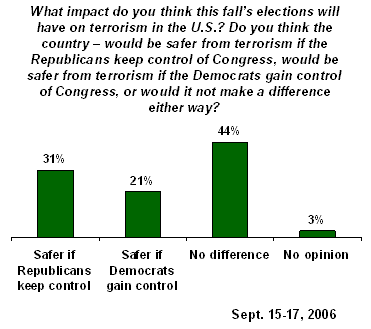
4. A key component of the Bush strategy appears to be the argument that the country would be less safe from terrorism if the Democrats take control of Congress.
The poll attempted to assess the effect of that argument. While a significant percentage of Americans say that either way -- whether the Democrats take control or the Republicans keep control -- it would not have an impact on terrorism; among those who do think it will make a difference, the GOP has an advantage.
5. A key element of the Bush administration's strategy has been the president's repeated attempts to draw a connection between the war in Iraq and the war on terrorism. By December of last year, and carrying through to March of this year, small majorities of Americans had rejected that connection, instead opting to believe the war in Iraq was a separate military action, not part of the war on terror.
The current poll, however, shows a change. At this point, the public is roughly divided on this question, with 49% saying the war was a separate military action and 48% saying it is part of the war on terrorism. (As late as mid-August, CBS News/New York Times polling had found half of Americans saying the war in Iraq was a separate military action and 44% saying it was part of the war on terrorism, similar to Gallup's March survey.)
Do you consider the war in Iraq to be part of the war on terrorism which began on Sept. 11, 2001, or do you consider it to be an entirely separate military action?
|
|
Part of war |
Separate |
No |
|
% |
% |
% |
|
|
2006 Sep 15-17 |
48 |
49 |
3 |
|
|
|
|
|
|
2006 Mar 10-12 ^ |
44 |
53 |
3 |
|
2005 Dec 16-18 |
43 |
55 |
2 |
|
2005 Jun 24-26 ^ |
47 |
50 |
3 |
|
2004 Oct 1-3 |
50 |
47 |
3 |
|
2004 Jul 19-21 ^ |
51 |
47 |
2 |
|
2004 Mar 26-28 |
50 |
48 |
2 |
|
2003 Aug 25-26 |
57 |
41 |
2 |
|
|
|
|
|
|
^Asked of a half sample. |
|||
Trends for Comparison: If the United States goes to war with Iraq, would you consider that to be part of the war on terrorism which began on September 11th, or would you consider it to be an entirely separate military action?
|
|
Part of war |
Separate |
No |
|
2003 Jan 23-25 |
50% |
48 |
2 |
|
2002 Sep 20-22 |
55% |
42 |
3 |
Survey Methods
The latest results are based on telephone interviews with a randomly selected national sample of 1,003 adults, aged 18 and older, conducted Sept. 15-17, 2006. For results based on this sample, one can say with 95% confidence that the maximum error attributable to sampling and other random effects is ±3 percentage points. In addition to sampling error, question wording and practical difficulties in conducting surveys can introduce error or bias into the findings of public opinion polls.
For results based on the sample of 888 registered voters, the maximum margin of sampling error is ±4 percentage points.