GALLUP NEWS SERVICE
PRINCETON, NJ -- An analysis of USA Today/Gallup poll trend data indicates that while Democrats have made gains across the board on the generic Congressional ballot in the latest Oct. 6-8 survey, the change has been greater among religious whites than among less religious whites and among non whites. At this point, religious whites are equally as likely to say they will vote Democratic as Republican, a marked change from their strong tilt towards the Republicans in surveys conducted June through September.
For the purpose of political analysis this year, Gallup has divided the American population into three groups based on race and church attendance: Religious whites (defined as whites who self-report attending church weekly or almost every week), less religious whites (defined as whites who self-report attending church monthly or less often), and all others.
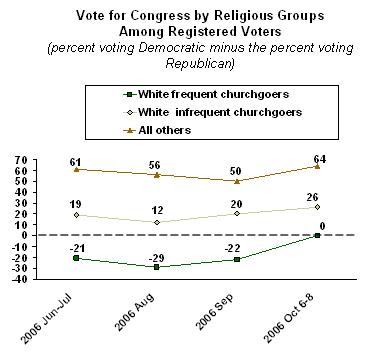
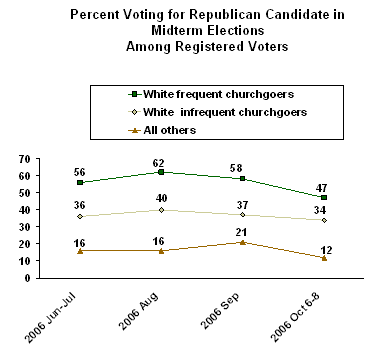
The chart below tracks the trends in congressional voting intentions across these three groups from June to the present, showing the net percent of registered voters planning to vote for the Democratic candidate in their congressional district (% voting Democratic minus % voting Republican). For June/July, August, and September, the figures represent aggregated data from all relevant surveys conducted in each of those time periods. The data for October are from the latest Oct. 6-8 survey only. The graph represents the difference in the percent voting Democrat and the percent voting Republican. (The full data are presented below the graphs)

|
Generic House Vote |
|||||
|
Jun-Jul |
Aug |
Sep |
Average of |
Oct |
|
|
White frequent churchgoers |
-21 |
-29 |
-22 |
-23 |
0 |
|
White infrequent churchgoers |
19 |
12 |
20 |
19 |
26 |
|
All others |
61 |
56 |
50 |
55 |
64 |
The Democrats made gains across all groups in the October poll compared to the averages in previous months. But the Democratic gain (or Republican loss depending on how one looks at it) is more significant among religious whites than among the other two groups. Religious whites went from an average Democratic disadvantage of 23 points across the June through September months, to dead even in October. Less religious whites shifted only seven points across these two time periods, while the group of "all others" shifted 9 points.
A comparison of the September average to October shows a 22-point gain for the Democrats among white frequent churchgoers, a six-point gain among white less frequent churchgoers, and a 14-point gain among all others.
The comparison between religious whites and less religious whites is particularly revealing. The gap between these two groups averaged 42 points in the June through September period, and is now down to 26 points. The gap between religious whites and all others averaged a dramatic 78 points in June thorough September, and is now a somewhat lower 64 points.
Implications
There are two main factors which determine election outcomes: the candidate preference of voters and the relative turnout on Election Day of each candidate's supporters. Republicans have benefited historically from having a significant advantage in terms of the vote choice among religious whites over the years, and have in addition placed a good deal of effort on the attempt to get these individuals motivated enough to turn out and vote.
The data reviewed here suggest that the Republicans have lost -- at least temporarily -- some of the disproportionate advantage in voting preference they have enjoyed among religious whites. This group continues to be much more likely than less religious whites or nonwhites to support the Republican candidate in their House race, and is currently as likely to support a Democrat as a Republican Congressional candidate. But, the difference between religious whites and these other two groups has narrowed somewhat as of the Oct. 6-8 poll.
One plausible explanation for the broad drop in Republican support in the most recent poll is the Mark Foley scandal in Congress. Since this situation involved issues of morality on the part of Foley, and allegations of a cover-up on the part of Republican leadership, it appears plausible that religious whites may have become disproportionately disillusioned with the Republicans and as a result lost more of their fervor for voting Republican than others in the population.
Survey Methods
The latest results are based on telephone interviews with a randomly selected national sample of 1,007 adults, aged 18 and older, conducted Oct. 6-8, 2006. For results based on this sample, one can say with 95% confidence that the maximum error attributable to sampling and other random effects is ±3 percentage points. In addition to sampling error, question wording and practical difficulties in conducting surveys can introduce error or bias into the findings of public opinion polls.