GALLUP NEWS SERVICE
PRINCETON, NJ -- Gallup's January read on Americans' attitudes about the U.S. economy shows a significant uptick in the assessment of current economic conditions, and a modest increase in the view that now is a good time to find a quality job. Both of these measures are now at their highest points since the earliest stages of the Bush presidency.
At the same time, a slight majority of Americans continue to say that economic conditions in this country are getting worse. This measure of economic expectations -- unlike the assessment of current economic conditions -- is little changed from the last several months.
Ratings of the Current Economy
Gallup's Jan. 15-18 update on Americans' views of current economic conditions in the United States shows that 52% rate the economy as excellent or good, 33% rate it as only fair, and 15% rate it as poor.
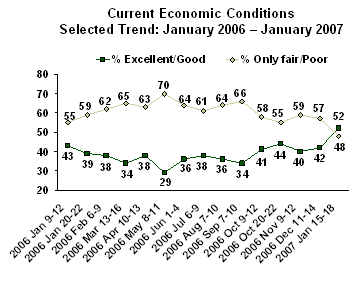
This reading marks a significant increase in positive perceptions from Gallup's December poll, when just 42% rated the economy as excellent or good: This assessment is the highest (based on the percentage rating the economy as excellent or good) since January 2001, which in turn marked the last strongly positive rating at the tail end of the dot.com boom.
What's behind this significant increase in positive assessments of the economy?
An analysis of trends from the last five months, broken out by the party identification of the respondent, shows an increase in positive perceptions among all three partisan groups, albeit slightly more so among Democrats:
|
Assessment of Current Economic Conditions
|
|||
|
Republicans |
Independents |
Democrats |
|
|
2007 Jan 15-18 |
78 |
46 |
35 |
|
2006 Dec 11-14 |
70 |
38 |
23 |
|
2006 Nov 9-12 |
70 |
37 |
25 |
|
2006 Oct 9-12 |
70 |
36 |
22 |
|
2006 Sep 7-10 |
60 |
29 |
18 |
Still, a wide gulf remains between the rosy view of Republicans, among whom 78% rate the economy as excellent or good, and Democrats, among whom only 35% rate the economy in one of these two categories.
Direction of the Economy
Slightly more than half of Americans, 53%, continue to say the U.S. economy is getting worse, while 38% say it is getting better.
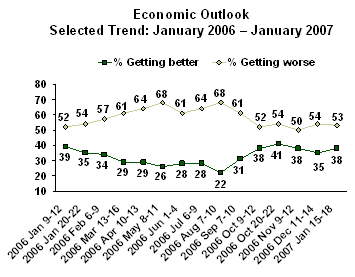
These views of the economy's direction are statistically unchanged from December, and are little changed since October.
There have been numerous occasions over the past six years in which the assessment of the economy's direction has been more positive, including in particular a stretch of time in late 2003 and early 2004, when the percentage saying the economy was getting better was consistently higher than the percentage saying the economy was getting worse.
Republicans became slightly more positive about the direction of the economy this month than they were in December, but Democrats' and independents' assessments changed little.
|
Direction of the U.S. Economy
|
|||
|
Republicans |
Independents |
Democrats |
|
|
2007 Jan 15-18 |
28 |
-23 |
-42 |
|
2006 Dec 11-14 |
19 |
-25 |
-44 |
|
2006 Nov 9-12 |
35 |
-15 |
-39 |
|
2006 Oct 9-12 |
43 |
-27 |
-51 |
|
2006 Sep 7-10 |
22 |
-37 |
-67 |
Job Market
For the first time since Gallup began assessing all Americans' views of the job market in August 2001, more Americans say now is a good time to find a quality job than say it is a bad time, by a one-point margin (48% to 47%). This job situation measure has been trending upward. Last month, 44% said it was a good time to find a quality job while 50% said it was not. The low point on this measure since 2001 came in March 2003, when only 16% of Americans said it was a good time to find a quality job.
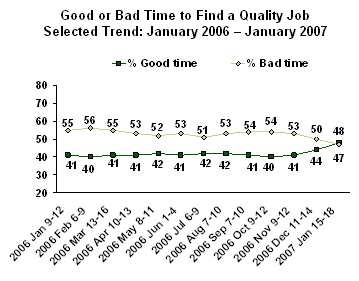
The expected major differences by party persist in these assessments:
|
Is Now a Good Time to Find a Quality Job?
|
|||
|
Republicans |
Independents |
Democrats |
|
|
2007 Jan 15-18 |
70 |
46 |
30 |
|
2006 Dec 11-14 |
65 |
44 |
28 |
|
2006 Nov 9-12 |
69 |
39 |
25 |
|
2006 Oct 9-12 |
67 |
36 |
23 |
|
2006 Sep 7-10 |
61 |
43 |
24 |
Discussion
For a while now, many economic commentators, as well as Republican stalwarts, have been perplexed by Americans' entrenched negativity toward the U.S. economy, at a time when the stock market is breaking records and unemployment is down.
These data on Americans' assessments of current economic conditions reflect what to some people would be the expected uptick in views of the economy. That these data reflect the most positive assessment of the economy since George W. Bush took office in theory represents a major plus for the current administration, which has been touting the improved economy for many months.

It is not entirely clear, however, why Americans would become more positive about current economic conditions while at the same time remaining negative about the overall direction of the economy. In fact, the trend for 2005, 2006, and now this first reading of 2007, shows a lack of correlation between these two measures, with the current assessment measure staying stable or (in the most recent poll) increasing, while views of the overall future direction of the economy have become more negative.
It is possible that the effect of more positive economic news is felt first in the estimate of current conditions, while Americans are taking longer to contemplate their feelings about longer-term trends -- perceptions that would be less susceptible to short-term economic news. It will be important to monitor these measures in coming months to see whether the expectations measure "catches up" with the assessments of the current economy.
Survey Methods
These results are based on telephone interviews with a randomly selected national sample of 1,018 adults, aged 18 and older, conducted Jan. 15-18, 2007. For results based on this sample, one can say with 95% confidence that the maximum error attributable to sampling and other random effects is ±3 percentage points. In addition to sampling error, question wording and practical difficulties in conducting surveys can introduce error or bias into the findings of public opinion polls.