GALLUP NEWS SERVICE
PRINCETON, NJ -- The American public is more in favor of Congress passing legislation that would set caps on the number of U.S. troops serving in Iraq and a timetable for withdrawal of all troops than they are in favor of Congress passing a non-binding resolution expressing disfavor with the recently announced troop "surge," while 6 out of 10 Americans oppose the surge. A majority of Americans continue to say that U.S. military involvement in Iraq was a mistake. Many Americans say that their congressional representative's position on the war will be an important factor in their congressional vote next year, but most do not know what their representative's position on the troop surge is.
What Should Congress Do?
A new USA Today/Gallup poll, conducted Feb. 9-11, 2007, includes a series of questions asking Americans about four different actions Congress could take in regard to the war in Iraq.

Although the increase in U.S. troops in Iraq is opposed by a 60% to 38% margin, only 40% of Americans want Congress to go so far as to deny funding needed to send those troops to Iraq. Additionally, the idea of Congress passing a "non-binding resolution to express disapproval of President Bush's plan to send more U.S. troops to Iraq" receives only mixed support; it is favored by a slim 51% to 46% margin.
Questions asked about a non-binding resolution in January generally found higher levels of support for the idea. This included a Gallup question asked Jan. 12-14, 2007, which found that 61% favored the Democrats in Congress passing a resolution to "express their opposition to President Bush's plan to send more U.S. troops to Iraq."
That question included this phrase: "This resolution, by itself, would not affect Bush's policy, but the Democrats are hoping it will put pressure on him to change his policy."
It may be that the currently lower level of support is a result of the fact that the surge in troops has in essence become a fait accompli. Some Americans may feel that the time for resolutions is past.
At the same time, there are higher levels of support from the public for two more significant congressional measures that would address broader aspects of the war effort:
- By a 57% to 40% margin, Americans favor Congress putting a cap or limit on the number of troops serving in Iraq at any one time.
- By a 63% to 35% margin, Americans favor Congress setting a time-table for withdrawing all U.S. troops from Iraq by the end of next year.
These data reinforce the finding that the public has perhaps moved beyond a limited focus on the "surge" in troops. There is less support for the two actions proposed in the survey that would address the surge (a resolution of disapproval and denying funding for the surge) than there is overall disapproval of the surge. In other words, some Americans disapprove of the troop increase but do not feel that Congress should be spending time passing resolutions to that effect, or even attempting to pass legislation to hold back funds. The fact that levels of support for legislation that would put a cap on troops and set a timetable for withdrawal are higher suggests that Americans believe congressional actions should be focused on these more major (and consequential) types of concerns.
These findings are consistent with other data that suggest Americans want Congress to be more involved in decisions about the Iraq war. A Newsweek poll conducted in late January, for example, found that 64% of Americans believe that Congress has not been assertive enough in challenging the Bush administration's conduct of the war in Iraq.
Frustration Over the Senate's Actions?
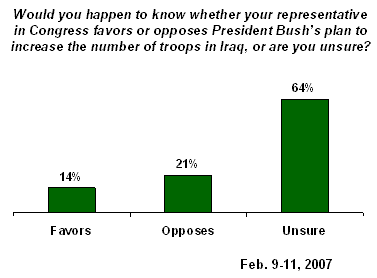
Most Americans at this point are unaware of where their representative in Congress stands on the Bush plan to increase troops in Iraq.
At the same time, about 4 out of 10 say that their representative's position on the war in Iraq will be a "major factor" in their vote in the next congressional elections, with another 28% saying that it will be a "minor factor."

Americans who are opposed to the troop surge are somewhat more likely than those who favor it to say that their representative's position on the war will be a major factor in their vote next year.
|
Impact of Representative's Position on Iraq War
|
||
|
Favor the increase in U.S. troops in Iraq |
Oppose the increase in U.S. troops in Iraq |
|
|
% |
% |
|
|
Representative's position on Iraq will be major factor in vote |
37 |
47 |
|
Representative's position on Iraq will be minor factor |
34 |
23 |
|
Representative's position will not be a factor |
29 |
28 |
The Senate has tried, unsuccessfully, to debate the war in Iraq, with the ultimate goal being to vote on a non-binding resolution. The debate has not proceeded because of disagreements about procedural matters surrounding that debate. About one-third of Americans say they are bothered "a great deal" by the fact that Senate attempts to hold a debate on the Iraq war have not been successful; another 28% say they are bothered a "fair amount."
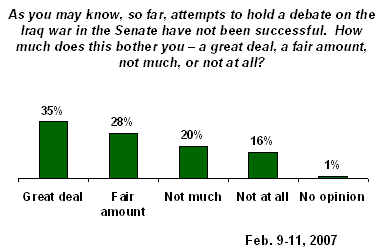
Those who favor such a resolution are somewhat more likely to say they are bothered a great deal by the lack of debate in the Senate, but even among this group the percentage of respondents saying they are bothered "a great deal" is less than 50%.
|
Self-report of Being "Bothered" by Lack of Senate Debate on Iraq
|
||
|
Favor resolution opposing troop increase |
Oppose resolution opposing troop increase |
|
|
% |
% |
|
|
Bothered a great deal by lack of Senate debate on Iraq |
40 |
30 |
|
Bothered a fair amount |
32 |
23 |
|
Not bothered much |
19 |
23 |
|
Not bothered at all |
8 |
24 |
Basic Opinions About the War
A majority of Americans continue to believe that the initial involvement of the U.S. in the Iraq situation was a mistake.
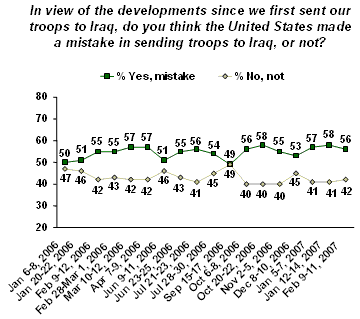
There has been very little change in this measure across three readings so far this year. The all-time high point on the "mistake" question is the 59% Gallup measured in September 2005. When the United States first initiated the war action in March 2003, only 23% said that it was a mistake. By June 2004, for the first time a majority of Americans said it was a mistake. This "mistake " percentage dropped back below 50% during the fall of 2004 and spring of 2005, and on occasion since, but for the most part over the last year a majority of Americans have consistently said that the Iraq war was a mistake.
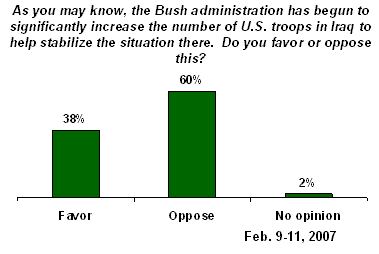
A majority of Americans disapprove of the recent Bush administration decision to send more troops to Iraq. There has been very little change in this sentiment over the last month.
Bottom Line
A majority of Americans want Congress to pass legislation that would set a cap on the number of U.S. troops in Iraq and a timetable for withdrawal of all troops by the end of next year. There is less interest on the part of the public in having Congress pass a non-binding resolution of opposition to the troop increase, even though 6 out of 10 Americans oppose the surge. The majority of Americans also oppose legislation that would deny funding for the surge.
These attitudes may be in part a result of the fact that the surge is now already underway, making rhetorical statements of opposition or attempts to deny funding less relevant.
Survey Methods
Results are based on telephone interviews with 1,007 national adults, aged 18 and older, conducted Feb. 9-11, 2007. For results based on the total sample of national adults, one can say with 95% confidence that the maximum margin of sampling error is ±3 percentage points. In addition to sampling error, question wording and practical difficulties in conducting surveys can introduce error or bias into the findings of public opinion polls.