GALLUP NEWS SERVICE
PRINCETON, NJ -- A new USA Today/Gallup poll finds 37% of Americans approving of the job George W. Bush is doing as president. The latest approval rating is slightly higher than Bush's overall average so far this year, but is on par with his average since the beginning of 2006. Americans are more likely to say they approve of the job the Democrats are doing in Congress than they are the Republicans in Congress, although most Americans disapprove of the jobs both parties are doing in the legislature.
Presidential Job Approval
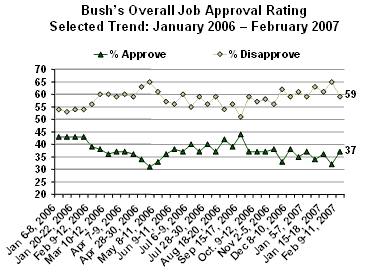
The Feb. 9-11, 2007, poll finds that 37% of Americans approve of the way Bush is handling his job as president, while 59% disapprove. Bush's latest rating is five points higher than the 32% he received earlier this month, and is slightly higher than his 35% approval average so far this year.
Bush's approval rating has ranged between 32% and 38% since October 2006. Since the start of 2006, Bush's job approval ratings have averaged 38%, with a high of 44% in September 2006 and an administration low of 31% in May 2006.
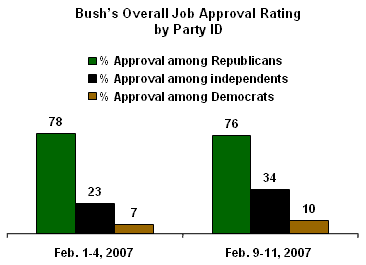
Republicans continue to be much more likely than independents or Democrats to approve of the job Bush is doing. Seventy-six percent of Republicans approve of the president, compared with 34% of independents and only 10% of Democrats. Republicans' and Democrats' ratings of Bush have shown little change since early February, but independents' ratings have increased from 23% to 34%.
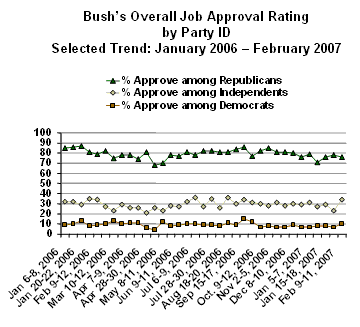
From a longer term perspective, Bush's current approval rating among Republicans and Democrats is roughly the same as the average over the past year. From January 2006 through the latest poll, an average of 79% of Republicans have approved of Bush, while among Democrats, this average is at 9%. The current approval rating that independents give regarding Bush's job as president is slightly higher than the 29% average over this time period.
Approval Ratings of Republicans and Democrats in Congress
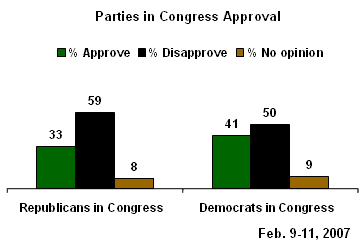
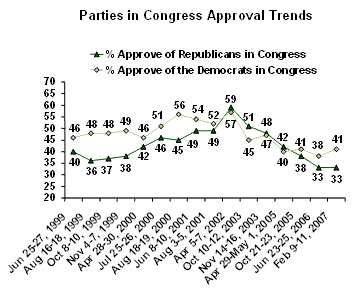
Americans are more likely to say that they approve of the job the Democrats in Congress are doing rather than job the Republicans in Congress are doing. Still, a majority of Americans disapprove of the way both parties in Congress are handling their jobs right now. The latest poll finds that 33% of Americans approve of the Republicans in Congress and 41% approve of the Democrats in Congress.
By comparison, Gallup's Feb. 1-4, 2007, poll found a 37% approval rating for Congress overall. The results to this more general question, updated monthly, have been higher since the Democrats took control of Congress this year than at any other time since late 2005.
Since 1999, Gallup has periodically asked Americans to rate the parties in Congress. The current results show no change in Americans' ratings of the Republicans in Congress since June 2006 (33% approval in both polls), but Americans' ratings of the Democrats in Congress have edged up slightly, from 38% to 41%.
Both parties' ratings are near their lows since 1999. In fact, the 33% approval rating for Republicans ties for the lowest Gallup has measured. The Democrats' 41% approval score is three points higher than the low of 38% from last June.
Low ratings are not necessarily typical -- a majority of Americans approved of the Democrats from July 2000 through April 2002, and a majority also approved of the Republicans from April 2002 through October 2003. For the most part, Americans have historically given congressional Democrats the same or higher ratings than congressional Republicans.
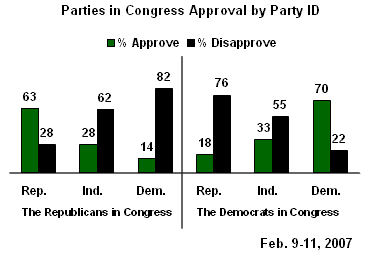
Republicans and Democrats are much more likely to approve of the job their own party members are doing in Congress. But, Democrats are more likely to approve of the Democrats in Congress than Republicans are to approve of their own party in Congress. Relatively small percentages of Republicans or Democrats approve of their rival parties in Congress.
Survey Methods
Results are based on telephone interviews with 1,006 national adults, aged 18 and older, conducted Feb. 9-11, 2007. For results based on the total sample of national adults, one can say with 95% confidence that the maximum margin of sampling error is ±3 percentage points. In addition to sampling error, question wording and practical difficulties in conducting surveys can introduce error or bias into the findings of public opinion polls.