GALLUP NEWS SERVICE
PRINCETON, NJ -- Recently collected Gallup Poll data suggest that most highly religious Americans either believe that they can be personally religious without needing to spread their beliefs, or that they can best spread their beliefs by converting others to their religion. Only a small percentage of highly religious Americans -- 15% -- believe the best way to spread their religion is to change society to conform to their religious beliefs.
These data are important in an environment in which the relationship between religion and society has become more and more of an issue. There is a strong relationship in the United States today between one's religion and one's political beliefs. One of the keys to Republican successes in elections in the first part of this decade was the activation of highly religious voters. Protestants, in particular, were concerned about the secularization of society and therefore focused on changing societal elements to reduce instances of abortion, same-sex marriages, and stem cell research using embryos. The data reviewed here, however, suggest that such interest in imposing change on society on the basis of one's religion is, in theory at least, small. Most highly religious Americans appear content to live the best possible personal life on the basis of their religious beliefs or to engage in traditional attempts at one-on-one conversion.
Basic Data
Two Gallup Poll Panel surveys conducted last fall included a series of questions designed to shed light on what highly religious Americans believe the appropriate manifestation of their religious convictions should be.
The three questions were asked in surveys conducted in September and November, and the results were combined to create an aggregate of more than 2,000 interviews:
Q.26-28 REPORTED ON BASIS OF COMBINED DATA FROM SEPT. 21-24, 2006, AND NOV. 27-29, 2006 POLLS
Turning now to religion,
How religious are you -- extremely religious, very religious, somewhat religious, not too religious, or not religious at all?
|
|
|
|
|
|
Not
|
|
|
|
|
|
|
|
|
|
|
2006 Sep-Nov |
8% |
29 |
39 |
14 |
9 |
1 |
(Asked of those who say they are extremely or very religious) Do you think it is sufficient to attempt to live the best possible personal life you, personally, can based on your religion's beliefs and principles, or do you think it is also necessary to attempt to spread your religion's beliefs and principles to other people?
BASED ON 782 ADULTS WHO SAY THEY ARE EXTREMELY OR VERY RELIGIOUS (±4 PCT. PTS.)
|
Sufficient to live
|
Necessary to spread
|
No
|
|
|
|
|
|
|
|
2006 Sep-Nov |
48% |
49 |
2 |
(Asked of extremely or very religious adults who say it is necessary to spread beliefs to others) Which do you think is the better way to spread your religion's beliefs and principles – [ROTATED: by converting others to your religion, (or) by changing aspects of society to make them consistent with your religion's beliefs and principles]?
BASED ON 358 RELIGIOUS ADULTS WHO SAY IT IS NECESSARY TO SPREAD BELIEFS TO OTHER PEOPLE (±6 PCT. PTS.)
|
By converting others
|
By changing aspects
|
No
|
|
|
|
|
|
|
|
2006 Sep-Nov |
55% |
31 |
14 |
The key findings from these measures are as follows:
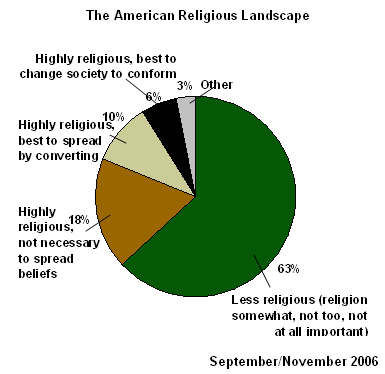
- Thirty-seven percent of Americans classify themselves as extremely or very religious.
- This group of highly religious Americans is split on the question of whether it's best to live the best possible personally religious life or it is also necessary to spread their beliefs. Forty-eight percent believe the former; 49% the latter.
- More than half of highly religious Americans who believe it is necessary to spread beliefs to others say this is best accomplished by converting others to one's religion. This type of traditional evangelical view has, within the Christian tradition over the years, been the basis for such things as Billy Graham's evangelistic crusades and the sponsorship of missionary work in foreign countries. The Mormon religion, as another example, places emphasis on the effort to convert individuals to the Mormon faith, expecting most young men (and in some instances women) of the faith to spend up to two years in missionary work.
- A little less than a third of the group of highly religious Americans say that spreading one's religious beliefs is best accomplished by changing aspects of society to make them consistent with one's religious beliefs and practices. This works out to just 15% of highly religious Americans and only about 6% of the whole adult U.S. population.
Bottom Line
The majority of highly religious Americans believe that they do not need to change the society around them to conform to their religious beliefs, but instead can live the best possible personal religious life, or focus on one-on-one conversion.
Survey Methods
Results for this panel study are based on telephone interviews with 2,013 national adults, aged 18 and older, conducted in September and November 2006. Respondents were randomly drawn from Gallup's nationally representative household panel, which was originally recruited through random selection methods. For results based on the total sample of national adults, one can say with 95% confidence that the margin of sampling error is ±3 percentage points.
For results based on 782 adults who say they are very or extremely religious, the maximum margin of error is ±4 percentage points.
For results based on 358 religious adults who say it is necessary to spread their beliefs to other people, the maximum margin of error is ±6 percentage points.