GALLUP NEWS SERVICE
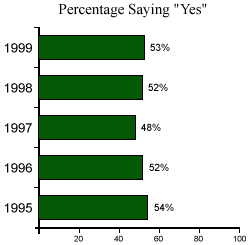
PRINCETON, NJ -- According to a recent Gallup poll, nearly six out of 10 consumers (59%) believe that the size of a financial institution affects the types of accounts they offer. And, nearly as many consumers (53%) believe that the size of a financial institution has an effect on the level of service they are offered. Previous Gallup Poll data show that in each year since 1995, similar percentages of American consumers have held these same beliefs.
Americans have always held a populist view of banking. Some say it derives from the average American's healthy aversion to the concentration of economic power. Others say it also reflects the independence of the nation's local communities. Whatever the derivation, the banking regulations that grew out of the Great Depression encouraged the growth of local banking institutions and discouraged interstate banking in the decades following World War II. As a result, the United States has many more banking institutions than does any other country, even after adjusting for wealth and geography.
In the 1990s, much has changed. Legislative and regulatory changes have made it easier for banks to grow and merge. As a result, big bank mergers have become commonplace. Still, the United States has thousands of healthy financial institutions and is considered over-banked by many observers worldwide. And, while many Americans like the added convenience provided by today's bigger banks, they also like the quality of service provided by many smaller financial services companies.
Consumers Value the Added Convenience Provided by Big
Banks
Three out of four consumers (76%) agree that larger financial
services companies offer more products and services. Gallup's
experience suggests that consumers value not only the new products
and services that bigger banking institutions provide but also the
added convenience of having a wider selection available at one
place.
Historically, convenience has determined where consumers banked, with convenience generally being defined by the location of a bank's branches. People want to bank with an institution that has a branch near their home or their place of work. Ideally, they'd prefer a bank with branches near both home and office.
In the 1990s, however, the definition of convenience has changed for many consumers. The technological revolution of recent years has produced many new banking products and services. In turn, the availability -- or lack thereof -- of these new products and services can mean more or less convenience for a bank's customers.
For example, many banking consumers of the 1990s may think of banking convenience as including one or more of the following products and/or services:
- Having a branch and/or ATM in a local grocery or other retail
store
- Balance and other account information available 24 hours a day
by phone
- Bill paying by phone
- PC banking
In addition, in some big cities, some customers think that the ability of a bank to perform international transactions defines convenience.
Consumers Also Value Service Quality
Given the advantage of larger financial services firms in providing
convenience to consumers, one might assume that such firms are
likely to attract and retain the customers of their smaller
competitors. However, larger banking institutions also face the
challenge of some negative consumer perceptions. For example, few
consumers agree with the notion that bigger financial institutions
are more personal (12%) or provide better customer service (23%).
And, less than half agree that larger companies:
- have more knowledgeable staff (36%)
- offer better rates on deposits (40%)
- offer better loan rates (42%)
Obviously, consumers have mixed views of today's banking firms. Consumers value the added convenience larger banking companies provide, but they also value the quality of service offered by smaller firms.
Gallup interviewed 1,000 consumers between February 3 -28, 1999, concerning their views of larger financial institutions. For results based on this sample of national adults, one can say with 95% confidence that the maximum error attributable to sampling and other random effects is plus or minus 3 percentage points. In addition to sampling error, question wording and practical difficulties in conducting surveys can introduce error or bias into the findings of public opinion polls.
Do you believe the size of a financial institution has any effect on the level of service a person is offered?"