GALLUP NEWS SERVICE
PRINCETON, NJ -- When the Fed lowered interest rates by 25 basis points at its August meeting, it sent a signal that monetary policy makers remain concerned about the economy. The August UBS/PaineWebber- Gallup Index of Investor Optimism reinforces that concern, as the Index continues to show investor optimism near its lowest point in five years.
The overall Index is now at 86 points -- not much different from the 82 recorded last month, and still at its lowest levels since the Index's inception in October of 1996. More importantly, the economic dimension of the Index, which has proven to be highly predictive of future economic activity, is currently at 11 - - an all time low.
| INDEX OF INVESTOR OPTIMISM October 1996 to July 2001 |
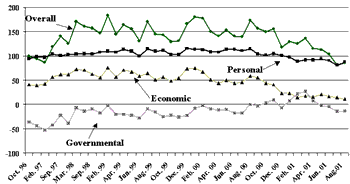 |
The index has declined steadily from 137 points, its March 2001 mark. In August of 2000, the index was at 174, more than twice its current level.
Investors' sentiments about the economy fell four points this month to 11. When the Index was established, the economic dimension registered at 41. In August of 2000, the economic dimension was at 59.
Investors' optimism about their own financial situations increased to 88 in August from 81 in July. This is the source of the modest up-tick in the overall index for August. The increase in this dimension more than offsets the decline in the economic dimension of the index. The personal dimension of the Index, however, remains low compared to the past -- in August of 2000, the personal dimension of the index was at 115.
In August, the governmental dimension of the index remained virtually unchanged at -13. This dimension was at -14 last month.
Investors Do Not Expect a Recovery Soon
Not only is investor optimism at a five year low but, significantly, many investors don't expect things to improve any time soon. According to the current survey, about two-thirds of investors (64%) say the economy is in a slowdown, while another 8% say it is in a recession.
When investors who believe the economy is in a slowdown or recession are asked how long it will be before the economy recovers, only 11% say the recovery will start in six months or less. Another 30% say the recovery will take place within one year. But a majority, 56%, say it will take more than a year before the economic recovery begins.
Investors See Pharmaceuticals and Biotech Industries as Most Attractive
Given current investor concerns about the economy, what sectors do investors feel are most attractive in the most six months? Mostly, investors favor the same sectors in August that they did last March.
- Three out of four investors (75%) say that they think pharmaceuticals are an excellent or very good investment opportunity -- just about the same percentage as did in March (72%).
- Sixty percent choose the biotech sector, also just about the same percentage as did in March (62%).
- Half of all investors (50%) opt for energy, up slightly from 47% in March.
Similarly, the sectors investors found least attractive last March are the same sectors they find least attractive now.
- Only 13% of investors say that they think retail is an excellent or very good investment opportunity -- compared with 15% who said that in March.
- By comparison, one in five investors (21%) choose transportation (the same percentage as in March).
- One in five investors (20%) opt for the Internet, down from 27% in March.
Survey Methods
Results for the Gallup/UBS PaineWebber "Index of Investor Optimism" poll are based on telephone interviews with a randomly selected national sample of 1,002 adult investors, 18 years and older, with at least $10,000 of investable assets, conducted August 2-19, 2001. For results based on this sample, one can say with 95 percent confidence that the maximum error attributable to sampling and other random effects is plus or minus 3 percentage points.
In addition to sampling error, question wording and practical difficulties in conducting surveys can introduce error or bias into the findings of public opinion polls.
How would you describe current economic conditions in the United States today? Would you say the economy is currently: (Read and rotate 1-4)?
|
01 Aug |
|
|
% |
|
|
In a sustained expansion |
9 |
|
In a recovery |
17 |
|
In a slowdown |
64 |
|
In a recession |
8 |
|
DK/Refused |
2 |
|
100% |
How long do you think it will be before the United States is on the way to an economic recovery [Read and rotate 1-5) [BASED ON THOSE WHO THINK THE ECONOMY IS NOT IN A RECOVERY OR EXPANSION; N = 725; MARGIN OF ERROR = +/- 4 %]?
|
01 Aug |
|
|
% |
|
|
Within the next three months |
1 |
|
Within the next six months |
10 |
|
Within a year |
30 |
|
Within at least two years |
20 |
|
At least two years from now or longer |
36 |
|
DK/Refused |
3 |
|
100% |
Now, I would like to ask some questions about different sectors and which ones you believe will provide the most attractive investment opportunities in the next six months. For each of the following areas, please indicate whether this will provide an excellent opportunity, very good opportunity, only about average, poor opportunity, or very poor opportunity for investment in the next six months. How ABOUT [READ AND ROTATE A-K]? [WORDING IN MARCH, 2001, ASKED WHICH SECTORS PROVIDED THE MOST ATTRACTIVE INVESTMENT OPPORTUNITIES, IMPLICITLY MEANING AT THAT TIME.]
A. Biotechnology companies
|
Excellent |
Very good |
Average |
Poor |
Very poor |
Don't know/ Refused |
|
|
01 Aug |
16% |
44 |
29 |
4 |
1 |
6 |
|
01 Mar |
13% |
49 |
30 |
4 |
* |
4 |
B. Internet companies
|
Excellent |
Very good |
Average |
Poor |
Very poor |
Don't know/ Refused |
|
|
01 Aug |
4% |
16 |
40 |
31 |
6 |
3 |
|
01 Mar |
6% |
21 |
38 |
27 |
5 |
3 |
C. Telecommunications companies
|
Excellent |
Very good |
Average |
Poor |
Very poor |
Don't know/ Refused |
|
|
01 Aug |
8% |
34 |
40 |
13 |
3 |
2 |
|
01 Mar |
12% |
46 |
32 |
7 |
2 |
1 |
D. Retail companies
|
Excellent |
Very good |
Average |
Poor |
Very poor |
Don't know/ Refused |
|
|
01 Aug |
2% |
11 |
65 |
19 |
1 |
2 |
|
01 Mar |
* |
15% |
62 |
19 |
2 |
2 |
E. Utilities
|
Excellent |
Very good |
Average |
Poor |
Very poor |
Don't know/ Refused |
|
|
01 Aug |
9% |
35 |
43 |
10 |
1 |
2 |
|
01 Mar |
7% |
28 |
47 |
13 |
3 |
2 |
F. Healthcare companies
|
Excellent |
Very good |
Average |
Poor |
Very poor |
Don't know/ Refused |
|
|
01 Aug |
10% |
34 |
36 |
16 |
1 |
3 |
|
01 Mar |
8% |
36 |
40 |
12 |
3 |
1 |
G. Transportation companies
|
Excellent |
Very good |
Average |
Poor |
Very poor |
Don't know/ Refused |
|
|
01 Aug |
3% |
18 |
55 |
19 |
1 |
4 |
|
01 Mar |
3% |
18 |
61 |
15 |
1 |
2 |
H. Technology companies
|
Excellent |
Very good |
Average |
Poor |
Very poor |
Don't know/ Refused |
|
|
01 Aug |
11% |
32 |
36 |
16 |
3 |
2 |
|
01 Mar |
11% |
43 |
31 |
12 |
2 |
1 |
I. Energy companies
|
Excellent |
Very good |
Average |
Poor |
Very poor |
Don't know/ Refused |
|
|
01 Aug |
9% |
41 |
37 |
10 |
1 |
2 |
|
01 Mar |
9% |
38 |
38 |
12 |
2 |
1 |
J. Pharmaceuticals companies
|
Excellent |
Very good |
Average |
Poor |
Very poor |
Don't know/ Refused |
|
|
01 Aug |
23% |
52 |
20 |
3 |
* |
2 |
|
01 Mar |
18% |
54 |
23 |
4 |
* |
1 |
K. Financial services companies
|
Excellent |
Very good |
Average |
Poor |
Very poor |
Don't know/ Refused |
|
|
01 Aug |
5% |
25 |
55 |
10 |
1 |
4 |
|
01 Mar |
3% |
32 |
54 |
7 |
1 |
3 |
DK -- Don't Know
* -- Less than 0.5%