The college graduates of 2002 have bolted out of the starting gate to hunt for the perfect job, but many have more on their minds than a grand salary and a chance at the corner office. Before leaving the ivory towers of some of the country's top colleges and universities, many graduates signed a "Grad Pledge" -- a promise "to explore and take into account the social and environmental consequences of any job I consider and will try to improve these aspects of any organizations for which I work." Eighty percent of the 1,200 seniors at Princeton University signed the pledge several weeks ago, just before graduation. They joined their fellow graduates from Harvard, Cornell, Dartmouth, Vassar, Colby, Manchester, Brandeis, Macalester and Humboldt State in taking a promising leap toward social responsibility.
In August of 2001*, the Gallup Poll asked Americans aged 18 and older if they were satisfied with the overall contributions their employers make to society. About half, 51%, said they were completely satisfied and another 32% reported being somewhat satisfied. Obviously, that's not good enough for the current generation.
In 1999**, when most of today's college students were still in high school, the Gallup Youth Survey asked them to tell us about what they thought their generation would bring to the future. On average, three-quarters said they planned to make positive contributions to society during the next century.
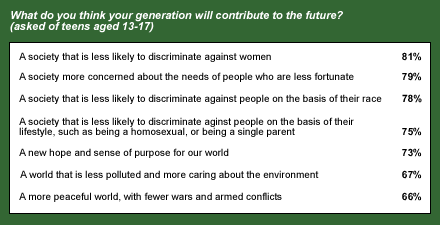
College seniors are serious about their commitment to improve the quality of life in the business community and society at large. Many have participated in seminars, panel discussions and other activities sponsored by their schools to learn the nuts and bolts of building a better world. When asked whether she thought the Grad Pledge may be one response to the heady economic times of the 1980s and 1990s, Princeton senior Helen Labun, who helped organize the campus signers, responded, "Princeton students know the stereotype of the power-hungry corporate climber, and no one I know identifies with that stereotype. We all would like to assume that we will improve the world in some way, even a small way, post-Princeton. The real test now is whether we can prove that we really don't deserve to be seen that way."
All this suggests that the current crop of grads is particularly in tune with the words of social scientist Margaret Mead: "Never doubt that a small group of committed individuals can change the world: indeed, it's the only thing that ever does."
*Findings are based on telephone interviews with a national cross section of 599 adults, aged 18 and older, conducted in August 2001. For results based on this sample, one can say with 95% confidence that the margin of sampling error is ±4.1%.
**Findings are based on telephone interviews with a national cross section of 208 teen-agers, aged 13 to 17, conducted September and October 1999. For results based on this sample, one can say with 95% confidence that the margin of sampling error is ±7.2%.