GALLUP NEWS SERVICE
PRINCETON, NJ -- On July 9, a major federally funded study of hormone replacement therapy (HRT) was aborted when researchers determined that the therapy was associated with an increased risk of breast cancer, heart attacks, strokes, and blood clots, and that these risks outweighed potential benefits in the areas of colorectal cancer and hip fractures.
Shortly after this finding was reported, Gallup interviewed 935 women, asking them about their use of HRT and measuring their perceptions of its risks. About half the respondents were interviewed in a nationwide Gallup survey conducted July 22-24; the other half were interviewed Aug. 19-21.
Major Findings
To read the news accounts of the Women's Health Initiative (WHI) research findings concerning HRT, one might expect women to have concluded that HRT is a dangerous treatment to be avoided at all costs. To the contrary, Gallup data indicate that the impact of the study has been more along the lines of muddying the waters for consumers. Women are more likely to say the recent reports have confused them rather than helped them make better decisions concerning this widely prescribed treatment for menopausal symptoms. And perhaps as a result, the majority of women currently have no firm opinion about whether HRT is more harmful or beneficial to those who take it.
Only a small number of women tell Gallup they have stopped using HRT specifically because of the news reports. The Gallup data indicate that many more women continue to take these drugs than have stopped taking them because of the recently reported risks (17 million vs. 2.5 million).
The WHI research findings do seem to have a substantial minority of women thinking about the safety of hormone therapy. Four in 10 current HRT users say they are considering getting off the treatment because of the reports. A third of women who have never taken HRT say they are less likely to consider it in the future because of the reports.
Gallup's July survey measured Americans' attention paid to the recent news about HRT and found a majority of all women, including nearly three-quarters of those aged 50 and older, saying they have followed the issue in the news either very or somewhat closely.
Details
- Only 37% of women tell Gallup they feel better able to make decisions about HRT as a result of recent news reports about the treatment. Another 44% say the reports have left them only more confused on the issue. The remaining 19% don't know enough to say.
- Only 19% of women believe HRT is mostly harmful to those who take it while slightly more, 25%, consider it mostly beneficial. The majority of women, 55%, are unsure.
| Hormone Replacement Therapy: Mostly Beneficial or Harmful? |
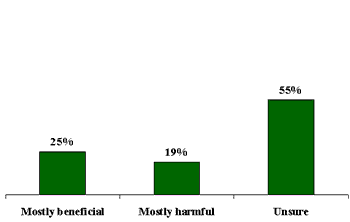 |
| July/August 2002 |
- Sixteen percent of women aged 18 and older (approximately 17 million women nationwide) tell Gallup they are currently taking HRT. Another 12% say they previously used it but have stopped, while 70% have never taken it.
- Among those who formerly took HRT, only a fraction (18%) say the reason they stopped was the recent news reports. This figure translates into roughly 2.5 million women.
- Close to half (40%) of those currently taking hormone replacement drugs say they are considering stopping their treatment as a result of the recent news reports. The majority (54%), however, say they will not stop the treatment for this specific reason.
- When Gallup asked the 70% of American women who have never taken HRT how the recent news reports have affected their likelihood of using it in the future, a surprisingly large number, 55%, said such reports have made no difference to them. But among those who said the news reports did make a difference, most (35% of women who have never taken HRT) said they were less likely to use the drugs; just 4% said they were more likely to use them.
Additional Key Points
- It is important to note that many women who tell Gallup they use HRT most likely do not use the specific combination of estrogen and progestin that was studied in the WHI's randomized, controlled trial. The National Institutes of Health estimates that 14 million American women use some form of hormonal treatment to address menopausal symptoms, but that only 6 million use the specific combination of estrogen and progestin known as "hormone replacement therapy." Thus, the fact that 16% of adult women (which translates into approximately 17 million women) tell Gallup they take "hormone replacement therapy" indicates that many women do not make the fine distinction between different types of hormone treatment.
- With this in mind, it is still interesting to note that reported use of hormone treatment is highest among women of post-menopausal age: 29% of women aged 50 and older say they currently use hormone therapy, compared to only 9% of those aged 30-49 and just 3% of those aged 18-29. The rate is particularly high among women aged 50-64 (37%).
| Current Use of Hormone Replacement
Therapy: By Age Group |
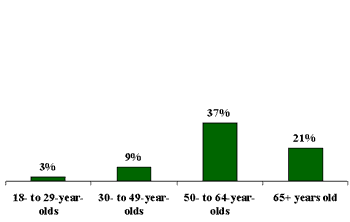 |
| July/August 2002 |
- Factoring in those who have taken hormone drugs in the past, the importance of the safety of these drugs to older women is clear. Half of women aged 50 or older either are using hormone drugs currently or did so in the past.
- Confusion about the recent HRT news reports is particularly high among current users of hormone therapy, indicating the need for better doctor-patient communication on this subject. Fifty-three percent of this group tells Gallup it is confused by the recent reports, compared to only 34% of previous users, and 44% of those who have never used the therapy.
- There are important differences in perceptions about the effects of HRT according to personal experience. A majority of those currently taking hormone replacement drugs believe their effects are mostly good, while those who have discontinued using the drugs are more likely to think they are harmful than helpful. Uncertainty about the drugs' impact is highest among those who have never used the treatment.
|
Perceptions About HRT According to Personal Use |
|||
|
Currently |
Previously |
Never |
|
|
% |
% |
% |
|
|
Believe HRT is mostly beneficial |
55 |
23 |
19 |
|
Believe HRT is mostly harmful |
2 |
32 |
20 |
|
Unsure about effects of HRT |
42 |
43 |
60 |
|
No opinion |
1 |
2 |
1 |
|
TOTAL |
100% |
100% |
100% |
- Not clear is whether current users' higher rate of positive perceptions about HRT represents a lack of understanding about the new findings -- essentially reflecting their understanding of the treatment at the time they started it -- or whether it reflects consultation with their physicians in recent weeks based on the updated information.
Survey Methods
These results are based on telephone interviews with a randomly selected national sample of 935 women, 18 years and older, conducted July 22-24, 2002 and Aug. 19-21, 2002. For results based on the total sample of women, one can say with 95% confidence that the maximum error attributable to sampling and other random effects is ±4 percentage points. For results based on the sample of -- 165 -- women who are currently taking hormone replacement therapy, the maximum margin of sampling error is ±8 percentage points. In addition to sampling error, question wording and practical difficulties in conducting surveys can introduce error or bias into the findings of public opinion polls.
How closely have you been following the recent news reports about medical studies on hormone replacement therapy for women -- very closely, somewhat closely, not too closely, or not at all?
|
Very |
Somewhat closely |
Not too closely |
|
No |
|
|
2002 Jul 22-24 |
|||||
|
All Women |
22% |
35 |
23 |
19 |
1 |
|
Women 18-49 |
13% |
33 |
32 |
22 |
0 |
|
Women 50+ |
35% |
37 |
12 |
15 |
1 |
Which of the following best describes your current use of hormone replacement therapy -- [ROTATED: you are currently taking hormone replacement therapy, you previously took it but have stopped, or you have never taken hormone replacement therapy]?
BASED ON -- 935 -- NATIONAL WOMEN, 18+; MARGIN OF SAMPLING ERROR IS +/- 4 PCT PTS
|
Currently |
Previously took but stopped |
Never |
No |
|
|
2002 Jul-Aug |
16% |
12 |
70 |
2 |
Have the recent news reports about hormone replacement therapy made you consider stopping your treatment, or not?
BASED ON -- 165 -- WOMEN CURRENTLY TAKING HORMONE REPLACEMENT THERAPY; +/- 8 PCT PTS
|
Yes |
No |
No opinion |
|
|
2002 Jul-Aug |
40% |
54 |
6 |
Did you stop taking hormone replacement therapy as a result of the recent news reports about hormone replacement therapy or did you stop taking it for some other reason?
BASED ON -- 136 -- WOMEN WHO PREVIOUSLY TOOK HORMONE REPLACEMENT THERAPY; +/- 9 PCT PTS
|
Recent news reports |
Some other reason |
No opinion |
|
|
2002 Jul-Aug |
18% |
82 |
0 |
Have the recent news reports about hormone replacement therapy made you more likely or less likely to take hormone replacement therapy in the future, or have they not made any difference?
BASED ON -- 617 -- WOMEN WHO HAVE NEVER TAKEN HORMONE REPLACEMENT THERAPY; +/- 4 PCT PTS
|
More likely |
Less likely |
No difference |
No opinion |
|
|
2002 Jul-Aug |
4% |
35 |
55 |
6 |
Do you think hormone replacement therapy is mostly -- [ROTATED: beneficial (or mostly) harmful] -- to women who take it, or are you unsure?
BASED ON -- 935 -- NATIONAL WOMEN, 18+; +/- 4 PCT PTS
|
Mostly beneficial |
Mostly harmful |
Unsure |
No answer |
|
|
2002 Jul-Aug |
25% |
19 |
55 |
1 |
Which comes closer to your view about the recent news reports about hormone replacement therapy -- [ROTATED: the reports left you better able to make decisions about this health issue than before, (or) the reports left you more confused about this health issue than before]?
BASED ON -- 935 -- NATIONAL WOMEN
|
|
Better able to |
Confused about |
No |
|
2002 Jul-Aug |
37% |
44 |
19 |