Although many social observers maintain that the United States is in a period of "postmodernism" -- a time of fragmentation of religious and cultural norms -- it is interesting to note that the vast majority of Americans continue to affirm a belief in the concept or doctrine of "sin." Although the current figure (from a March 2003 CNN/USA Today/Gallup poll*) is six points lower than the previous Gallup measurement taken in 1995, 84% of Americans still express a belief in "sin," while only 14% do not.
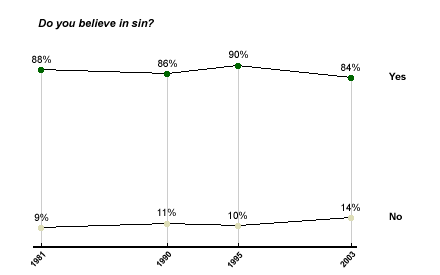
Some people define sin broadly, as a violation of some religious or moral principle. But others probably see the term from a more biblical perspective -- as a transgression of divine law, an offense against God, or a state of alienation from God. A series of Gallup surveys from the late 1980s indicated that about 8 in 10 Americans believed in a "Day of Judgment," a biblical teaching that all people will be accountable to God for their moral actions, and will be summoned at a time of reckoning. By way of background, it is important to bear in mind that about 8 in 10 Americans identify themselves as part of the Christian religious tradition, 6% indicate they are in a non-Christian tradition, and 13% claim no religious tradition**.
There are remarkably few differences in responses to this question based on age, race, sex, and level of formal education. Those with a liberal political ideology (25%), those with a postgraduate education (21%), and those who "rarely" or "never" attend religious services (22%) are more likely than others to say they do not believe in sin. Regionally, those living in the West (18%) and East (17%) are slightly more likely to say they do not believe in sin than those in the Midwest (12%) and South (11%).
*Findings are based on telephone interviews with 1,007 national adults, aged 18 and older, conducted March 14-15, 2003. For results based on the total sample of national adults, one can say with 95% confidence that the maximum margin of sampling error is ±3%.
**Findings are based on telephone interviews with 1,509 national adults, aged 18 and older, conducted June 2002. For results based on the total sample of national adults, one can say with 95% confidence that the maximum margin of sampling error is ±3%.