GALLUP NEWS SERVICE
PRINCETON, NJ -- On Oct. 7, California will hold a recall election to decide whether incumbent Governor Gray Davis will serve out his term or be dumped more than three years early. California's recall effort has been controversial, with a number of observers claiming that it could set an unhealthy precedent, disrupting the normal democratic process by which elected officials are allowed to serve their full terms unless they commit crimes or other acts of moral turpitude. But a CNN/USA Today/Gallup poll finds that Americans support the principle of electoral recall, though most would not recall the governor in their own state. The same poll also finds that a slight majority of California respondents would favor the recall of their governor.
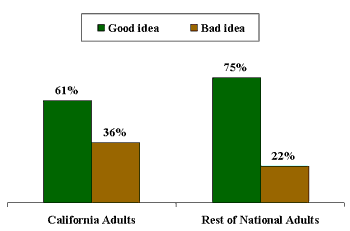
The poll, conducted July 25-27, includes a sample of 100 California adults, allowing a cautious interpretation of the results for that state compared with other states. The national results show that 74% of Americans believe it is a good idea "for people to be able to recall elected governors solely on the basis of their performance in office." Another 24% say it is a bad idea.
Among California respondents in the poll, 61% say it is a good idea, compared with 75% among respondents throughout the rest of the country. Despite the relatively small sample size of California respondents, the 14-point difference is statistically significant.
| Recall of Elected State Governors Because of Performance in Office |
 |
| July 25-27, 2003 |
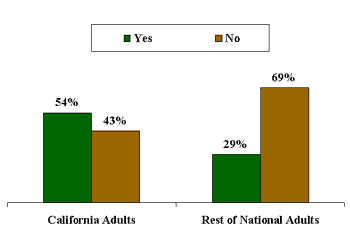
Although Americans support electoral recall in principle, most would not vote to recall their own governor. Only 31% say they would, while 66% would not.
Among Californians, however, a slight majority -- 54% -- say they would vote to recall their governor, while 43% would not, and another 3% express no opinion. (A Los Angeles Times poll, conducted June 28-July 2, which included a sample of 1,127 registered voters in California, found similar results: 51% of registered voters supported the recall of Governor Davis, while 42% were opposed.) Excluding Californians, Americans in the rest of the country show only 29% supporting recall of their governor, and 69% opposed.
| Would You Recall Your Own State Governor? |
 |
| July 25-27, 2003 |
Seeming Paradox of Principle and Action
It may seem paradoxical that Californians as a whole are less likely to support the principle of electoral recall than are other Americans, but more likely to support a recall of their own governor. But the apparent paradox is a result of two different contexts. For most Californians, the question about recall in principle is almost identical to the question about the recall of the current governor. The vast majority of Californians who support recall in principle also support the recall of Davis, while the vast majority who oppose recall in principle also oppose the recall of Davis.
However, no other state is facing a similar election, so for people outside of California, there is a difference between the principle of recall and support for recalling their own governor. In fact, a large majority of Americans oppose the recall of their own governor whether they support -- or oppose -- recall in principle.
No Differences by Partisan Group
Outside of California, the opinions of Americans on the principle of recall, and on the recall of their own governor, are not correlated with either party affiliation or political ideology. In California, as the Los Angeles Times poll shows, both partisanship and ideology are highly correlated with the recall election -- not surprising, since the recall election targets a Democratic governor.
Survey Methods
Results are based on telephone interviews with 1,006 national adults, aged 18+, conducted July 25-27, 2003. For results based on the total sample of national adults, one can say with 95% confidence that the margin of sampling error is ±3 percentage points. For the sample of 100 California respondents, the margin of error is ±11 percentage points.
In addition to sampling error, question wording and practical difficulties in conducting surveys can introduce error or bias into the findings of public opinion polls.