An ambulance races by as its lights flash and sirens blare a sense of urgency. Time is of the essence in most emergencies. How confident does the public feel about the "first responders" who staff these ambulances, many of whom are volunteers? This question was explored in a February 2003 CNN/USA Today/Gallup poll.
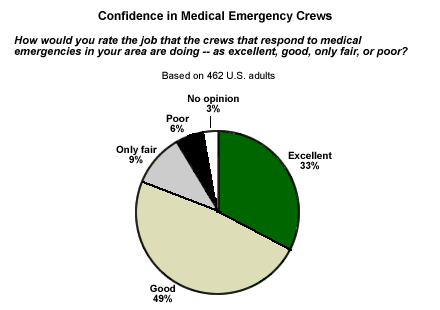
When Gallup asked Americans to rate the performance of crews who respond to medical emergencies in their area, the response was positive. One in three respondents (33%) rated the job that emergency crews do as "excellent," and another 49% rated it as "good."*
Americans are also confident in the ability of emergency crews in their area to reach them and provide medical care in a timely manner. Thirty-eight percent of Americans express "a great deal" of confidence that emergency crews would be able to do this. Another 43% have "a moderate amount" of confidence**.
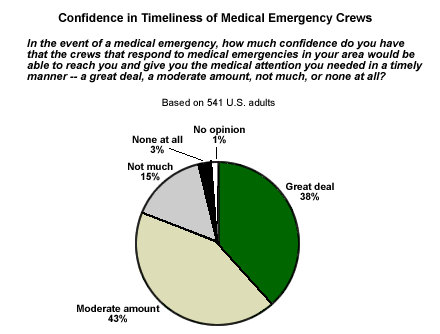
However, residents of rural areas are less confident in this respect than other Americans are. Only 25% of rural residents have a great deal of confidence that crews would be able to reach them quickly in an emergency, compared with 47% of those in urban areas and 41% of those in suburban locales.
Can Emergency Personnel Maintain This Level of Performance?
The job outlook for professional first responders is bright, according to the Bureau of Labor Statistics. However, increased demand for these professionals may be a red flag, especially when considering the general shortage of trained healthcare workers, and the need for every community in this country to prepare for the possibility of terrorist attacks. A shortage of emergency medical personnel could spell disaster for communities across the country.
Concern over shortages of volunteer emergency personnel already exists. Serving as a volunteer emergency medical technician requires incredibly high levels of dedication and commitment, as well as many specific talents. Volunteers must give up their free time to very demanding work, and they frequently face shocking situations that may necessitate grief counseling or other forms of therapy. These individuals must devote hours to studying for certifications, and the cost of certification is increasingly seen as recruitment barrier.
Bottom Line
Americans seem to have great confidence in first responders, but we must not take them for granted. If your community is served by volunteers, it's important to support them in their drives to help minimize the expenses that they personally incur. Above all, encourage people to consider serving in this vital capacity, either as volunteers or career professionals.
*Results are based on telephone interviews with 462 national adults, aged 18 and older, conducted Feb. 24-26, 2003. For results based on these total samples of national adults, one can say with 95% confidence that the maximum margin of sampling error is ±5 percentage points.
**Results are based on telephone interviews with 541 national adults, aged 18 and older, conducted Feb. 24-26, 2003. For results based on these total samples of national adults, one can say with 95% confidence that the maximum margin of sampling error is ±5 percentage points.