GALLUP NEWS SERVICE
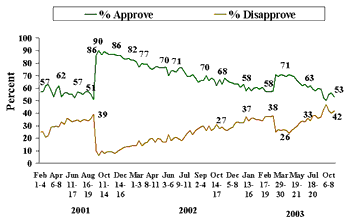
PRINCETON, NJ -- After a surge of support in the wake of his official entrance into the race for president, retired Gen. Wesley Clark has slipped from being the sole frontrunner to being tied for first with former Vermont Governor Howard Dean. According to a CNN/USA Today/Gallup poll conducted over the weekend, three other candidates are close behind -- Congressman Richard Gephardt and Senators Joe Lieberman and John Kerry. President George W. Bush continues to appear somewhat vulnerable, earning a respectable 53% job approval rating, but leading a "generic" Democratic candidate by only three percentage points among registered voters.
Among Democrats and Democratic leaners who say they are registered to vote, Dean receives 16% support, compared with 15% for Clark, 12% each for Gephardt and Lieberman, and 10% for Kerry. Civil rights activist Al Sharpton and Senator John Edwards each receive 6% support, while former Senator Carol Moseley Braun gets 4% and Congressman Dennis Kucinich 1%. Another 18% of registered voters express no preference.
|
Next, I'm going to read a list of people who may be running in the Democratic primary for president in the next election. After I read all the names, please tell me which of those candidates you would be most likely to support for the Democratic nomination for President in the year 2004 [NAMES READ WITH TITLES]. |
||||||||||||
|
|
|
|
|
|
|
|
|
|
|
None/ other/ no opin. |
||
|
% |
% |
% |
% |
% |
% |
% |
% |
% |
% |
% |
||
|
Democrats/Democratic Leaners Who Are Registered to Vote |
||||||||||||
|
2003 Oct 24-26 |
16 |
15 |
12 |
12 |
10 |
6 |
6 |
4 |
1 |
-- |
18 |
|
|
2003 Oct 10-12 |
13 |
18 |
10 |
13 |
11 |
6 |
6 |
5 |
3 |
-- |
15 |
|
|
2003 Oct 6-8 ^ |
16 |
21 |
8 |
13 |
13 |
6 |
2 |
4 |
2 |
-- |
15 |
|
|
2003 Sep 19-21 |
13 |
22 |
11 |
10 |
11 |
4 |
4 |
3 |
2 |
4 |
16 |
|
|
2003 Sep 8-10 |
14 |
10 |
16 |
13 |
12 |
2 |
5 |
4 |
2 |
5 |
17 |
|
|
2003 Aug 25-26 |
12 |
2 |
13 |
23 |
10 |
4 |
5 |
5 |
1 |
4 |
21 |
|
|
2003 Aug 4-6 |
15 |
-- |
15 |
18 |
12 |
4 |
5 |
5 |
2 |
5 |
19 |
|
|
2003 Jul 25-27 |
11 |
-- |
16 |
21 |
15 |
5 |
6 |
6 |
2 |
4 |
14 |
|
|
2003 Jun 12-18 |
7 |
-- |
17 |
21 |
13 |
6 |
6 |
5 |
1 |
7 |
17 |
|
|
2003 May 31-Jun 1 |
5 |
-- |
14 |
20 |
17 |
7 |
6 |
4 |
2 |
4 |
21 |
|
|
2003 Apr 22-23 |
6 |
-- |
16 |
22 |
18 |
3 |
8 |
4 |
3 |
5 |
15 |
|
|
^ |
NOTE: Bob Graham dropped out of race on Oct. 6, his name was removed from question for Oct. 7-8 interviewing and in subsequent polls; Graham response from Oct. 6 included in "other" category. |
|||||||||||
Gallup's first true measure of support for Clark -- taken in mid-September after a flurry of speculation in the news about Clark's possible candidacy, followed by his official announcement -- showed Clark leading Dean by nine percentage points, 22% to 13% among Democrats and Democratic leaners who are registered to vote. Clark's support stayed above 20% in an early October poll, in which he led Dean by five percentage points. But in the latest poll, Clark's support is down to 15%, a point lower than Dean's.
Given the sample of 374, this latest poll by itself would not necessarily indicate that Dean and Clark have significant leads over the next three candidates. But several other surveys in recent weeks find similar results.
- A Newsweek poll of 356 registered Democrats and Democratic leaners, conducted Oct. 23-24 by Princeton Survey Research Associates, showed Dean with 15%, Clark 12%, Lieberman 10%, Kerry 8%, and Gephardt 8%.
- A Zogby poll of 500 "likely Democratic voters," conducted Oct. 15-18, found Dean with 12%, Clark 10%, Kerry 9%, Lieberman 8%, and Gephardt 5%.
- A Fox News/Opinion Dynamics poll of 345 registered Democrats, conducted Oct. 14-15, found Clark with 13%, Dean 12%, Lieberman 11%, Kerry 10%, and Gephardt 9%.
- An ABC News/Washington Post poll of registered Democrats and leaning Democrats, conducted Oct. 9-13, had Dean in first with 16%, followed by Gephardt with 14%, Clark 13%, Kerry 11%, and Lieberman 10%.
An average of these four polls would place Dean (14%) and Clark (12%) as the two leaders, but only by small margins. The averages for Lieberman (10%), Kerry (10%), and Gephardt (9%) show them all close behind.
Type of Candidate Democrats Want
In the past two months, Democratic voters as a whole have become more likely to want their party's presidential nominee to be politically "liberal." A majority still prefer the nominee to be moderate rather than liberal, by a 53% to 39% margin. But that margin is down considerably from August, when Democratic voters preferred the moderate candidate by 68% to 27%.
If you had to choose, would you rather see the Democrats nominate someone for president in 2004 who -- [ROTATED: is a liberal (or who) is a moderate]?
BASED ON 374 DEMOCRATS OR DEMOCRATIC LEANERS WHO ARE REGISTERED TO VOTE
|
|
|
CONSERVATIVE (vol.) |
No |
|
|
% |
% |
% |
% |
|
|
2003 Oct. 24-26 |
39 |
53 |
1 |
7 |
|
2003 Aug. 25-26 |
27 |
68 |
1 |
4 |
|
(Vol.) Volunteered response |
||||
Bush's Vulnerability
The poll shows that Bush continues to enjoy majority approval, with 53% of Americans overall approving and 42% disapproving of his job performance. Approval is down from 56% two weeks ago, though higher than the 50% rating he received toward the end of September.
| George W. Bush's Job Approval Rating |
 |
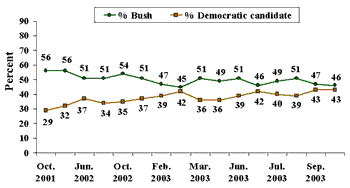
Among registered voters, Bush leads an unnamed "Democratic candidate" by just three percentage points, 46% to 43%. Bush's support is only a point lower than last month's reading, showing Bush winning by 47% to 43%. But the margins are much smaller than what Gallup measured in August, when Bush led by 51% to 39%.
| If George W. Bush runs for re-election in
2004, in general, are you more likely to vote for Bush or for the
Democratic Party's candidate for president? Among Registered Voters |
 |
At this stage of the election cycle, it is too early to make any solid predictions about the nature of the 2004 presidential race. But the current results suggest that the Democrats have the potential to make the 2004 presidential race competitive.
Survey Methods
Results are based on telephone interviews with 1,006 adults, aged 18 and older, conducted Oct. 24-26, 2003. This included a sample of 374 Democrats and Democratic leaners who are registered to vote. The maximum margin of sampling error for this sample of Democratic voters is ±6 percentage points.
In addition to sampling error, question wording and practical difficulties in conducting surveys can introduce error or bias into the findings of public opinion polls.