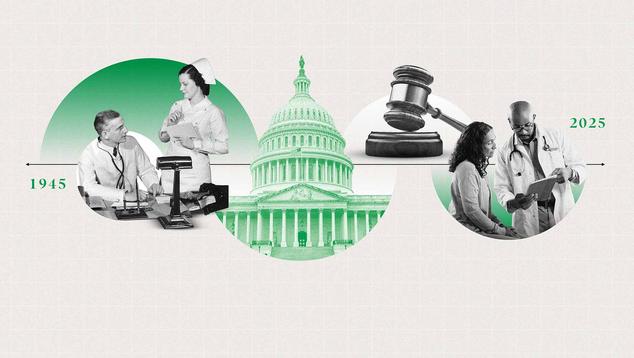
The current debate over the role of government in providing healthcare for the nation’s citizens is complex and contentious. But this shouldn’t surprise us. History shows that politicians have, on a regular basis since World War II, argued about the role of government in the nation’s healthcare system. Congress’ ongoing efforts to grapple with the expiration of Affordable Care Act subsidies are simply the latest episode.
Luckily, Gallup public opinion polling has followed these proposals over the years. In the context of what was happening at the time, these measures of public opinion provide us with an important (and interesting) window into the way Americans approach this very important topic.
Public More Negative Than Positive on Truman’s Proposal for Compulsory Health Insurance
We can start with President Harry Truman’s proposal for a nationwide, compulsory healthcare system in the 1940s. (The debate over the government’s role in healthcare stretched back much further than that, of course, but systematic polling on the issue didn’t begin until after World War II.)
Truman proposed a universal national health insurance program soon after the end of World War II in 1945. The program, in a harbinger of things to come, became the center of debate, was strongly opposed by the American Medical Association (which associated it with communism) and ultimately faded away. Later in life, Truman said, “I have had some bitter disappointments as president, but one that has troubled me most, in a personal way, has been the failure to defeat organized opposition to a national compulsory health insurance program.”
Truman didn’t get a lot of support from the American people for his proposal. Americans initially favored the plan in 1945, but by 1949 and 1950, the public had turned against it. In a November-December 1949 Gallup poll, 31% of Americans opposed the “plan for compulsory health insurance,” 22% favored it, 13% had no opinion, and 34% said they were not familiar with it. By October 1950, support had dropped to 13%, with 34% opposed, and the remainder either had no opinion or hadn’t heard of it. The plan eventually died in committee and never reached a vote.
Americans Behind Johnson’s Medicare and Medicaid Plans
Lyndon Johnson advanced the next major proposal on healthcare in the 1960s. Unlike Truman’s universal plan, Johnson’s targeted national healthcare plans for two specific populations — senior citizens (Medicare) and low-income families (Medicaid) — were more successful.
Gallup polling at the time showed strong majority support for Medicare. A Gallup poll conducted in October 1964 explained the poll as “a compulsory medical insurance program covering hospital and nursing home care for the elderly … financed out of increased Social Security taxes.” At that point, 61% of Americans favored the idea, with 31% opposed. Support has grown even stronger over the years. After the bill was passed into law in April 1965, a Harris poll in August of that year showed an even higher 82% approval.
Support for Medicare has remained high. A 2024 Kaiser Family Foundation poll, for example, found that 79% of Americans had a favorable opinion of “Medicare, the federal government health insurance program for adults 65 and older and for some younger adults with disabilities.”
There was little polling on Medicaid during the 1960s, but Gallup’s polling over the years has consistently shown that a majority of Americans (dating back to 1938) believe the government should be responsible for providing healthcare to those who can’t afford it. And more recently, the 2024 Kaiser Family Foundation poll showed a 76% favorable opinion of “Medicaid, the federal-state government health insurance for certain low-income adults and children and long-term care program for adults 65 and older and younger adults with disabilities.”
Support Lacking for Clinton’s Effort at Healthcare Reform
Bill Clinton was the next president to propose major changes to the government’s role in healthcare. Soon after he took office, a commission led by first lady Hillary Clinton worked on and promulgated a major, comprehensive plan for universal healthcare coverage, unveiled in 1993. The plan became a political football, and ultimately never reached a vote in either house of Congress.
Gallup conducted a great deal of polling on this high-profile issue. Initially, the results showed majority public support, with over half of Americans favoring the Clinton plan. But support fell as the debate over the plan continued, dropping below the majority level by February 1994. By June of that year, 50% opposed the plan, while 42% favored it.
Public Becomes More Positive About Obama’s Affordable Care Act Over Time
President Barack Obama’s Affordable Care Act (ACA), after a great deal of acrimonious debate, was passed by both the Senate and the House and signed into law by Obama in March 2010. The ACA received generally tepid public support at the time it was being debated, and Americans remained more opposed than in favor throughout the rest of Obama’s term in office. But when Trump took office in 2017, opinion flipped, and support has generally been higher than opposition in the years since.
Most recently, a November West Health-Gallup poll showed that 57% of Americans approve of the ACA, a new high, although support remains extraordinarily partisan, with only 15% of Republicans approving, compared with 91% of Democrats and 63% of independents.
Bottom Line: Lessons Learned
What do we learn from all of this? Times change, of course, but history does provide us with some important lessons germane to our current political situation.
First, and most fundamentally, it is clear from the historical record and our current polling that Americans generally believe their government needs to be involved in healthcare and should take on the responsibility of helping develop a system to ensure all Americans have access to healthcare coverage. Gallup’s recent polling shows that almost two-thirds of Americans believe it is the federal government’s responsibility “to make sure all Americans have healthcare coverage.”
The challenge, of course, is answering the thorny question of exactly how this responsibility should be manifested.
History and our current polling make it clear that Americans don’t want the government to actually run a national healthcare system. Gallup polling over the past 15 years shows that, for the most part, Americans have preferred a system based on private insurance rather than a government-run system — although in November’s latest poll, the preferences are roughly tied. Older polling conducted by the Kaiser Family Foundation also shows mixed opinions about a “Medicare for All” plan.
The reluctance to support a government-run system is not surprising, given the low faith Americans have in their government in general. Plus, Americans may be mindful of the notorious costs associated with other government-run systems such as defense weapons acquisitions and attempts to modernize IRS technology.
Thus, although Sen. Bernie Sanders and others continue to advocate for a Medicare for All system, polling and history indicate a reluctance on the part of the public to enact large, comprehensive and compulsory reforms (as proposed by Truman and Clinton).
On the other hand, despite its shaky start in the minds of Americans, the public also doesn’t want the ACA scrapped, at least not without a clear alternative. Well over half of Americans (57%) approve of the ACA in Gallup’s November poll, although many of those who approve are open to changes.
In general, history tells us that targeted expansions (seniors, low-income families, ACA subsidies) endure, while big, systemwide redesigns struggle or fail. Johnson succeeded by limiting reform to defined populations, and Obama succeeded by building on the existing system. Americans appear more comfortable tweaking the healthcare system than replacing it.
Republicans in Congress have been fighting to repeal the Affordable Care Act since its inception, and the issue has now resurfaced, given that some of its provisions expired at the end of 2025. Majority public opinion, as we have seen, shows that the American public would accept a continuation of the ACA, although many supporters also endorse making “significant changes” to the plan.
As this debate continues, leaders would do well to review history and be cognizant of where the public stands, all of which suggests that decisions about the government’s role in healthcare need to avoid extremes on either side and instead incorporate trade-offs. As Gallup noted earlier this year in reviewing polling on how elected officials should do their jobs, “Americans are generally pragmatic when it comes to how their leaders should perform the nation’s business, with far more preferring that leaders in Washington compromise to ensure things get done than stand on principle with little to show for it.”
Stay up to date with the latest insights by following @Gallup on X and on Instagram.