GALLUP NEWS SERVICE
PRINCETON, NJ -- An analysis of recent polling data shows that Americans remain divided on the issue of Iraq, and that so far, there is no clear indication of how the issue is going to affect the presidential election. Four basic conclusions can be drawn from the data: 1) President George W. Bush is vulnerable on the issue of Iraq; 2) Democratic presidential candidate John Kerry is no better positioned on Iraq than Bush; 3) the public is divided about whether going to war in Iraq in the first place was the correct thing to do; 4) the public lacks consensus over what should be done now in Iraq.
1. Bush is vulnerable on Iraq.
Bush's job approval rating for handling Iraq has been below 50% since April of this year. Gallup's latest job approval rating for Bush on Iraq, from late June, was 42%. A TIME magazine poll released this past weekend gave Bush a 45% job approval rating on handling Iraq.
Americans are also not convinced that Bush has a clear plan on how to deal with Iraq. A July 30-Aug. 1 CNN/USA Today/Gallup poll shows that only 42% of Americans believe that Bush has a clear plan for handling the situation in Iraq, while a majority, 56%, believe that he does not.
2. Kerry does not have any perceptual advantage over Bush on Iraq.
Kerry has been unable to clearly differentiate himself from Bush on Iraq at this point.
Only 38% of Americans say that Kerry has a clear plan for handling the situation in Iraq, slightly lower than the percentage who believe that Bush has a clear plan. A slight majority, 52%, says that Kerry does not have a clear plan, while 10% do not have an opinion either way.
Both candidates are at rough parity when Americans are asked who can better handle Iraq. The July 30-Aug. 1 poll shows that 48% believe Kerry could better handle the situation there, compared with 47% who choose Bush. This rough parity between Bush and Kerry has held across four Gallup Polls conducted since May.
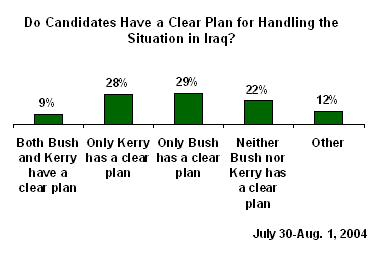
All in all, an analysis shows that the public breaks down as follows:
- Twenty-two percent say that neither Bush nor Kerry has a clear
plan for handling Iraq.
- Twenty-nine percent say that Bush has a clear plan for handling
Iraq, but that Kerry does not.
- Twenty-eight percent say that Kerry has a clear plan for
handling Iraq, but that Bush does not.
- Nine percent say that both Bush and Kerry have clear plans for
handling Iraq.
- Three percent say Bush has a clear plan for handling Iraq, but
don't know about Kerry.
- Six percent say that Bush does not have a clear plan for handling Iraq, but don't know about Kerry.
3. There is no clear-cut consensus among Americans that it was a mistake to get into the Iraq war to begin with.
A good deal of the recent news coverage concerning Kerry and Iraq has focused on his stance on the basic issue of U.S. involvement in that country. As is well known, as a senator, Kerry voted for the initial resolution to authorize the president to invade Iraq, but in October 2003 voted against the authorization of additional funds to conduct military operations in that country. This week, Kerry said that even knowing what he does now about the lack of weapons of mass destruction in Iraq, he still would have voted to give the president the authority to go to war, although he disagrees strongly with the way in which the Bush administration has handled that authority.
An analysis of available data suggests that Kerry's stance -- which Bush has called a new "nuance" -- to some degree reflects the ambiguity of the American public on the issue.
There is no clear-cut majority sentiment that the United States should not have gone into Iraq to begin with, nor is there clear-cut majority sentiment that the war was the right thing to do. Depending on the question wording and time at which the question was asked, it appears that the public is split roughly 50-50 on the basic issue of going to war in Iraq.
Gallup's most fundamental question on this issue reads: "In view of developments since we first sent our troops to Iraq, do you think the United States made a mistake in sending troops to Iraq, or not?" The percentage of Americans who say "yes" climbed slightly above 50% in late June and early July (54% in two consecutive Gallup Polls), but has now settled back down to 47% in the most recent poll. Fifty-one percent say it was not a mistake.

Other questions asked by other polling organizations show similarly mixed results on the basic question of war involvement. The recent TIME magazine poll asked: "Do you think the United States was right or wrong in going to war with Iraq?", and found an absolutely even split, with 47% of registered voters saying it was, and 47% saying it was not.
It comes as no surprise to find that there are strong partisan leanings on the question of whether it was a mistake, with 74% of Democrats in the Gallup Poll saying that involvement in Iraq was a mistake, while 87% of Republicans say it was not a mistake.

Importantly, independents, who make up about 30% of the electorate, tilt toward saying it was a mistake, by 55% to 42%.
From a strategic standpoint, two important groups of voters in this election are: a) voters who live in key showdown states that remain up for grabs, and b) voters, regardless of state, who can be classified as "swing voters" and who are not hardened in their candidate choice right now.
An analysis of voters by state grouping shows that -- not surprisingly -- those living in strongly Republican "red" states (that is, states in which Bush won by more than five percentage points in 2000) are significantly more likely than the national average to say that U.S. involvement in Iraq was not a mistake. Voters living in strongly Democratic "blue" states (in which Gore won by more than five percentage points in 2000) are above national norms in saying that the war was a mistake. Those voters living in the key showdown states are somewhat more like the red-state voters than the blue-state voters -- saying that the war was not a mistake by 52% to 46%.
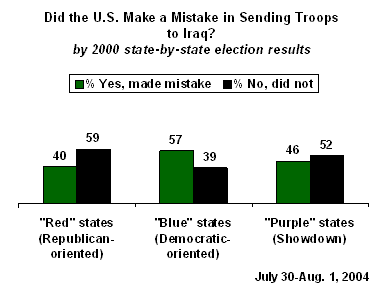
This is not a large distinction, however, suggesting that Kerry would run into trouble with a sizable chunk of these voters if he were somehow to declare that his initial vote was wrong and that the war was a mistake.
An analysis of the views of swing voters nationwide also underscores the difficulty a challenger candidate has in taking a strong position on the basic premise of the war.
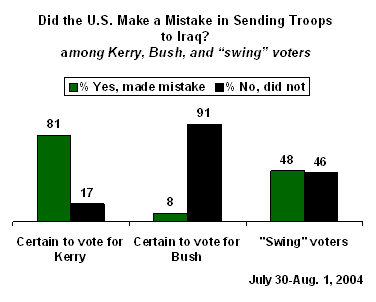
Swing voters -- 19% of adults nationwide -- are defined as those who are either undecided in their vote choice (either have no preference at all or say they only "lean" to one or the other candidate), or who currently have a preference but say that they might change their minds and vote for the other candidate. Forty-eight percent of this group says that U.S. involvement in Iraq was a mistake, while 46% say that it was not.
4. There does not appear to be a clear-cut consensus among Americans about what the public would have its leaders do about Iraq.
The key issue relating to U.S. involvement in Iraq centers on American troop presence in that country. There are approximately 148,000 U.S. troops serving in Iraq at this point in time, and there have been 933 U.S. deaths in Iraq as of Aug. 11, 2004.
An analysis of available data suggests there is no clear majority sense from the American public that all troops should be withdrawn immediately, nor is there a sense that a large number of additional troops should be sent to Iraq. The American public seems to adopt a stance of short-term troop retention in Iraq, with a longer-term focus on figuring out a way to withdraw troops.
Gallup has asked the public five times this year about the "number of U.S. troops in Iraq" and in each instance a third or less of Americans have chosen the two extreme alternatives of sending in more troops or withdrawing all troops. Instead, Americans seem divided between the other two alternatives of keeping troop levels as they are now or withdrawing some troops.
Similarly, a June Gallup Poll asked Americans what they felt should be the case in terms of future troop presence in Iraq. Just 40% said that significant numbers of U.S. troops should be in Iraq for just a year or less. The rest agreed that a significant number of troops should stay there for one year or more.
Other polls have found similar results:
- A Pew Research Center poll conducted in mid-July gave
respondents a binary choice between "keep troops in Iraq" or "bring
troops home as soon as possible" and found only 43% opted for the
latter.
- A June ABC/Washington Post poll found 57% chose to
keep military forces in Iraq "until civil order is restored there,
even if that means continued U.S. military casualties."
- A CBS News/New York Times poll conducted in late June
found that 54% said that the United States should stay in Iraq "as
long as it takes to make sure Iraq is a stable democracy, even if
that takes a long time," while only 40% opted for the alternative
of turning over control to Iraqis as soon as possible "even if Iraq
is not completely stable."
- An NBC/Wall Street Journal poll in late June gave Americans three choices about what should be done now, and found no majority agreement with any:
A) "American troops should be withdrawn from Iraq now or as soon as possible," chosen by 24% of respondents
B) "American troops should be withdrawn from Iraq according to a specified timetable and leave within the next 18 months regardless of the situation at that time" (31%)
C) "American troops should stay as long as necessary to complete the process, even if it takes as long as five years" (43%)
In summary, there is no consensus among the American public that the United States should just pick up and leave Iraq immediately and withdraw all U.S. troops. In fact, a majority of Americans favor the idea that U.S. troops should stay in Iraq at least for some time into the indefinite future if necessary.
Conclusion
Gallup's post-Democratic-convention poll showed that there is little meaningful distinction between the two major party candidates on Iraq. At the same time, it is clear that Americans are looking for some ideas on this issue; less than a majority think that Bush has a clear plan for handling Iraq and less than a majority feel that Kerry has a clear plan.
There isn't an immediately obvious strategy on Iraq that a challenger like Kerry can use at this point. Kerry this week reaffirmed the fact that he will not go so far as to declare the initial decision to go to war in Iraq as a mistake, which leaves him with much less room for differentiation from Bush. The fact that Kerry and Bush can be characterized as in rough agreement on the basic premise of the war shifts the focus toward the candidates' positions on what should be done from this point forward. The majority of the public does not favor an immediate withdrawal from Iraq, nor does it favor sending in more troops. Thus, using public opinion as a guide, Kerry is left with the challenge of advocating more subtle policy distinctions vis-à-vis Bush -- making it harder for him to use Iraq as a major election differentiator.
Survey Methods
These results are based on telephone interviews with a randomly selected national sample of 1,518 adults, aged 18 and older, conducted July 30-Aug. 1, 2004. For results based on this sample, one can say with 95% confidence that the maximum error attributable to sampling and other random effects is ±3 percentage points. In addition to sampling error, question wording and practical difficulties in conducting surveys can introduce error or bias into the findings of public opinion polls.