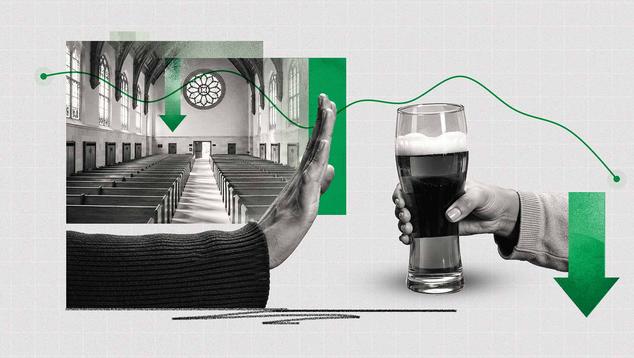
As Gallup recently reported, Americans’ use of alcohol is at its lowest point in history.
The question that follows, of course, is “Why the change?” There are numerous possible explanations. One of these involves religion.
At first glance, Gallup data on religion and drinking are counterintuitive. The country has become less religious overall. Yet, as I noted in a 2019 analysis, less religious Americans have historically been the most likely to drink. If changes in Americans' religiosity were a primary driver of alcohol use, we should have seen an increase in drinking, not a decrease.
That hasn’t happened. Alcohol use is down despite the increasing numbers of less religious (and historically more likely to drink) Americans.
The explanation for these trends lies in changes in drinking patterns among those who are less religious. Those who attend religious services less than weekly — a growing group that constitutes the significant majority of all Americans — are now reporting their lowest use of alcohol in our Gallup timeline.
Weekly church attendees’ alcohol use has also declined modestly from a relative high point in 2017-2022, although now back to levels recorded at times prior to that.
The size of the weekly church-attending group is relatively small, having shrunk from 30% of the adult population 15 years ago to about 20% today. Their modest decline in drinking behavior is thus mathematically less of a significant factor in the overall decline in drinking.
It is those who are less religious who are making a big difference. This group of people who attend church less frequently is large and growing, and it follows that their decline in alcohol use has the greatest impact on overall national rates of drinking.
Religious Identity
I highlighted the strong historical connection between religious identity and alcohol in my 2019 review of religion and drinking. As I reported, the three largest religious groups in America — Protestants, Catholics and those with no religious identity (“nones”) — differed significantly in their use of alcohol. Protestants were consistently less likely to say they had occasion to drink alcoholic beverages than either Catholics or nones. The differences varied somewhat from year to year. But the pattern was clear: Protestants were less likely to drink than those in the other two groups.
Fast forward to today. The distinction in drinking across religious groups has largely disappeared. Drinking among Protestants, historically the least likely to imbibe, hasn’t changed materially. But drinking among both Catholics and nones has declined. Unlike in the past, Protestants and Catholics are now identical in their alcohol use. Nones are just modestly higher.
The relative sizes of these groups have changed. As was the case with infrequent church attendees, nones have increased in size over the decades, nearly doubling over the past 15 years (to their current 25% of the adult population). Catholics are slightly less prevalent than in the past (now at about 20%). Protestants remain the largest religious group in the country (44%), but their numbers have declined from well above half of the population 15 to 20 years ago.
But these changes in group size don’t help explain the drop in alcohol use. If anything, the shrinking of Protestants and the expansion of nones could have been expected to result in an increase in drinking.
But, as we have seen, there are other forces at work. Drinking has dropped significantly within both the group of those who have no religious identity and, in particular, among Catholics. These declines are the most significant factor in the overall drop in drinking nationwide.
Impact of Moderate Drinking
There is another interesting pattern of note. As Gallup recently reported, Americans’ perceptions that moderate drinking is bad for one’s health are now near record highs.
This increase in negative perceptions of drinking is evident across Protestants, Catholics and nones. Each group is more likely now than in the past to perceive harm from moderate drinking. There is a little more spread among the groups now than in the past. Nones are now the most likely to say moderate drinking is unhealthy, followed by Catholics and then Protestants.
Weekly church attendees have historically been the most likely to say moderate drinking is harmful. Those who attend seldom or never were usually the least likely. In recent years, there has been a convergence of opinion. Negative perceptions of moderate drinking have risen among all three groups. The differences in these perceptions across the groups are now quite small.
In short, views that drinking is harmful have risen significantly across religious groups and across segments defined by their religiosity.
As we have seen, Catholics and nones are largely responsible for the drop in alcohol use. At the same time, nones and Catholics are now more likely than in the past to say that moderate drinking is harmful to health, even more so than among Protestants. Nones and Catholics appear to have “gotten religion” when it comes to drinking. Similarly, those who are less frequent church attendees — those whose alcohol use has dropped proportionally the most — are also now more likely to say alcohol is harmful.
Bottom Line
Relative changes in the size of religious groups don’t appear to be the explanation for why Americans are drinking less. In fact, it is the religious groups that historically have been most likely to drink alcohol that have grown the most.
What has happened is the shift in drinking within these groups, which may not be tied to religiosity at all. Those with no religious identity, Catholics and those who attend church services less than weekly all now report drinking less than they did in the past.
At the same time, perceptions that moderate drinking is harmful have risen broadly across religious groups, whether defined by religious identity or church attendance. This shift in attitudes, particularly among the large group of those historically less religious but historically most likely to drink, is plausibly one factor related to the overall decline in Americans’ drinking.
Stay up to date with the latest insights by following @Gallup on X and on Instagram.