GALLUP NEWS SERVICE
PRINCETON, NJ -- Rising oil prices have yet to affect Americans' assessment of the country's energy situation, because the public currently rates the energy situation as no more serious than in the past two years. However, Americans do show higher concern about the availability and affordability of energy than in the previous two years. The public still tilts toward conservation and environmental protection over increased energy production as ways to address the energy situation. George W. Bush's ratings for improving the nation's energy policy are now the worst of his presidency.
These results are based on Gallup's annual Environment poll, conducted March 7-10.
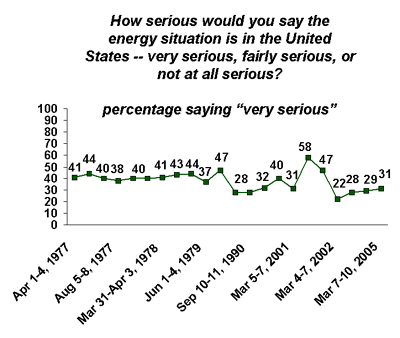
Thirty-one percent of Americans rate the "energy situation in the United States" as "very serious," little changed from the last two years, when 29% and 28%, respectively, said it was very serious. The only departure from that level of concern in recent years came in 2001. Rolling blackouts and rising gas prices caused 58% to assess the energy situation as very serious in May of that year.
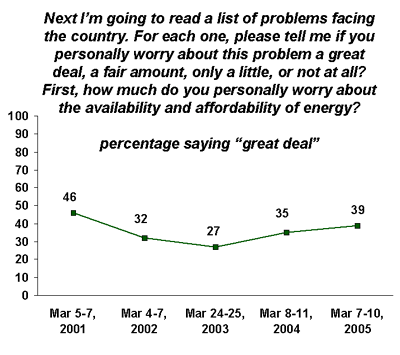
Overall, 39% of Americans say they worry "a great deal" about the "availability and affordability of energy." Twenty-six percent say they worry "a fair amount," 26% "only a little," and 8% "not at all."
That represents a slightly higher level of worry compared with last year's polling, and much higher than in 2003. Last year, 35% expressed a great deal of worry; in 2003, just 27% did so. Still, concern has not reached the same level it did in 2001, when 46% said they worried a great deal.
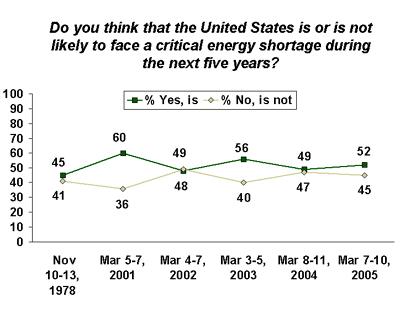
A slight majority of Americans, 52%, think the United States is "likely to face a critical energy shortage during the next five years." Forty-five percent disagree. Those numbers have fluctuated in recent years, reaching as high as 60% predicting a shortage (in 2001).
These assessments of the energy situation vary according to one's household income -- with those at lower income levels showing greater concern.
|
Views of Energy Situation by Household Income |
|||
|
|
Less than |
$30,000- |
$75,000 |
|
% |
% |
% |
|
|
Percentage who say energy situation is "very serious" |
39 |
32 |
26 |
|
Percentage who worry "a great deal" about energy availability/affordability |
48 |
40 |
29 |
|
Percentage who expect critical energy shortage in next five years |
62 |
53 |
44 |
Dealing With the Energy Situation
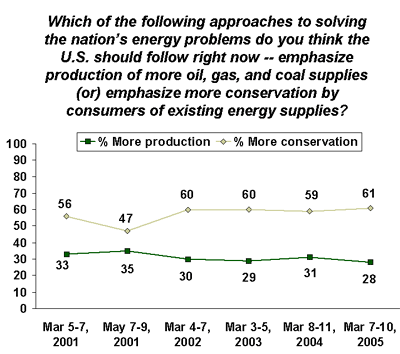
When asked to choose the proper approach to solving the nation's energy problems, the public is more likely to come down on the side of conservation and environmental protection than production and increasing energy supplies.
Consistent with past results, Americans by a 2-to-1 margin say the United States should emphasize greater consumer conservation of existing energy supplies (61%) rather than "production of more oil, gas, and coal supplies" (28%). The only deviation from that general pattern occurred in May 2001, when Americans favored conservation, but by a slimmer 47% to 35% margin.
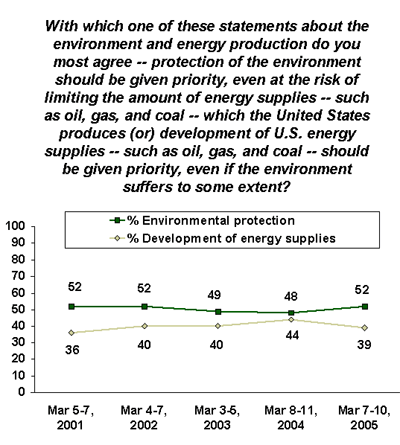
Americans do not show nearly the same level of consensus when asked to choose the higher priority between protecting the environment and development of energy supplies, but still side against increased development. In the latest poll, 52% say priority should be given to environmental protection, while 39% say development of energy supplies should get the higher priority. The latest results are marginally more pro-environment than in the past two years, and are about the same as the results in earlier years.
These attitudes are influenced by one's political orientation. Republicans come down much more on the side of production, while Democrats (as well as independents) fall more on the side of environmental protection. While all partisan groups show a preference for conservation over production to address the nation's energy problems, Democrats show the strongest margin in favor of it.
|
Energy Attitudes by Party Affiliation |
|||
|
|
Republican |
Independent |
Democrat |
|
Approach U.S. should follow |
|||
|
Conservation of existing supplies |
50% |
65% |
71% |
|
More production of oil, gas, coal |
37% |
25% |
22% |
|
|
|
|
|
|
Which should be given |
|||
|
Environmental protection |
33% |
60% |
65% |
|
Development of U.S. energy supplies |
58% |
30% |
27% |
Low Marks for Bush
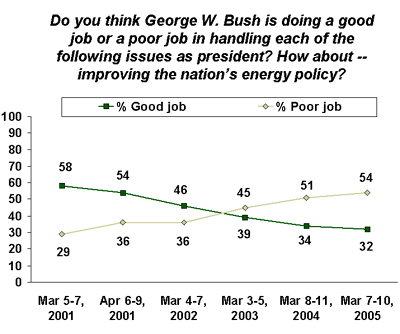
Public support for Bush's energy policy shows continued decline; his current ratings are the worst of his administration. Each time Gallup has asked whether Bush is doing a good job or a poor job of "improving the nation's energy policy," the percentage saying "a good job" has been lower than the previous time. Currently, just 32% say he is doing a good job, while 54% say he is doing a poor job.
Survey Methods
These results are based on telephone interviews with a randomly selected national sample of 1,004 adults, aged 18 and older, conducted March 7-10, 2005. For results based on this sample, one can say with 95% confidence that the maximum error attributable to sampling and other random effects is ±3 percentage points. In addition to sampling error, question wording and practical difficulties in conducting surveys can introduce error or bias into the findings of public opinion polls.
12. Next I'm going to read a list of problems facing the country. For each one, please tell me if you personally worry about this problem a great deal, a fair amount, only a little, or not at all? First, how much do you personally worry about -- [ITEMS A-J R READ IN RANDOM ORDER, ITEM L READ LAST]?
H. The availability and affordability of energy
|
|
Great |
Fair |
Only a |
Not |
No |
|
% |
% |
% |
% |
% |
|
|
2005 Mar 7-10 |
39 |
26 |
26 |
8 |
1 |
|
|
|
|
|
|
|
|
2004 Mar 8-11 |
35 |
28 |
25 |
11 |
1 |
|
2003 Mar 24-25 |
27 |
36 |
25 |
11 |
1 |
|
2002 Mar 4-7 |
32 |
30 |
29 |
9 |
* |
|
2001 Mar 5-7 |
46 |
31 |
16 |
6 |
1 |
|
* Less than 0.5% |
|||||
13. Do you think George W. Bush is doing a good job or a poor job in handling each of the following issues as president? How about -- [RANDOM ORDER]?
B. Improving the nation's energy policy
|
|
|
|
FAIR/ |
|
|
% |
% |
% |
% |
|
|
2005 Mar 7-10 |
32 |
54 |
7 |
7 |
|
|
|
|
|
|
|
2004 Mar 8-11 |
34 |
51 |
8 |
7 |
|
2003 Mar 3-5 |
39 |
45 |
7 |
9 |
|
2002 Mar 4-7 |
46 |
36 |
8 |
10 |
|
2001 Apr 6-9 ^ |
54 |
36 |
3 |
7 |
|
2001 Mar 5-7 ^ |
58 |
29 |
6 |
7 |
|
(vol.) = Volunteered response |
||||
24. With which one of these statements about the environment and energy production do you most agree -- [ROTATED: protection of the environment should be given priority, even at the risk of limiting the amount of energy supplies -- such as oil, gas and coal -- which the United States produces (or) development of U.S. energy supplies -- such as oil, gas and coal -- should be given priority, even if the environment suffers to some extent]?
|
|
Environment |
Development |
BOTH/ |
NEITHER/ |
No |
|
% |
% |
% |
% |
% |
|
|
2005 Mar 7-10 |
52 |
39 |
4 |
2 |
3 |
|
|
|
|
|
|
|
|
2004 Mar 8-11 |
48 |
44 |
3 |
1 |
4 |
|
2003 Mar 3-5 |
49 |
40 |
5 |
2 |
4 |
|
2002 Mar 4-7 |
52 |
40 |
3 |
2 |
3 |
|
2001 Mar 5-7 |
52 |
36 |
6 |
2 |
4 |
|
(vol.) = Volunteered response |
|||||
Now turning to the subject of energy,
26. How serious would you say the energy situation is in the United States -- very serious, fairly serious, or not at all serious?
|
|
Very |
Fairly |
Not at all |
No |
|
% |
% |
% |
% |
|
|
2005 Mar 7-10 |
31 |
56 |
10 |
3 |
|
|
|
|
|
|
|
2004 Mar 8-11 |
29 |
57 |
12 |
2 |
|
2003 Mar 3-5 |
28 |
59 |
11 |
2 |
|
2002 Mar 4-7 |
22 |
63 |
12 |
3 |
|
2001 Jun 28-Jul 1 |
47 |
43 |
8 |
2 |
|
2001 May 7-9 |
58 |
36 |
4 |
2 |
|
2001 Mar 5-7 |
31 |
59 |
9 |
1 |
|
1991 Feb 7-10 |
40 |
44 |
14 |
2 |
|
1990 Sep 27-30 |
32 |
46 |
19 |
3 |
|
1990 Sep 10-11 |
28 |
48 |
21 |
3 |
|
1990 Aug 9-12 |
28 |
45 |
23 |
4 |
|
1979 Aug 3-6 |
47 |
35 |
16 |
3 |
|
1979 Jun 1-4 |
37 |
36 |
24 |
3 |
|
1979 Apr 27-May 4 |
44 |
36 |
16 |
4 |
|
1979 Feb 23-26 |
43 |
42 |
13 |
2 |
|
1978 Mar 31-Apr 3 |
41 |
39 |
15 |
5 |
|
1977 Nov 18-21 |
40 |
42 |
14 |
4 |
|
1977 Sep 30-Oct 3 |
40 |
40 |
16 |
4 |
|
1977 Aug 5-8 |
38 |
43 |
13 |
6 |
|
1977 Jun 3-6 |
40 |
42 |
13 |
5 |
|
1977 Apr 29-May 2 |
44 |
40 |
11 |
5 |
|
1977 Apr 1-4 |
41 |
39 |
16 |
4 |
27. Which of the following approaches to solving the nation's energy problems do you think the U.S. should follow right now -- [ROTATED: emphasize production of more oil, gas and coal supplies (or) emphasize more conservation by consumers of existing energy supplies]?
|
|
More |
More |
BOTH/ |
NEITHER/ |
|
|
% |
% |
% |
% |
% |
|
|
2005 Mar 7-10 |
28 |
61 |
7 |
2 |
2 |
|
|
|
|
|
|
|
|
2004 Mar 8-11 |
31 |
59 |
6 |
2 |
2 |
|
2003 Mar 3-5 |
29 |
60 |
7 |
2 |
2 |
|
2002 Mar 4-7 |
30 |
60 |
6 |
2 |
2 |
|
2001 May 7-9 |
35 |
47 |
14 |
2 |
2 |
|
2001 Mar 5-7 |
33 |
56 |
8 |
1 |
2 |
|
(vol.) = Volunteered response |
|||||
28. Do you think that the United States is or is not likely to face a critical energy shortage during the next five years?
|
|
|
|
ALREADY |
No |
|
% |
% |
% |
% |
|
|
2005 Mar 7-10 |
52 |
45 |
* |
3 |
|
|
|
|
|
|
|
2004 Mar 8-11 |
49 |
47 |
1 |
3 |
|
2003 Mar 3-5 |
56 |
40 |
1 |
3 |
|
2002 Mar 4-7 |
48 |
49 |
1 |
2 |
|
2001 Mar 5-7 |
60 |
36 |
1 |
3 |
|
1978 Nov 10-13 |
45 |
41 |
4 |
10 |
|
* Less than 0.5% |
||||
|
(vol.) = Volunteered response |
||||