GALLUP NEWS SERVICE
PRINCETON, NJ -- A new CNN/USA Today/Gallup survey of current New Orleans residents reveal that Hurricane Katrina had a profound impact on their personal financial situations. Roughly 6 in 10 residents say they suffered major financial losses, including one in three who report losing everything they had. The poll indicates that black residents suffered more profoundly than whites. Most residents who were working before the hurricane are working now, though a significant number are without work. Seven in 10 residents have filed insurance claims, and though many are dissatisfied with the way their claims have been handled, a relatively small proportion believe they are being cheated by the insurance companies.
The Feb. 18-26, 2006 poll interviewed a random sample of adults currently living in the city of New Orleans. Respondents were contacted on landline telephones and cellular telephones, since many areas of the city still do not have working telephone service in their homes five months after Hurricane Katrina devastated the city.
Personal Financial Situation
When asked to assess the impact of Hurricane Katrina on their personal financial situation, 32% of those surveyed say they "lost everything." An additional 27% say they "took a major financial hit but did not lose everything." Twenty-eight percent suffered "some financial losses but nothing major," and 13% say they were not "hurt that much by the hurricane."
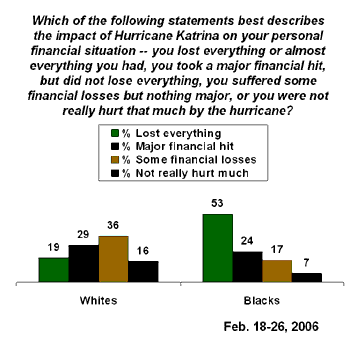
Many of the media news images following the hurricane suggested that blacks in New Orleans were more severely affected by Katrina than whites. The poll provides strong support for this notion -- a majority of blacks, 53%, say they lost everything following Katrina, compared with just 19% of whites.
Differences are also evident by respondents' 2004 household incomes. Among those whose income two years ago was less than $50,000, 44% say they lost everything, compared with just 20% of those whose 2004 income was $50,000 or more.
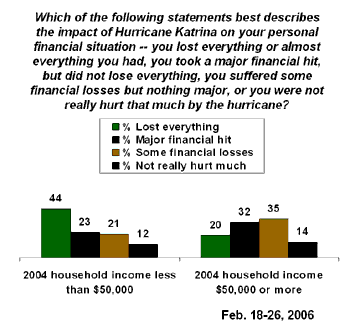
While race and income tend to be correlated, the data suggest that income has an independent effect beyond that of race, though even at similar income levels, blacks appear to have suffered more than whites.
Job Situation
Seventy-five percent of those surveyed indicated they were working before Hurricane Katrina; now, 58% say they are working. In addition to the 17% who are unemployed since the hurricane, an additional 7% are currently working, but in a job not as good as what they had before the hurricane.
Most working New Orleans residents, however, are still in the same job they were at before the hurricane. Many others are in a new job, but one that is just as good as the job they had before Katrina.
|
New Orleans' Residents Self-Reported Job Situation |
||
|
|
Working |
|
|
% |
% |
|
|
Employed before Katrina |
75 |
100 |
|
(Working in same job) |
(44) |
(58) |
|
(Working in new job, as good as old one) |
(7) |
(10) |
|
(Working in new job, not as good as old one) |
(7) |
(10) |
|
(Not working) |
(17) |
(22) |
|
|
|
|
|
Not employed before Katrina |
25 |
-- |
Again, blacks seem to have been affected more by the hurricane. While 71% of whites are working now in the same job they were before Hurricane Katrina, only 42% of blacks can say the same. Blacks who were employed before the hurricane are more than twice as likely as whites to be currently out of work.
|
New Orleans' Residents Self-Reported Job Situation By Race |
||
|
Whites |
Blacks |
|
|
% |
% |
|
|
Employed before Katrina |
100 |
100 |
|
(Working in same job) |
(71) |
(42) |
|
(Working in new job as good as old one) |
(7) |
(11) |
|
(Working in new job not as good as old one) |
(7) |
(11) |
|
(Not working) |
(15) |
(34) |
|
(No answer) |
(--) |
(2) |
Recovering the Losses
The poll asked respondents whether they have tried to file any insurance claims to recover losses from the hurricane and 72% say they have. Of these, more are dissatisfied (56%) than satisfied (44%) with the response of their insurance companies. But only about one in four New Orleans residents who have filed an insurance claim believe they are being "cheated" by their insurance company, while the remainder think the insurer is doing a bad job with the claim, or are satisfied with the insurer's work.
Do you feel like the insurance company has cheated you out of money you deserve, or do you feel like the insurance company has not cheated you but is doing a bad job of handling your claim?
BASED ON ADULTS WHO HAVE TRIED TO FILE INSURANCE CLAIMS
|
2006 Feb 18-26 |
|
|
% |
|
|
Satisfied |
44 |
|
|
|
|
Dissatisfied |
56 |
|
(Being cheated) |
(24) |
|
(Not being cheated) |
(32) |
|
|
|
|
No opinion |
1 |
New Orleans residents who had greater financial means before the hurricane are significantly more likely to have filed an insurance claim -- 83% of those with 2004 household incomes of $50,000 or more have done so, compared with 61% of those with incomes of less than $50,000.
While there are essentially no differences by income in regards to whether people are satisfied with the way their claims have been handled, there are significant differences by race. Fifty-two percent of whites who have filed claims are satisfied with how they have been handled, compared with just 31% of blacks who have made claims. Blacks and whites who have made claims are about as equally likely to say they felt cheated by the insurance company. Therefore, the satisfaction differences observed between whites and blacks are not due to a sense of being denied a legitimate claim, but, instead, the perception of the job the insurance companies are doing in handling those claims.
Survey Methods
These results are based on telephone interviews with a randomly selected sample of 800 adults, 18 years and older, who are currently living in the city of New Orleans, conducted Feb. 18-26, 2006. For results based on this sample, one can say with 95% confidence that the maximum error attributable to sampling and other random effects is ±4 percentage points. Respondents were contacted on both landline telephones and cellular telephones. The sample was weighted to adjust for the likelihood that a person would be included in the sample based on the number of telephone lines they have and the number of people who use those lines. In addition to sampling error, question wording and practical difficulties in conducting surveys can introduce error or bias into the findings of public opinion polls.
10. Which of the following statements best describes the impact of Hurricane Katrina on your personal financial situation -- [ROTATED: you lost everything or almost everything you had, you took a major financial hit, but did not lose everything, you suffered some financial losses but nothing major, you were not really hurt that much by the hurricane]?
|
Lost |
Major |
Some |
Not |
No |
|
|
% |
% |
% |
% |
% |
|
|
2006 Feb 18-26 |
32 |
27 |
28 |
13 |
* |
|
*Less than 0.5% |
|||||
11. Have you tried to file any insurance claims for losses you suffered as a result of Hurricane Katrina, or not?
|
Yes |
No |
No |
|
|
% |
% |
% |
|
|
2006 Feb 18-26 |
72 |
28 |
* |
|
*Less than 0.5% |
|||
12. Are you satisfied or dissatisfied with the way your insurance companies have handled these claims?
BASED ON 579 ADULTS WHO HAVE TRIED TO FILE INSURANCE CLAIMS FOR LOSSES SUFFERED AS A RESULT OF HURRICANE KATRINA
|
Satisfied |
Dissatisfied |
No |
|||
|
% |
% |
% |
|||
|
2006 Feb 18-26 |
44 |
56 |
1 |
||
13. Do you feel like the insurance company has cheated you out of money you deserve, or do you feel like the insurance company has not cheated you but is doing a bad job of handling your claim?
COMBINED RESPONSES (Q.12-13): BASED ON ADULTS WHO HAVE TRIED TO FILE INSURANCE CLAIMS
|
2006 Feb 18-26 |
|
|
% |
|
|
Satisfied |
44 |
|
|
|
|
Dissatisfied |
56 |
|
(Being cheated) |
(24) |
|
(Not being cheated) |
(32) |
|
|
|
|
No opinion |
1 |
Turning now to your employment situation,
15. Did you, personally, have a job immediately before Hurricane Katrina hit, or not?
|
Yes |
No |
No |
|
|
% |
% |
% |
|
|
2006 Feb 18-26 |
75 |
25 |
* |
16. Which best describes your current employment situation -- [ROTATED: you are still at the same job you had before Hurricane Katrina hit, you have a new job that is just as good as the job you had before the hurricane, you have a new job, but one that is not as good as the job you had before the hurricane, (or) you do not have a job at the present time]?
BASED ON 604 ADULTS WHO WERE EMPLOYED BEFORE HURRICANE KATRINA
|
Same |
New job, |
New job, |
No job |
No |
|
|
% |
% |
% |
% |
% |
|
|
2006 Feb 18-26 |
58 |
10 |
9 |
22 |
* |
|
*Less than 0.5% |
|||||
COMBINED RESPONSES (Q.15-16): BASED ON FULL SAMPLE
|
2006 Feb 18-26 |
|
|
% |
|
|
Working in same job as before hurricane |
44 |
|
|
|
|
Working in new job since hurricane |
14 |
|
(Just as good as old job) |
(7) |
|
(Not as good as old job) |
(7) |
|
|
|
|
Not working now, working before hurricane |
17 |
|
|
|
|
Not working before hurricane |
25 |
|
|
|
|
No opinion |
* |
|
*Less than 0.5% |
|
