GALLUP NEWS SERVICE
PRINCETON, NJ -- The Commerce Department reported Tuesday that single-family housing starts fell 12% last month. Privately owned housing starts fell 7.8% to the lowest level since March 2005, while new building permits fell 5.5%. At the same time, the Labor Department reported that wholesale prices rose 0.5% last month as oil and gasoline prices are approaching new record highs.
Does all this suggest that the "housing bubble" is finally ready to burst? New findings from the April Experian/Gallup Personal Credit Index survey suggest that many Americans believe this may well be the case.
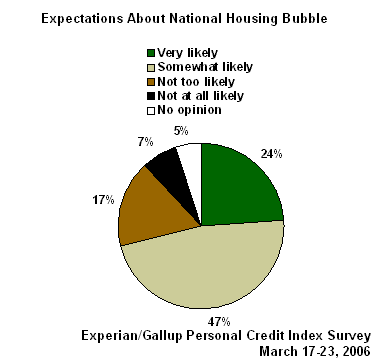
National Housing Bubble
Increasing mortgage rates and a growing inventory of unsold homes likely has many U.S. consumers wondering about whether the sharp increase in housing prices over recent years -- the "housing bubble" -- will burst at some point during the coming year. Seventy-one percent of consumers believe it is very likely (24%) or somewhat likely (47%) that housing prices will collapse in housing markets across the nation as a whole within the next year, according to the April Experian/Gallup Personal Credit Index survey.
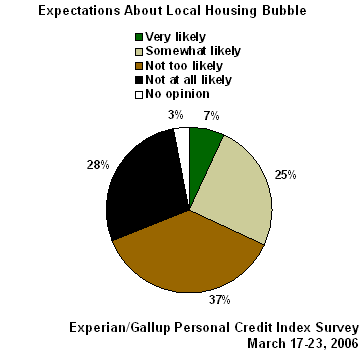
Local Housing Bubble
Consumers are far less pessimistic when it comes to their local housing markets. Only 32% of consumers think it is very likely (7%) or somewhat likely (25%) that their local areas will experience a housing bubble in the next year. For that matter, 28% of consumers say such an eventuality is not at all likely.
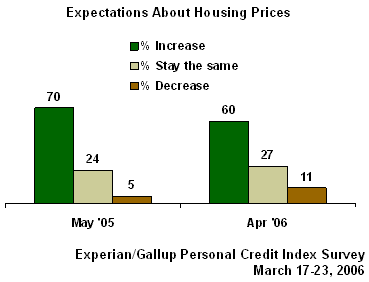
Local Housing Prices
Overall, most consumers remain optimistic about the future trend of housing prices in their local markets. While about one in three consumers feel a housing bubble could burst in their local areas, only 11% say housing prices in their local market will decline over the next year. Another 27% expect housing prices to stay the same. Still, 6 in 10 consumers expect housing prices to increase in their local areas. While these expectations are less optimistic than those observed a year ago, they likely do not reflect a belief that bubble-bursting in selected markets across the nation will lead to a widespread decline in housing prices.
Consumer Pessimism Concerning Housing May Be Warranted
Housing has been one of the key drivers of economic activity in the United States over the past several years. Building new homes not only creates jobs but also stimulates the purchase of a variety of consumer durables including appliances and home furnishings. More importantly, the growth of housing equity has had a pronounced wealth effect not only on consumer spending, but also on consumer borrowing.
Currently, the housing sector is under assault from the double-whammy of increasing interest rates and surging energy prices. As might be expected, housing activity is slowing as consumers pull back from making major long-term commitments in the face of such economic pressures.
Still, even in today's housing market, short-term adjustments may only represent a first-stage effect. For example, soaring gas prices could significantly affect the price of houses built far away from major employment areas while simultaneously increasing prices close to where people work. Even the size and construction of housing could be affected as consumer expectations about the potential cost of heating and cooling their homes increases.
The most significant impact, however, may involve the effect of a housing slowdown on the overall U.S. economy. A significant economic slowdown during the second half of this year could lay bare many of the housing finance excesses of the past several years. In turn, this could make the pessimism 7 in 10 consumers have about the potential for a bursting of the housing bubble seem prescient later this year.
Survey Methods
Results for the Experian/Gallup Personal Credit Index poll are based on telephone interviews with 1,004 adults, aged 18 and older, conducted March 17-23, 2006. For results based on the total sample, one can say with 95% confidence that the margin of sampling error is ±3 percentage points.