GALLUP NEWS SERVICE
PRINCETON, NJ -- President George W. Bush's announcement yesterday that Goldman Sachs executive Henry Paulson would become the nation's Treasury Secretary has been widely construed as an acknowledgement that Americans continue to remain negative about the U.S. economy. The White House presumably believes that new blood in the Treasury Department may lead to a more positive outlook on the economy.
It seems appropriate, therefore, to review recent Gallup Poll data measuring the public's economic attitudes. The review suggests that Paulson has four major challenges and/or opportunities as far as U.S. public opinion is concerned:
1. The American public is simply not convinced that the economy is in good shape, or that economic conditions are getting better.
Gallup's monthly assessment of consumer attitudes continues to show that Americans are pessimistic about the direction of the economy. There has been no improvement in Americans' assessment of either current or future economic conditions. Consumer confidence may rebound at some point, but there is little evidence of any trend in this direction at this time.
Here are the trends for two key questions that Gallup tracks on a monthly basis:
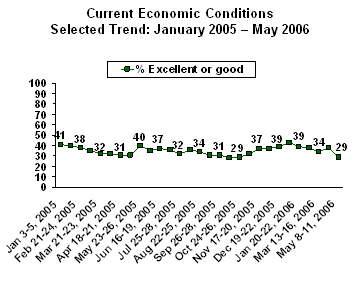
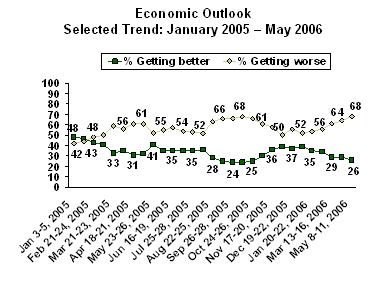
The "getting better"/ "getting worse" chart is particularly telling and encapsulates the challenge facing any official attempting to convince Americans that things are looking positive in terms of the economy. About two-thirds of Americans said in mid-May that the U.S. economy was getting worse, while just about one-quarter said it was getting better.
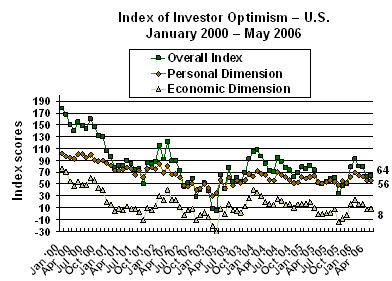
The attitudes of investors interviewed in May as part of the UBS/Gallup Index of Investor Optimism were similarly negative. Although the Index has been lower at times, particularly in 2003 and after Hurricane Katrina last year, the current value of 64 is down from late last year and is in significantly negative territory.
2. There is one bright spot in Americans' economic assessment: the employment picture.
Gallup's question asking whether or not it is a good time or a bad time to find a quality job shows a positive trend:
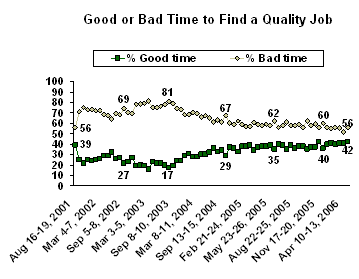
This acknowledgement that the job market may be perking up is also borne from looking at other explanations given by those who say that the economy is mostly good:
What are some of the reasons you think current economic conditions are mostly good? [OPEN-ENDED]
|
2006 May 22-24 |
|
|
% |
|
|
Job availability/Unemployment down |
47 |
|
Consumers are spending/buying more |
12 |
|
Economy is improving |
11 |
|
Stock market is up/Stocks doing well |
11 |
|
Housing/real estate is booming |
7 |
|
New business growth/Businesses are growing |
6 |
|
Interest rates are good for buying/relatively low |
5 |
|
U.S. is richest country in the world |
4 |
|
Inflation is low/being held to a minimum |
4 |
|
Education is improving |
4 |
|
Gas prices have not hurt economy |
2 |
|
Tax cuts/breaks |
2 |
|
More building/construction taking place |
2 |
|
|
|
|
Other |
9 |
|
Nothing in particular |
1 |
|
No opinion |
8 |
|
Percentages add to more than 100% due to multiple responses |
|
The bad news for economic policy makers at this point is that improved perceptions about the labor market are apparently not yet filtering into Americans' broader views about the economy. Still, the fact that at least some Americans acknowledge that the employment picture may be getting better suggests that the new Treasury Secretary may have a modestly positive baseline to work with in his efforts to increase consumer confidence.
3. The high price of gas is a significant part of the explanation for Americans' dour mood on the economy.
While unemployment has occasionally been a pivotal factor in determining consumer confidence -- declining employment sent consumer confidence tumbling in the fall of 2001, immediately before the 9/11 attacks changed Americans' focus -- it appears that gas prices are the preeminent factor at work in the formation of these attitudes today.
A recent Gallup Poll asked Americans viewing the economy as "mostly bad" to explain why, with the following responses:
What are some of the reasons you think current economic conditions are mostly bad? [OPEN-ENDED]
|
2006 May 22-24 |
|
|
% |
|
|
Fuel/oil prices |
26 |
|
Unemployment/jobs |
21 |
|
Inflation/rising costs |
14 |
|
Outsourcing of jobs |
10 |
|
Lack of money |
9 |
|
Gap between the rich and poor |
8 |
|
Federal budget deficit |
5 |
|
George Bush's policies |
4 |
|
War in Iraq/Cost of the war |
4 |
|
Poorly run government/politics |
3 |
|
Healthcare/Health insurance costs |
3 |
|
Companies closing/No growth |
3 |
|
Credit card/Overspending |
3 |
|
Interest rates |
3 |
|
Illegal immigrants |
2 |
|
Taxes |
2 |
|
Social Security |
2 |
|
Poverty/Hunger/Homelessness |
1 |
|
Foreign aid/Focus on other countries |
1 |
|
Education reform |
1 |
|
Trade deficit |
1 |
|
Stock market |
1 |
|
Welfare |
* |
|
International relations |
* |
|
Security/Threat of terrorism |
* |
|
Senior care/Medicaid/Medicare coverage |
* |
|
Retirement |
* |
|
|
|
|
Other |
8 |
|
Nothing in particular |
* |
|
No opinion |
4 |
|
* Less than 0.5% |
|
|
Percentages add to more than 100% due to multiple responses |
|
Gas prices are the number one reason given for these negative views.
The impact of high gas prices is also evident in response to a recent question asking Americans to name the most important financial problem facing their family today:
What is the most important financial problem facing your family today? [OPEN-ENDED]
|
May |
Apr |
Feb |
Dec |
Nov |
Oct |
|
|
% |
% |
% |
% |
% |
% |
|
|
Energy costs/Oil and gas prices |
20 |
12 |
8 |
14 |
11 |
17 |
|
Healthcare costs |
17 |
18 |
17 |
15 |
16 |
12 |
|
Lack of money/Low wages |
14 |
12 |
11 |
12 |
11 |
11 |
|
College expenses |
9 |
8 |
8 |
7 |
8 |
6 |
|
Too much debt/Not enough money to pay debts |
8 |
9 |
9 |
7 |
7 |
7 |
|
Retirement savings |
7 |
6 |
7 |
5 |
5 |
4 |
|
Cost of owning/renting a home |
7 |
7 |
7 |
5 |
5 |
5 |
|
High cost of living/Inflation |
6 |
5 |
6 |
4 |
5 |
6 |
|
Taxes |
5 |
4 |
5 |
4 |
4 |
4 |
|
Unemployment/Loss of job |
3 |
3 |
6 |
6 |
8 |
6 |
|
Lack of savings |
2 |
5 |
2 |
2 |
2 |
1 |
|
Social Security |
2 |
1 |
1 |
1 |
* |
1 |
|
Interest rates |
1 |
2 |
1 |
1 |
1 |
1 |
|
Transportation/commuting costs |
1 |
* |
* |
1 |
1 |
1 |
|
Stock market/investments |
1 |
1 |
* |
* |
1 |
1 |
|
State of the economy |
1 |
1 |
* |
1 |
1 |
2 |
|
Controlling spending |
* |
1 |
1 |
1 |
1 |
* |
|
|
|
|
|
|
|
|
|
Other |
2 |
4 |
3 |
3 |
5 |
3 |
|
None |
15 |
14 |
13 |
16 |
14 |
16 |
|
No opinion |
2 |
4 |
4 |
2 |
4 |
3 |
|
* Less than 0.5% |
||||||
|
Percentages add to more than 100% due to multiple responses |
||||||
|
Contact Gallup for full trend |
||||||
Energy costs are the number one category of answers given in response to this question, having returned to that spot from lower levels earlier this year.
4. Views of the economy are driven to a significant degree by politics. In a polarized political environment, Democrats simply cannot bring themselves to be positive about the economy.
Here are the most recent responses to Gallup's two basic questions about the economy, broken out by respondents' party identification:
|
Rate the Current Economy |
|||
|
Republican |
Independent |
Democrat |
|
|
% |
% |
% |
|
|
Excellent/Good |
52 |
23 |
16 |
|
Only fair |
35 |
47 |
52 |
|
Poor |
12 |
30 |
32 |
|
|
|||
|
Republican |
Independent |
Democrat |
|
|
% |
% |
% |
|
|
Getting better |
46 |
22 |
13 |
|
Getting worse |
46 |
72 |
81 |
This type of political polarization of economic views (and views of many other issues) is not new; Democrats were more positive about the economy when Bill Clinton was president, for example, and Republicans were more positive than Democrats when George H.W. Bush was president. Still, the high level of polarization today is clearly a factor in dragging down the overall level of optimism about the U.S. economy.
In some ways this suggests that a solution for the negative state of consumer confidence may actually lie in terms of solutions to some of the other problems currently troubling the public. Recent Gallup research shows that Americans believe that the Iraq war is the top problem facing the country today and should be the number one priority for the President and Congress to address. More positive attitudes about Iraq might shore up the president's overall approval numbers, which in turn might lead to a situation in which Democrats are less likely to react negatively to questions about the country's economy.
Survey Methods
These results are based on telephone interviews with 1,003 national adults, aged 18 and older, conducted May 22-24, 2006. Respondents were randomly drawn from Gallup's household panel, which was originally recruited through random selection methods. Gallup Panel households are sampled in such a way as to yield an initial sample that is demographically representative of the U.S. adult population. The final sample after interviewing is weighted so that it is also demographically representative of the U.S. adult population. In addition to sampling error, question wording and practical difficulties in conducting surveys can introduce error or bias into the findings of public opinion polls.
Results are also based on randomly selected national samples of approximately 1,000 adults, aged 18 and older, conducted in January 2005, January 2006, and April 28-May 11, 2006.
For results based on these combined samples, one can say with 95% confidence that the maximum error attributable to sampling and other random effects is ±2 percentage points. Margins of errors for subgroups will be higher.
In addition to sampling error, question wording and practical difficulties in conducting surveys can introduce error or bias into the findings of public opinion polls.