GALLUP NEWS SERVICE
PRINCETON, NJ -- Hamas' victory in the Palestinian elections earlier this year -- a mostly unexpected development that has provoked Israel's ire and thrown Palestinian politics into progressive disarray -- has arrested what little life there was in the Israeli/Palestinian peace process. The Israeli and Palestinian governments are as intractable as ever in their rival demands for unconditional recognition, and an escalating cycle of attacks and counterattacks are making peace discussions practically impossible. Intervention from a trusted third party seems crucial for breaking the juggernaut.
But this has usually been in partnership with willing participants. Today, even the United States is not prepared to sit at the negotiating table as long as Hamas, which the United States considers a terrorist organization, is representing the Palestinians.
Complicating the U.S. position at this thorny time is the great imbalance in the way the United States is viewed by both sides. Recent Gallup World Poll surveys in Israel and Palestine document the deep animosity that Palestinians feel toward the United States and toward President George W. Bush in particular. Israelis, by contrast, have mostly favorable views of the United States. And while this is not new, Gallup trends in the region document that the pattern has intensified in recent years.
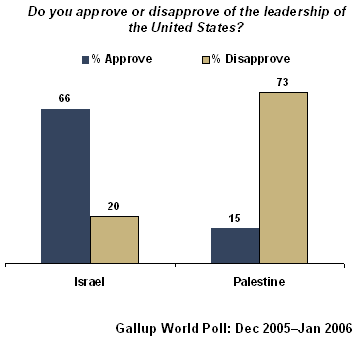
According to Gallup World Poll surveys conducted in December 2005, and January 2006, two-thirds of Israelis (66%) approve of the leadership of the United States, compared with only 15% of Palestinians.
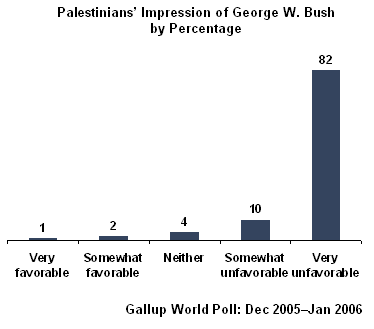
When asked specifically about Bush, only a small fraction of Palestinians -- 3% -- are willing to say they have a favorable view of him. More than 9 in 10 have an unfavorable view of Bush, most of whom (82%) say their impression is "very unfavorable."
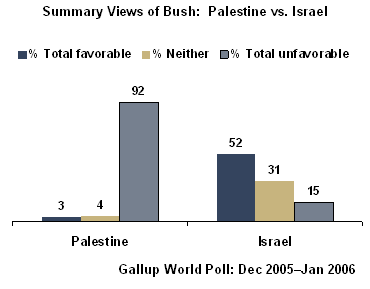
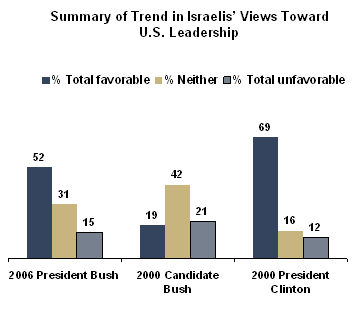
Israelis are not nearly as unanimous in endorsing Bush as Palestinians are in denouncing him, but they are significantly more positive. In fact, more than half of Israelis (52%) have a favorable view of Bush; another 31% are neutral, while only 15% have an unfavorable view.
Palestinian Hostility Toward Bush Has Grown
A Gallup survey conducted in the Palestinian territories in the summer of 2000, just prior to the commencement of the 2000 Palestinian uprising against the Israeli occupation called the al-Aqsa intifada, found Palestinians much less hostile toward Bush than they are today. (Bush was then the Republican nominee for president.) While only 3% had a favorable impression of Bush in 2000, just 51% had a very unfavorable impression of him while 23% had a somewhat unfavorable impression.
Palestinian attitudes of Bush in 2000 were similar to those of then-President Bill Clinton at the same time. Thus, the relatively less negative ratings of Bush in 2000 were not merely a function of him not being the U.S. president, but reflective of a time when Palestinians were generally less negative toward the United States.
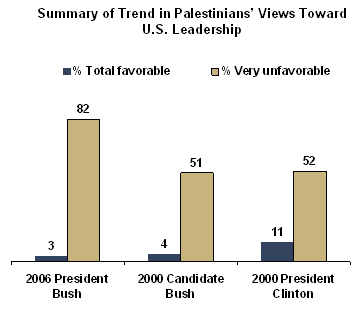
Over the same period, as Bush and his Middle East policies have become better known, Israelis' attitudes toward him have become largely favorable (from 19% favorable in 2000 to 52% favorable today). Bush is still not viewed as positively by Israelis as was Bill Clinton in 2000 (69% favorable).
United States' Split Image as Honest Broker
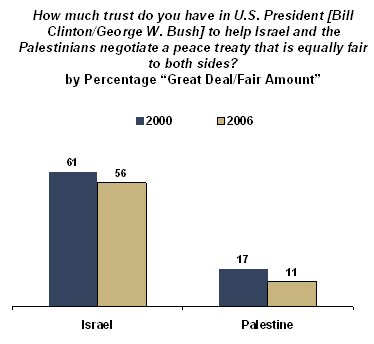
Overall, most Israelis express confidence in the U.S. president "to help Israel and the Palestinians negotiate a peace treaty that is equally fair to both sides." Most Palestinians say they have no confidence in the United States to do this.
Present confidence is a bit lower in both countries compared with 2000. The percentage in Palestine saying they have either a "great deal" or "fair amount" has dipped from 17% to 11%. In Israel, it has declined from 61% to 56%.
Despite its image problem among the Palestinians, the United States is likely to remain the main peace broker in the Middle East by virtue of its leading position in world affairs, and because of the influence the United States has with both sides through foreign aid. Also, it is not clear who the alternative mediator would be if not the United States. As negatively as the Palestinians feel about the United States, no other major power rated in the Gallup World Poll -- including the United Kingdom, France, Russia, China, or Egypt gets their approval.
And to put Palestinian opinion of the United States in context, the Gallup World Poll finds a similarly low percentage of Western Europeans approving of U.S. leadership (19% in Western Europe vs. 15% in Palestine). But because a sizeable number in Western Europe have no opinion on this (26%) only 54% say they disapprove of U.S. leadership, compared with about three-quarters of Palestinians.
Survey Methods
Palestinian results are based on face-to-face interviews with a nationally representative sample of 1,000 Palestinians, aged 15 and older, conducted Dec. 26, 2005, through Jan. 8, 2006. Respondents were interviewed in 52 sampling points throughout the West Bank (including East Jerusalem) and the Gaza Strip. Interviews were conducted in Arabic. Households were selected at random, and respondents within households were chosen at random according to Kish tables.
Israeli results are based on face-to-face interviews with a nationally representative sample of 1,002 Israelis, aged 15 and older, conducted Jan. 5-23, 2006. Respondents were interviewed in 120 sampling points throughout Israel. Interviews were conducted in Hebrew, Arabic, and Russian. Households were selected at random, and respondents within households were chosen at random according to Kish tables.
For results based on these samples, one can say with 95% confidence that the maximum error attributable to sampling and other random effects is ±3 percentage points. In addition to sampling error, question wording and practical difficulties in conducting surveys can introduce error or bias into the findings of public opinion polls.