GALLUP NEWS SERVICE
PRINCETON, NJ -- The final minutes of 2006 are ticking off the clock, and that is something the American public seems to be excited about. Most Americans -- nearly 9 in 10 -- say they are more excited to see the year 2007 arrive than they are sad to see the year 2006 go, according to a recent Gallup Panel poll. A majority of Americans also say they will stay awake until midnight to ring in the New Year. Young adults, non-married Americans, parents of young children, and those residing in urban or suburban communities are particularly interested in staying up to celebrate the arrival of 2007.
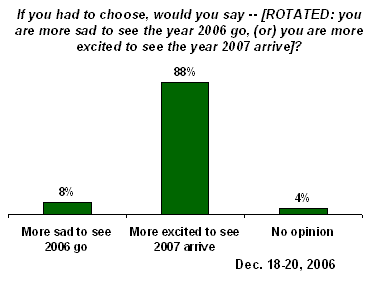
The Dec. 18-20 Gallup Panel survey finds that, by an 88% to 8% margin, Americans are more excited to see the year 2007 arrive than they are sad to see the year 2006 go.
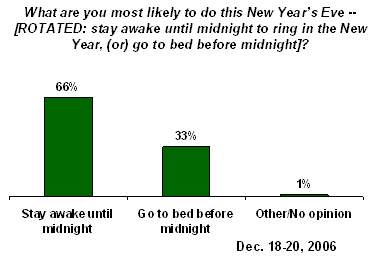
Two in three Americans (66%) also report that they plan to stay awake until midnight to ring in the New Year, while 33% say they will go to bed before midnight.
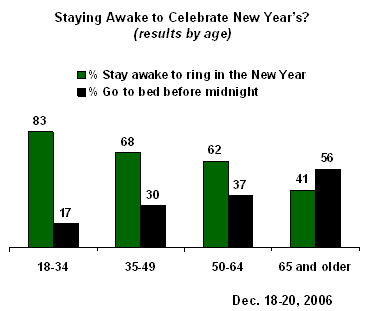
Elderly Americans may be nodding off a little too early to toast the New Year this year. Only 41% of adults aged 65 and older tell Gallup they will stay awake until midnight to celebrate the New Year this year. This compares with 83% of 18- to 34-year-olds, 68% of 35- to 49-year-olds, and 62% of 50- to 64-year-olds.
Men (65%) and women (66%) are equally likely to say they will stay awake until midnight to ring in the New Year.
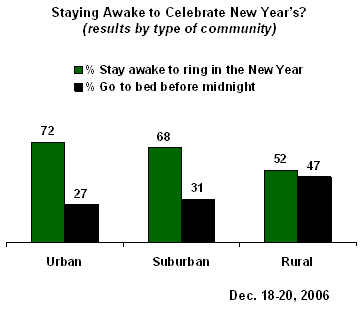
Staying awake to ring in the New Year is more appealing to Americans residing in urban or suburban communities more so than to those living in rural communities. Roughly 7 in 10 Americans living in urban (72%) or suburban (68%) communities say they will stay up until midnight this New Year's Eve. Only about half of those residing in rural areas (52%) say they will do this on New Year's.
Survey Methods
Results for this panel study are based on telephone interviews with 1,013 national adults, aged 18 and older, conducted Dec. 18-20, 2006. Respondents were randomly drawn from Gallup's nationally representative household panel, which was originally recruited through random selection methods. For results based on the total sample of national adults, one can say with 95% confidence that the maximum margin of sampling error is ±4 percentage points. In addition to sampling error, question wording and practical difficulties in conducting surveys can introduce error or bias into the findings of public opinion polls.