GALLUP NEWS SERVICE
PRINCETON, NJ -- Housing activity has plummeted over the past year as sales have slowed and housing prices have leveled off. Single-family housing starts ended 2006 down 25% from the end of 2005 according to the Commerce Department. Sales of previously owned homes were down 8.4% last year from 2005 -- the biggest drop in 17 years -- and the average price of an existing home in December 2006 was $222,000 -- unchanged from December 2005 -- according to the National Association of Realtors.
Still, many on Wall Street suggest the residential real estate markets have already hit bottom and that now is the time to get out in front of the housing recovery. In fact, the Federal Open Market Committee (FOMC) noted as it ended its meeting last week, "…some tentative signs of stabilization have appeared in the housing market." Something of a tepid endorsement on the part of the FOMC as far as the housing market is concerned, but clearly encouraging to the housing bulls on Wall Street trying to anticipate a housing sector recovery.
Have local residential real estate markets actually hit bottom thereby laying the foundation for a housing recovery? In fact, a new Experian/Gallup Personal Credit Index (PCI) poll suggests just the opposite as many consumers remain concerned about the potential for a housing price collapse in their local residential real estate markets.
Potential Local Housing Bubble Induced Housing Price Collapse
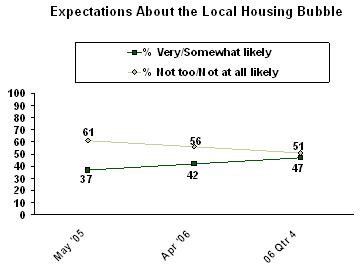
In sharp contrast to growing optimism about the housing markets in some investor circles, the new Experian/Gallup PCI poll shows nearly half of U.S. consumers (47%) say they think it is very likely (16%) or somewhat likely (31%) that their local residential real estate price bubble will burst, leading to a collapse of housing prices in their local residential real estate market during the next three years. This is up from the 37% of Americans who felt this way in May 2005 and the 42% who held this opinion in April 2006.
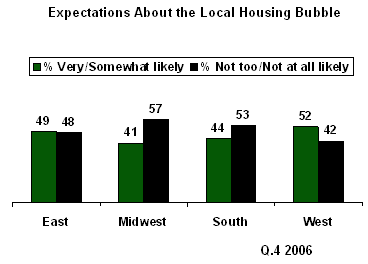
Fears of a potential housing bubble induced residential real estate price collapse are greatest in the West (52%) and the East (49%). Consumers with annual household incomes of $75,000 or more are somewhat less fearful of a collapse in housing prices (42%) than are those with incomes of $40,000 a year but less than $75,000 a year (50%) or those making less than $40,000 a year (48%). Renters think such a drop in housing prices is more likely (57%) than do homeowners (43%).
Local Housing Prices in the Next 12 Months
While many consumers fear a housing price collapse during the next few years, fewer say it will occur within the next year. Eighteen percent expect housing prices to fall in their local markets over the next 12 months. Another 33% expect housing prices to remain unchanged, while 47% of consumers expect housing prices to increase in their local areas over the next 12 months. Still, these expectations are far less optimistic about short-term housing prices than those of April 2006 when only 11% of consumers expected housing prices to decline within 12 months, 60% expected them to increase. The current one-year forecast is even dimmer than May 2005, when only 5% of consumers expected their local housing prices to decline and 70% expected them to increase in the next 12 months.
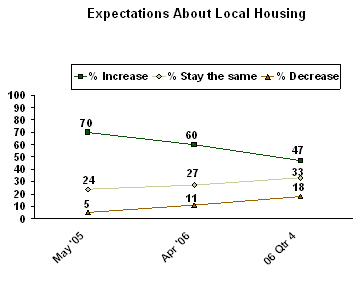
Expectations for a decrease in average housing prices are greatest in the West (23%) and the East (22%) -- areas experiencing the sharpest run-up in prices during recent years -- and less pronounced in the Midwest (16%) and the South (11%). Twenty percent of consumers with annual household incomes of $75,000 or more say they expect housing prices to decline over the coming year, compared with 18% of those with incomes of $40,000 a year but less than $75,000 a year and 15% of those making less than $40,000 a year.
Can the U.S. Economy Grow If Housing Continues to Weaken?
New preliminary GDP estimates show the U.S. economy expanding at a faster-than-expected 3.5% annual rate during the fourth quarter of 2006 and January's employment report shows the economy continues to grow new jobs. The fact that the economy showed such strong growth, even as the investment in housing fell 19.2% during the fourth quarter, has many wondering about how important housing is to expansion of the U.S. economy in 2007.
Still, housing has been one of the key drivers of economic activity in the United States over the past several years. Building new homes not only creates jobs but also stimulates the purchase of a variety of durable goods including appliances and home furnishings. More importantly, the growth of home equity has had a pronounced wealth effect not only on consumer spending but also in enabling consumer borrowing.
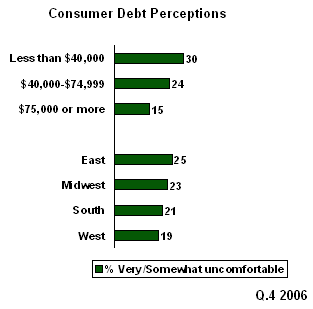
In this regard, it should be noted that consumer spending escalated significantly during the fourth quarter of 2006 and accounted for approximately 87% of GDP growth. This simply is not maintainable given the anemic nature of consumers' real income growth and the enormous level of consumer debt. In fact, 22% of today's consumers say they are very uncomfortable (7%) or somewhat uncomfortable (15%) with their current debt burden. Consumer discomfort over their level of debt is comparatively higher among those under 50 years of age, those making less than $40,000 a year, and those in the East as opposed to the West.
As residential real estate markets around the country continue to weaken, we are likely to see a lot of financial distress among consumers who opted for creative mortgage financing to participate in the housing price bubbles of recent years. Add in a continued decline in home equity borrowing -- not to mention the more than one in five consumers already struggling with their current debt burdens -- and its hard to see how consumer spending can continue to more than offset the economic drag of declines in housing as 2007 unfolds.
Survey Methods
Results for the Experian/Gallup Personal Credit Index (PCI) poll are based on telephone interviews with 3,053 adults, aged 18 and older, conducted Oct.-Dec. 2006. For results based on the total sample of consumers, one can say with 95% confidence that the maximum margin of sampling error is ± 2 percentage points. In addition to sampling error, question wording and practical difficulties in conducting surveys can introduce error or bias into the findings of public opinion polls.