GALLUP NEWS SERVICE
PRINCETON, NJ -- Americans believe that it is in the best interests of Elian Gonzalez that he return to Cuba with his father, and that the U.S. government should physically remove him from the Miami home where he is staying if his relatives do not turn the boy over. At the same time, the majority of Americans disapprove of the way in which the U.S. federal agencies have been handling the entire situation, which has now been in dispute for over four months.
Best Interest of Elian?
When Gallup first asked Americans their opinion on what action
would be in the best interests of six-year-old Elian Gonzalez last
December, the public was split, with 45% saying that he should
return, and 45% saying that he should remain with his relatives in
Miami. This year, however, in four separate polls conducted since
mid-January, a majority of Americans have come down on the side of
returning the boy to live with his father in Cuba:
| Which of the following solutions do you think would be in the best interests of the boy - [ROTATED: for him to remain in the U.S. to live with relatives who have requested he stay here (or) for him to live with his father in Cuba, as his father has requested]? |
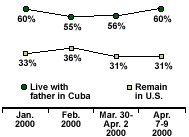 |
Despite the publicity surrounding the arrival of Elian's father in this country last week, the basic views of the American public have not changed. By a 2-to-1 ratio - 60% to 31% -- Americans interviewed through Sunday night say they favor the boy's return to Cuba.
The Elian Gonzalez situation has been highly politicized, with Republican Senators offering resolutions in Congress that would give the boy a permanent residency status, and with both presidential candidates weighing in on the side of Elian's relatives in Miami. One big surprise has been Vice President Al Gore's decision to break with the Clinton administration and back the proposal that Elian Gonzalez be allowed to stay in this country until a family custody hearing can be conducted.
Across the country, however, Republicans do not differ significantly from Democrats in their feelings about the case. Republicans come down in favor of the boy returning to Cuba by a 57% to 35% margin, while Democrats are only a little stronger in their opinions, favoring Elian's return by a 64% to 27% margin. Similarly, there are very few differences on this issue by ideology, with self-described conservatives essentially as likely to favor his return as moderates and liberals.
Although those who oppose the boy's return to Cuba have been the most demonstrative in making their opinions known, including demonstrations in Miami and elsewhere, there are no apparent differences in strength of support on either side of the issue. The poll shows that those who feel Elian should return are just as passionate about their position as those who feel the boy should be allowed to stay.
| Want Elian to Remain in U.S. | |
| Strongly | 23% |
| Not strongly | 8 |
| Want Elian to Return to Cuba | |
| Strongly | 50 |
| Not strongly | 10 |
| No opinion | 9 |
| Total | 100% |
Majority Disapprove of U.S. Government Handling of
Situation
Despite the fact that a majority of Americans agree with the U.S.
government position that Elian should return to Cuba, 60% of
Americans disapprove of the way in which the government has handled
the situation, while just 32% approve. Conventional wisdom might
dictate that those who oppose the government ruling that Elian
should return would be most negative towards the government's
handling of the case, but the negative assessment of the government
is held by Americans regardless of their opinion on the case:
Overall, do you approve or disapprove of the way the United States federal agencies dealing with the Elian Gonzalez situation have handled the case so far?
| Total | Those who Want Elian to Remain in U.S. | Those who Want Elian to Return to Cuba | |
|---|---|---|---|
| % | % | % | |
| Approve | 32 | 31 | 34 |
| Disapprove | 60 | 61 | 61 |
| No opinion | 8 | 8 | 5 |
| 100% | 100% | 100% |
Physically Remove Elian if Necessary?
One of the emerging, and important, issues in the case concerns the
actual process by which Elian could be transferred from his
relatives in Miami to the custody of his father, which has been
ordered by U.S. government officials. The U.S. Government is
seeking ways to find a neutral place for the transfer, but the poll
shows that if these efforts fail, the public would support forcible
removal if necessary:
What do you think the federal government should do if it orders the relatives of Elian Gonzalez in Miami to turn the boy over to his father, but the family refuses to do so? Should the government then have the authorities physically remove the boy from the Miami home, or not?
| Yes, physically remove him | 59% |
| No, not physically remove him | 29 |
| DEPENDS/OTHER (vol.) | 4 |
| No opinion | 8 |
| Total | 100% |
| (vol.) = volunteered response | |
Survey Methods
The results reported here are based on telephone interviews with a
randomly selected national sample of 1,006 adults, 18 years and
older, conducted April 7-9, 2000. For results based on samples of
this size, one can say with 95% confidence that the maximum error
attributable to sampling and other random effects is plus or minus
3 percentage points. In addition to sampling error, question
wording and practical difficulties in conducting surveys can
introduce error or bias into the findings of public opinion
polls.