GALLUP NEWS SERVICE
PRINCETON, NJ -- As Democrats and Republicans begin their public relations battle over a "patient's bill of rights," a new CNN/USA Today/Gallup poll shows that more than three in four Americans say such a bill is either "extremely" or "very" important to them. Both parties in Congress support some form of a patient's bill of rights, and the Senate is ready to debate the two different measures -- one backed by President Bush and the Republican leaders in the Senate, the other backed by Senate Democratic leaders. While most people may not know the details of the two bills, the poll shows that, by a margin of 49% to 34%, Americans say they have more confidence in the Democratic leaders than in President Bush on this issue. Not surprisingly, the poll also shows that partisan affiliation polarizes the issue -- with Democrats more likely than Republicans to say the issue is important, and that they trust Democratic leaders more than President Bush on the issue.
The poll, conducted June 8-10, shows that 40% of Americans say it is "extremely" important, and another 37% say "very" important, that Congress and the president address the issue of a patient's bill of rights this year. These results rank the issue in fourth place among nine measured in the poll, with education, prescription drugs for older Americans, and energy conservation seen as more important. Issues that are not as important to the public include increased oil and gas production, price caps on electricity, raising the minimum wage, a missile defense shield, and campaign finance reform.
| Salience of Issues Facing Congress and
President (Based on % "extremely/very important") |
 |
| June 8-10, 2001 |
Although large majorities of virtually all groups of Americans say the issue is important, there are some significant differences by party affiliation. As shown in the table below, 71% of Republicans say the issue is extremely or very important, as do 76% of independents and 83% of Democrats. For Republicans, the issue ranks fifth among the nine measured in the poll, while for independents the issue ranks fourth, and for Democrats it ties for third place.
|
IMPORTANCE OF PATIENT'S BILL OF RIGHTS
COMPARED TO OTHER ISSUES |
|||||
|
(Percent Who Say Issue is "Extremely" or "Very" Important) |
|||||
|
Repub- |
Inde- |
Demo- |
|||
|
(%) |
(%) |
(%) |
|||
|
Education |
89 |
Education |
94 |
Education |
94 |
|
Increased oil/gas production |
84 |
Prescription drugs |
85 |
Prescription drugs |
93 |
|
Prescription drugs |
78 |
Increased energy conservation |
80 |
Increased energy conservation |
83 |
|
Increased energy conservation |
74 |
A patient's bill of rights |
76 |
A patient's bill of rights |
83 |
|
A patient's bill of rights |
71 |
Price caps on electricity |
65 |
Raising minimum wage |
75 |
|
Missile defense |
66 |
Raising minimum wage |
65 |
Price caps on electricity |
73 |
|
Price caps on electricity |
55 |
Increased oil/gas production |
62 |
Increased oil/gas production |
66 |
|
Raising minimum wage |
47 |
Missile defense |
46 |
Missile defense |
50 |
|
Campaign finance |
36 |
Campaign finance |
42 |
Campaign finance |
44 |
Despite these differences by party affiliation, the major conclusion is that widespread support exists among the American public for a bill that would give Americans more influence over decisions made by their healthcare providers and make healthcare providers more accountable to the patients they serve.
Major Partisan Differences on Confidence Measures
The major differences between the Republican and Democratic versions of a patient's bill of rights are found in the recourse patients have if they are denied coverage by their HMOs and are harmed by delays in treatment. The Democratic bill, sponsored by Democratic Senators Edward Kennedy and John Edwards, along with Republican Senator John McCain, allows patients to sue their HMOs in either state or federal court, and to seek unlimited damages for pain and suffering and up to $5 million in punitive damages. The Republican bill, sponsored by Republican Senator Bill Frist, Democratic Senator John Breaux, and newly declared independent Senator Jim Jeffords, would also allow suits against HMOs, but would restrict the venue to federal court, limit damages from pain and suffering to half a million dollars, and disallow any punitive damages.
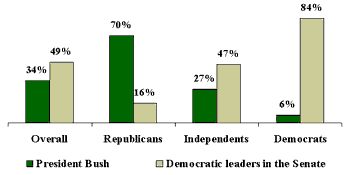
It is very likely that few Americans know the details of these bills and the precise differences between them. Nonetheless, from the debates on this issue over the past several years, they may know that, in general, the Republicans want more limits on a patient's ability to sue than do the Democrats. Also, typically, the Democratic Party is viewed more favorably than the Republican Party on health issues. Thus, it is not surprising that about half of Americans -- 49% -- say they have more confidence in the Democratic leaders in the Senate than in President Bush on the issue of a patient's bill of rights, while 34% of Americans express greater confidence in Bush.
| Bush vs. Democrats in the Senate: Confidence in Handling Patient's Bill of Rights by Party ID |
 |
| June 8-10, 2001 |
As shown in the chart above, those views are highly related to one's party orientation. Republicans prefer Bush, by 70% to 16%, while Democrats prefer the Senate Democratic leaders by an even larger margin of 84% to 6%. Independents express greater confidence in the Democratic leaders, by 47% to 27%.
Survey Methods
Results are based on telephone interviews with 1,011national adults, aged 18+, conducted June 8-10, 2001. For results based on the total sample of national adults, one can say with 95% confidence that the margin of sampling error is +/- 3 percentage points. In addition to sampling error, question wording and practical difficulties in conducting surveys can introduce error or bias into the findings of public opinion polls.
Next, how important is it to you that the president and Congress deal with each of the following issues in the next year -- is it extremely important, very important, moderately important, or not that important? How about -- [ROTATED]?
H. A patient's bill of rights
|
Extremely important |
Very important |
Moderately important |
Not that important |
No |
|
|
2001 Jun 8-10 |
40% |
37 |
16 |
5 |
2 |
ISSUE SALIENCE SUMMARY TABLE
|
2001 Jun 8-10 |
Extremely |
Extremely/very important |
|
% |
% |
|
|
Education |
61 |
93 |
|
Prescription drugs for older Americans |
49 |
85 |
|
Increased energy conservation |
42 |
79 |
|
A patient's bill of rights |
40 |
77 |
|
Increased oil and gas production |
35 |
70 |
|
Price caps on electricity |
34 |
65 |
|
Raising the minimum wage |
31 |
63 |
|
Missile defense |
25 |
54 |
|
Campaign finance |
18 |
40 |
Thinking for a moment about healthcare,
Overall, who do you have more confidence in when it comes to the issue of a patient's bill of rights -- [ROTATED: President Bush (or) the Democratic leaders in the Senate]?
|
|
Democrats |
BOTH/NEITHER (vol.) |
No |
|
|
2001 Jun 8-10 |
34% |
49 |
6 |
11 |
