GALLUP NEWS SERVICE
PRINCETON, NJ -- According to a recent Blue Chip Economic Indicators report, the overwhelming majority of private economists -- nine out of 10 -- believe that the current U.S. recession will end during the first quarter of 2002. Given this very unusual consensus among the nation's economic prognosticators, it is not surprising that consumer expectations for the future of the economy are becoming more optimistic. In turn, the improvement in consumer expectations simply reinforces the short-term optimism felt by many economists.
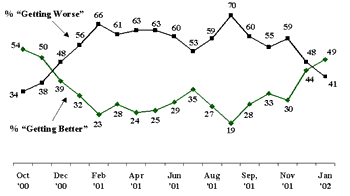
A new Gallup poll on the economy (conducted Jan. 7-9) shows that for the first time since November 2000, Americans are more likely to say that economic conditions in the country as a whole are getting better as opposed to getting worse. This dramatic positive change in the direction of consumer expectations began after the events of 9/11 and has continued into 2002.
Of course, the key question is whether optimism about the coming economic recovery will be justified by economic reality. Significantly, Federal Reserve Board Chairman Alan Greenspan, in a recent speech in San Francisco, did not endorse this widely held optimism. Instead, he used his first speech on the economy in 2002 to warn of "significant risks" to the short-term economic outlook.
Unfortunately, the Fed Chairman's comments are fully consistent with what the consumer is telling Gallup. While many consumers are optimistic about the future, they also say that they have not yet begun to see the improvements usually associated with an economic upturn. For example, only 29% of Americans rate national economic conditions as good or excellent in January 2002. This is down slightly from the November (31%) and December (31%) percentages. More importantly, it is less than half the levels of a year ago (Jan. 10-14, 2001), when two out of three Americans rated the economy good or excellent.
Public Increasingly Positive That National Economy is Recovering
This month, 49% of Americans say the economy is getting better, while 41% say it is getting worse. This is the first time since November 2000 that more consumers say economic conditions are getting better than worse. This continues an improving trend that started in September 2001.
Prior to September, an increasing percentage of American consumers were saying that the economy was going in the wrong direction -- getting worse, not better. By the time of the Sept. 7-10 poll, 70% of Americans said the economy was getting worse, and only 19% said better. In the wake of the terrorist attacks, however, this measure changed direction and has been moving in a positive direction ever since. A week after 9/11, the worse-to-better ratio improved to a 60% to 28% level, and the next month it improved even more -- 55% to 33%. In November, this rating showed a slight regression, 59% to 30%, but the December rating showed another improvement with 44% of Americans saying economic conditions were getting better and 48% saying worse.
| Public Rating, Direction of the Economy October 2000 - January 2002 |
 |
Consumers Say Their Local Economies are Getting Better
New Gallup Poll economic data (Jan. 7-9) also show that consumers think economic conditions are getting better in their local communities, the places where they work, and in their personal finances. Nearly half (49%) of Americans now say that local economic conditions are getting better, while only 35% say they are getting worse. These are virtually the same numbers consumers reported in December 2001 -- 48% said their local economy was getting better and 36% said it was getting worse. Both the December and January measures, however, are a substantial improvement -- and a reversal in direction -- from November, when 40% said that economic conditions in their communities were getting better and 42% said they were getting worse.
More importantly, in both January and December, about six out of 10 Americans say their own financial situations are getting better, while less than one out of four say their situations are getting worse. Once again, these measures represent a substantial improvement from November's 45% better/33% worse readings.
Most impressively, nearly two out of three of those who are employed told us in both January and December that the financial situation at the company where they work is getting better. Less than one out of four employees say things are getting worse at the companies where they work.
FUTURE EXPECTATIONS TABLE
|
Percentage "Getting Better" |
January |
December |
November |
October |
|
National economy |
49% |
44 |
30 |
33 |
|
Local economy |
49% |
48 |
40 |
41 |
|
Company where you work |
63% |
64 |
^ |
^ |
|
Personal financial situation |
60% |
59 |
45 |
50 |
^ Not available
Given the better-than-expected retail sales during Christmas, and consumers' increasingly positive expectations, it is not surprising that most economists are expecting a near-term recovery. Further, if the recession goes beyond the first quarter, it will exceed the average length of the modern recession. Still, the key question for the future is whether all of these positive future expectations for the economy will be realized.
Survey Methods
Results are based on telephone interviews with 1,004 national adults, aged 18+, conducted January 7-9, 2002. For results based on the total sample of national adults, one can say with 95% confidence that the margin of sampling error is +/- 3 percentage points.