GALLUP NEWS SERVICE
PRINCETON, NJ -- A recent CNN/USA Today/Gallup Poll finds that Americans continue to have a negative view of the overall health of the Social Security system. While a majority of the public supports the idea of allowing people to invest a portion of their Social Security taxes in private stock and bond investments, the percentage in favor of that proposal has declined since April, coincident with the decline of the stock market. Additionally, there has been a shift in the last two years in Americans' perceptions of whether continuing to fund Social Security as is done now or allowing people to invest part of their Social Security taxes represents the greater risk. Now, more Americans see the investing option as riskier. Social Security remains an important campaign issue, and the Democratic Party's perceptual advantage on the issue appears to be increasing.
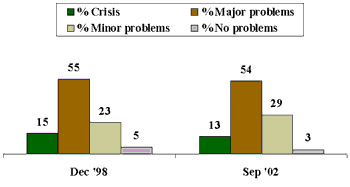
The poll, conducted Sept. 20-22, shows little has changed in the way Americans view the Social Security system. Two-thirds think it is either in a state of crisis (13%) or has major problems (54%), while 29% say it has minor problems and just 3% say it has no problems at all. In December 1998, 15% thought it was in a crisis and 55% thought it had major problems.
| State of Social Security |
 |
This pessimistic view on Social Security is shared by most Americans, except those aged 65 and older, the primary beneficiaries of Social Security. Among this group, just 43% believe the system is in a crisis (6%) or has major problems (37%). A plurality of older Americans, 46%, says the system has only minor problems, and 10% of this age group says it has no problems at all.
Support for Investment of Social Security Taxes Waning
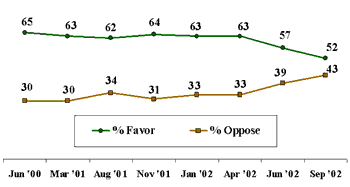
A major plank of George W. Bush's presidential campaign was a plan to allow Americans to invest a portion of their Social Security taxes in private stock and bond investments. In theory, this would allow Americans the opportunity to receive greater benefits when they qualify for them, but it also would entail the risk of lower benefits if the investments failed to grow. Throughout 2000, when Gallup first asked the question about the plan, and until as recently as this April, more than six in 10 Americans consistently favored the proposal. However, the percentage in favor dropped to 57% in June, shortly before the Dow Jones Industrial Average fell below 8000, and again to 52% in the most recent poll, taken when the Dow again fell below 8000 after being above that mark throughout August and much of September. Forty-three percent currently oppose the proposal.
| Favor or Oppose Investment of Social Security Taxes in Private Stocks and Bonds? |
 |
Younger Americans -- those between the ages of 18 and 29 -- are far more likely to favor the proposal (68% do) than is any other age group. Fifty-seven percent of 30- to 49-year-olds favor it, as do 46% of 50- to 64-year-olds (among whom 51% are opposed to the proposal). Americans aged 65 and older are twice as likely to oppose (63%) private investment of Social Security taxes as to favor it (30%). This pattern has been evident each time the question has been asked. However, support among all age groups except the 65-and-older group has eroded over the past several months.
One's views on the proposal are also influenced by partisanship. Republicans favor the plan by a 67% to 29% margin, while Democrats are opposed by a 58% to 37% margin. Independents are more likely to favor (56%) than to oppose (39%) the plan.
What Would the Effects of Private Investment Be?
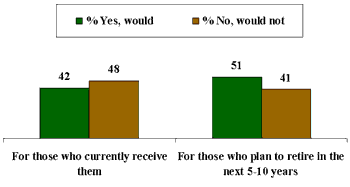
The public is somewhat divided as to the specific effects of allowing private investment of Social Security taxes. Forty-two percent think that allowing private investment would reduce benefits to those who currently receive them, while 48% say it would not. Thinking about the next five to 10 years, Americans are less optimistic -- 51% say the proposal would reduce benefits to those who plan to retire in the next five to 10 years, while 41% say it would not. However, when asked if the proposal would increase benefits for those who plan to retire in the next 20 years, 51% say yes and 43% say no.
These differences in opinion may be due to the differing time spans (now, five to 10 years, 20 years) offered in the questions, and also to variations in question wording ("increase" versus "reduce" benefits), but the data do support the general conclusion of a divided public.
| Would Privatizing Social Security Reduce Benefits? |
 |
| Sep. 20-22, 2002 |
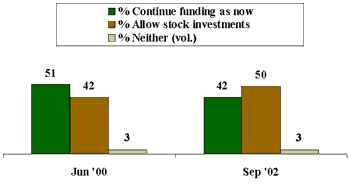
Given a choice, half of Americans say it is a greater risk to allow people to invest part of their Social Security taxes in the stock market, while 42% say it is a greater risk to continue funding Social Security as is done now. This represents a reversal of opinion from June 2000, when 51% thought that continuing to fund the system using current practice was riskier than allowing people to invest part of their taxes in stock and bond investments, and 42% thought the opposite.
| Greater Risk: Continue With Current Social Security Funding, or Change System to Allow Privatization? |
 |
Social Security Remains an Important Campaign Issue
Social Security traditionally ranks as a top campaign issue each election season. With the 2002 elections looming, 71% of Americans say Social Security will be either an extremely (37%) or a very (34%) important issue in determining their vote for Congress this year. Social Security is not the key issue this election -- terrorism, the economy and Iraq are generally viewed as more important -- but it still has a high ranking.
When the public is asked which party would do a better job of handling the issue, 55% say the Democrats and 31% the Republicans. As support for the private investment proposal has dropped, the advantage of the Democratic Party over the Republican Party on the issue has increased. Polls conducted in May and June showed the Democrats with a 10-point advantage on the issue (43% to 33% in May, 48% to 38% in June), compared to its current 21-point edge.
Survey Methods
These results are based on telephone interviews with a randomly selected national sample of 1,010 adults, 18 years and older, conducted September 20-22, 2002. For results based on this sample, one can say with 95 percent confidence that the maximum error attributable to sampling and other random effects is plus or minus 3 percentage points. In addition to sampling error, question wording and practical difficulties in conducting surveys can introduce error or bias into the findings of public opinion polls.
A proposal has been made that would allow people to put a portion of their Social Security payroll taxes into personal retirement accounts that would be invested in private stocks and bonds. Do you favor or oppose this proposal?
|
Favor |
Oppose |
No opinion |
||
|
% |
% |
% |
||
|
2002 Sep 20-22 |
52 |
43 |
5 |
|
|
2002 Jun 28-30 |
57 |
39 |
4 |
|
|
2002 Apr 8-11 |
63 |
33 |
4 |
|
|
2002 Jan 25-27 |
63 |
33 |
4 |
|
|
2001 Nov 26-27 ^ |
64 |
31 |
5 |
|
|
2001 Aug 24-26 |
62 |
34 |
4 |
|
|
2001 Mar 26-28 ^ |
63 |
30 |
7 |
|
|
2000 Jun 6-7 ^ |
65 |
30 |
5 |
|
|
^ |
Asked of half sample. |
|||
Which of these statements do you think best describes the Social Security system today -- the Social Security system is in a state of crisis, it has major problems, it has minor problems, or it does not have any problems?
|
|
Major problems |
Minor problems |
No |
No |
|
|
2002 Sep 20-22 |
13% |
54 |
29 |
3 |
1 |
|
1998 Dec 4-6 |
15% |
55 |
23 |
5 |
2 |
Just your best guess, do you think allowing people to invest part of their Social Security taxes in stocks and bonds would reduce Social Security benefits to people who currently receive them, or not?
|
Yes, would |
No, would not |
No opinion |
|
|
2002 Sep 20-22 |
42% |
48 |
10 |
Just your best guess, do you think this proposal would reduce Social Security benefits for people who plan to retire in the next five to ten years, or not?
BASED ON -- 492 -- NATIONAL ADULTS IN FORM A
|
Yes, would |
No, would not |
No opinion |
|
|
2002 Sep 20-22 |
51% |
41 |
8 |
Just your best guess, do you think this proposal would increase Social Security benefits for people who plan to retire twenty years from now, or not?
BASED ON -- 518 -- NATIONAL ADULTS IN FORM B
|
Yes, would |
No, would not |
No opinion |
|
|
2002 Sep 20-22 |
51% |
43 |
6 |
Which is the greater risk [ROTATE: to continue funding Social Security the way it is done now, (or) to change the system to allow people to put a portion of their Social Security payroll taxes into accounts that would be invested in the stock market]?
|
Continue funding as now |
Allow stock investments |
NEITHER |
No |
|
|
2002 Sep 20-22 |
42% |
50 |
3 |
5 |
|
2000 Jun 6-7 ^ |
51% |
42 |
3 |
4 |
|
(vol.) Volunteered response |
||||
|
^ Asked of a half sample. |
||||
