Story Highlights
- Most Americans see democratic dysfunction at the national and local levels
- Belief local democracy works tied to faith in democratic political system
- Local democracy ratings are higher when town and resident politics match
WASHINGTON, D.C. — Americans assess democracy more positively at the local level than at the national level, across multiple measures. They are more likely to say that democracy is doing well locally (34%) than nationally (19%) [performance], that local (39%) rather than national (23%) government officials are sensitive to the interests of people like them [responsiveness], and that ordinary people have the power to create change locally (46%) than nationally (35%) [agency]. And yet, less than half of Americans have a positive view of local democracy in terms of its performance, responsiveness or agency.
These findings, part of the Charles F. Kettering Foundation and Gallup Democracy for All Project, are based on a web and mail survey conducted April 24-June 10, 2026, with more than 23,000 U.S. adults.
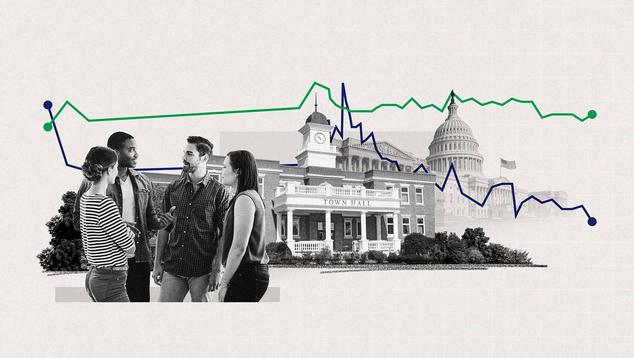
Since the early 1970s, Gallup has tracked how much trust and confidence Americans have in the federal government to handle domestic problems and in their local government to handle local problems. Majorities typically expressed a great deal or fair amount of trust in the federal government until 2007. Since then, that figure has fallen steadily, reaching a record low of 33% in September 2026. Trust in local government has held steadier, ranging from 63% to 77% over the same period.
Trust in the government to handle problems and perceptions of how democracy is doing are two different ways to measure democratic performance. One focuses on the ability to address tangible challenges, while the other captures democracy’s ability to function more broadly. Whether the trendline for how democracy is doing looks similar to the trendline for trust in government to handle problems is an open question.
Democratic Performance Drives Democratic Legitimacy
When people perceive that democracy works in their city or town [performance], they are more likely to agree that democracy is the best form of government [legitimacy]. Eighty-five percent of Americans who say democracy is doing “very well” in their local area or town agree or strongly agree that democracy is the best form of government, compared with half of those who say democracy is doing “very poorly.” Views on how democracy is doing at the national level also predict perceived legitimacy of the political system, but views at the local level explain more of the variation.
Another strong predictor of legitimacy is satisfaction with local conditions, which offers a proxy for the ability of local government to deliver tangible outcomes. People who are “very satisfied” with local conditions — housing, healthcare, food, schools, childcare — are 22 percentage points more likely than those who are “very dissatisfied” to agree or strongly agree that democracy is the best form of government.
Other important predictors of democratic legitimacy include age and engagement level in politics. Younger Americans are less likely than older Americans to agree that democracy is the best form of government. Independents who do not lean toward either party and those who pay little attention to political news are less likely to express faith in the democratic political system.
Local Democracy Ratings Are Higher When Town and Resident Politics Match
Americans increasingly live near people who vote like they do, and partisans increasingly view the other side more negatively. These trends can pose challenges to democratic systems, which depend on compromise and trust to function well.
The difference between an individual’s personal politics and their views of the political leaning of their local area provides a measure for a perceived partisan gap. Seventy-one percent of Americans believe the political leanings of the city or town where they live are the same as or close to their own partisan views. In contrast, only 14% of Americans believe the political leanings of their local area are nearly or completely the opposite of their own partisan views.
Individual/Community partisan alignment is strongly associated with perceptions of democratic performance at the local level. Twice as many Americans perceive democracy doing “moderately well” or “very well” in their local area (40% compared with 20%) when partisan leanings are the same between the respondent and local area as when they are opposite.
Importantly, the partisan gap does not directly predict views of whether democracy is the best form of government. Instead, the partisan gap influences perceptions of how local democracy is doing, which in turn affects views of democracy as the best form of government, according to a statistical model.
Other predictors associated with perceptions of how local democracy is doing include satisfaction with local conditions and views of the local area getting left behind or getting the attention and resources it needs. Perceived local social trust — how much respondents agree that people in their neighborhood are willing to help their neighbors and can be trusted — is the strongest predictor.
Partisan Gap Tied Mostly to Political Views, Not Social Trust
The partisan gap shows the biggest differences on political measures. The share saying local officials are sensitive to the interests of people like them falls from 45% to 20% as the gap widens, and the share trusting information from elected officials falls from 37% to 18%. The partisan gap also has a moderately negative impact on satisfaction with community basics and identification as a member of the local community. In contrast, the partisan gap does not appear to have a significant impact on the social trust of people who live in the neighborhood.
While overall trust in the American people has eroded over the past few decades, people still largely trust those who live in their local area, even if they believe those people’s politics are the opposite of their own. While the type of person who lives in an area they perceive as leaning in a political direction largely different from their own may be idiosyncratic, this finding suggests that Americans’ growing lack of trust in each other is real but fixable.
Conclusion
A notable deterioration in Americans’ attachment to democracy as a political system has occurred over the past 30 years. Restoring this article of faith requires significant work. One pathway that appears promising is improving Americans’ experience with democracy at the local level through good governance, responsive local leadership and sufficient resources to address problems. Americans who believe that local democracy is working are more likely to say democracy is the best form of government.
Stay up to date with the latest insights by following @Gallup on X and on Instagram.
Learn more about how the Gallup Panel works.
Editorial Note: The views and opinions expressed here are made independent of the Charles F. Kettering Foundation and without the foundation’s warranty of accuracy, authenticity or completeness. Such statements do not reflect the views and opinions of the foundation, which hereby disclaims liability to any party for direct, indirect, implied, punitive, special, incidental or other consequential damages that may arise in connection with statements made during association with the foundation or independently.