GALLUP NEWS SERVICE
PRINCETON, NJ -- A CNN/USA Today/Gallup poll conducted last night gauged Americans' immediate reaction to Secretary of State Colin Powell's Wednesday address before the United Nations Security Council. Powell presented the United States' evidence that indicates that Iraq is not complying with United Nations Resolution 1441, which called on Iraq to submit to inspections for weapons of mass destruction, or risk grave consequences.
Roughly two in three Americans, 62%, said they had heard or read something about Powell's speech by the time of the Wednesday night interviews. Relatively few Americans, just 13%, said they saw "all or most" of the address on television. An additional 30% said they saw at least a few minutes of the talk.
The poll suggests that the speech had a limited impact, even though most Americans who are familiar with it believe Powell presented a strong case to the United Nations about Iraq's noncompliance.
Americans who had heard or read something about Powell's speech were asked where they stood on a U.S. invasion of Iraq prior to the speech. Fifty percent said they were in favor, 22% were opposed, and 28% were unsure. Then, asked where they stood following the speech, 57% of those familiar with the speech said they are now in favor of an invasion, 15% are opposed, and 28% are unsure.
| Opinion of Invading Iraq |
 |
| Feb. 5, 2003 -- 601 adults who had heard or read about Powell's speech to the U.N. |
An analysis of these responses shows that 81% of those familiar with the speech did not change their views on an invasion of Iraq. Ten percent who were previously unsure about invading Iraq or were opposed to the idea say they now favor it following Powell's presentation. Eight percent who previously favored or opposed an invasion on Iraq now say they are unsure. Just 1% who favored or were unsure about invading Iraq now say they oppose it following Powell's speech.
| Effect of Powell's Speech |
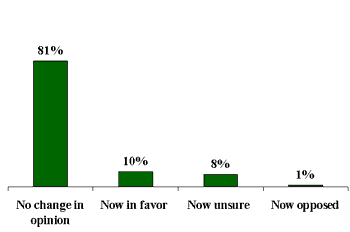 |
| Feb. 5, 2003 -- 601 adults who had heard or read about Powell's speech to the U.N. |
The ultimate effect on public support for Iraq probably will not be clear for several days as the media, political leaders, and the American public sort through the evidence Powell presented. The most recent CNN/USA Today/Gallup poll, conducted Jan. 31-Feb. 2, indicates that 56% of Americans said they could change their minds on whether the United States should invade Iraq, underscoring the importance of the much-publicized Powell speech.
Other findings from Wednesday's immediate-reaction poll show:
- Forty-two percent of those familiar with Powell's speech say he made a "very strong case about the need for the U.S. to invade Iraq." An additional 37% say he made a "fairly strong case," and only 13% say he did not make a strong case.
- Among the four allegations against Iraq that Powell discussed, it appears he made the strongest case that Iraq is hiding evidence from the United Nations weapons inspectors. Sixty-four percent of those familiar with Powell's speech say he made a very strong case on this count. Sixty-one percent say he made a very strong case that Iraq has biological or chemical weapons.
- Slightly fewer than half (44%) of those familiar with the speech say Powell made a very strong case that Iraq is trying to develop nuclear weapons.
- Powell was apparently least effective in convincing his audience that Iraq has ties to Osama bin Laden's al Qaeda terrorist organization. Just 36% of those familiar with the speech say he made a very strong case about links between Iraq and al Qaeda, though an additional 30% say he made a fairly strong case.
- By the time they were interviewed, 21% of Americans had heard or read a great deal about Powell's speech, and 19% had heard or read a moderate amount. Twenty-two percent had heard just "a little," and 38% had not heard or read anything at all about the speech.
- Republicans (51%), who tend to strongly favor military action against Iraq, were much more likely than independents (35%) or Democrats (40%) to have read or heard "a great deal" or "a moderate amount" about Powell's United Nations address.
Survey Methods
These results are based on telephone interviews with a randomly selected national sample of 876 adults, 18 years and older, conducted Feb. 5, 2003. For results based on this sample, one can say with 95% confidence that the maximum error attributable to sampling and other random effects is ±4 percentage points.
Most results are reported on the basis of 601 Americans in this sample who had heard or read about Powell's speech by the time they were interviewed. For results based on this sample, one can say with 95% confidence that the maximum error attributable to sampling and other random effects is ±4 percentage points.
In addition to sampling error, question wording and practical difficulties in conducting surveys can introduce error or bias into the findings of public opinion polls.
Polls conducted entirely in one day, such as this one, are subject to additional error or bias not found in polls conducted over several days.
As you may know, Secretary of State Colin Powell spoke to the United Nations for 90 minutes today to present evidence which the United States says it has about Iraq's weapons of mass destruction.
How much have you heard or read about what Powell said when he gave his speech to the United Nations today -- a great deal, a moderate amount, only a little, or nothing at all?
|
Great |
Moderate amount |
Only a |
Nothing |
No |
|
|
2003 Feb 5 |
21% |
19 |
22 |
38 |
* |
|
|
|
|
|
|
|
|
* Less than 0.5% |
|||||
How much of Powell's actual speech did you happen to see on television today -- [ROTATED: all or most of the speech, about an hour of it, about half an hour of it, only a few minutes of it (or) none of the speech]?
BASED ON -- 601 -- adults who heard or read about Powell's speech
|
All or |
About |
About |
Only |
None |
No |
|
|
2003 Feb 5 |
21% |
12 |
12 |
25 |
30 |
-- |
Based on all respondents
|
All or |
About |
About |
Only |
None/Did not hear or read about it |
No |
|
|
2003 Feb 5 |
13% |
8 |
7 |
15 |
57 |
* |
|
|
|
|
|
|
|
|
|
* Less than 0.5% |
||||||
Before Powell's speech to the United Nations today, would you say you favored or opposed invading Iraq with U.S. ground troops in an attempt to remove Saddam Hussein from power, or were you unsure?
BASED ON -- 601 -- adults who heard or read about Powell's speech
|
Favored |
Opposed |
Unsure |
No answer |
|
|
2003 Feb 5 |
50% |
22 |
28 |
* |
|
|
|
|
|
|
|
* Less than 0.5% |
||||
And after Powell's speech to the United Nations today, would you say you favor or oppose invading Iraq with U.S. ground troops in an attempt to remove Saddam Hussein from power, or are you unsure?
BASED ON -- 601 -- adults who heard or read about Powell's speech
|
Favor |
Oppose |
Unsure |
No answer |
|
|
2003 Feb 5 |
57% |
15 |
26 |
2 |
Regardless of your opinion about invading Iraq with U.S. ground troops, based on what you have heard or read about Powell's speech today, do you think Powell made -- a very strong case about the need for the U.S. to invade Iraq with ground troops, a fairly strong case, not too strong a case, or not a strong case at all?
BASED ON -- 601 -- adults who heard or read about Powell's speech
|
Very |
Fairly |
Not too |
Not strong |
No |
|
|
2003 Feb 5 |
42% |
37 |
9 |
4 |
8 |
And thinking specifically about each of the following topics that Powell discussed in his speech today, would you say he presented -- a very strong case, a fairly strong case, not too strong a case, or not a strong case at all -- that-- [RANDOM ORDER]?
BASED ON -- 601 -- adults who heard or read about Powell's speech
A. Iraq is hiding evidence from the United Nations weapons inspectors
|
Very |
Fairly |
Not too |
Not strong |
No |
|
|
2003 Feb 5 |
64% |
22 |
7 |
1 |
6 |
B. Iraq has biological or chemical weapons
|
Very |
Fairly |
Not too |
Not strong |
No |
|
|
2003 Feb 5 |
61% |
24 |
7 |
1 |
7 |
C. Iraq is trying to develop nuclear weapons
|
Very |
Fairly |
Not too |
Not strong |
No |
|
|
2003 Feb 5 |
44% |
31 |
11 |
4 |
10 |
D. Iraq has ties to Osama bin Laden's terrorist organization known as al Qaeda
|
Very |
Fairly |
Not too |
Not strong |
No |
|
|
2003 Feb 5 |
36% |
30 |
17 |
5 |
12 |