GALLUP NEWS SERVICE
PRINCETON, NJ -- Despite continuing perceptions of troubles in Iraq and low ratings of his handling of the economy, President's Bush's overall job approval rating is up from his administration's low point recorded less than a month ago.
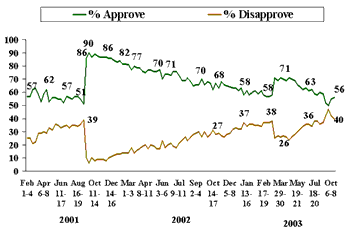
Bush's job approval rating in the just-completed Oct. 10-12 poll is 56%. It was 55% in Gallup's Oct. 6-8 poll. Both of these are higher than the 50% approval rating Bush received in a Sept. 19-21 poll.
The uptick in job approval ratings also represents a reversal of the general decline in Bush's ratings that has been taking place since the mini-rally of public support for Bush occurred in March and April, during the war in Iraq. At that time, his approval reached 71% -- lower than his record approval of 90% reached after the Sept. 11 terrorist attacks, but higher than it had been in the seven months before the start of the war.
| George W. Bush's Job Approval Rating |
 |
The recent increase in Bush's overall job approval comes at a time of some instability in poll readings on two key issues -- Iraq and the economy -- that may be affecting public attitudes toward the president.
When it comes to Iraq, most of the findings in the last two polls are fairly negative for the administration:
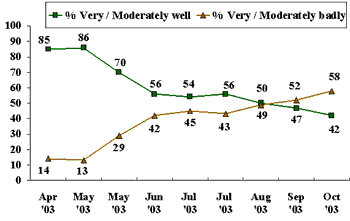
- The public's perceptions of how well the situation in Iraq is going are down to their lowest level of the year, with just 42% saying that the situation is going very or moderately well:
| How Are Things Going for the U.S. in Iraq Now That the Major Fighting Has Ended? |
 |
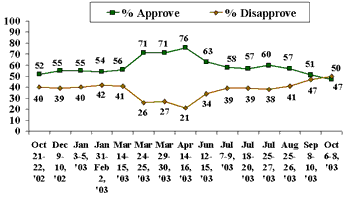
- Bush's approval rating for his handling of Iraq is at 47%, the lowest of his administration. As recently as June, 63% approved:
| George W. Bush's Job of Handling the Situation With Iraq |
 |
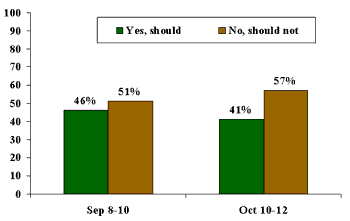
- A larger number of Americans -- well over the majority mark -- now say that Congress should not authorize the $87 billion the president has requested for Iraq and the war on terrorism. Americans are less inclined now than they were about a month ago to say the government should spend this money:
| As you may know, President Bush requested that Congress authorize an additional $87 billion in government spending for Iraq and the war on terrorism. Do you think Congress should -- or should not -- vote to authorize this? |
 |
However, there is one important bright spot:
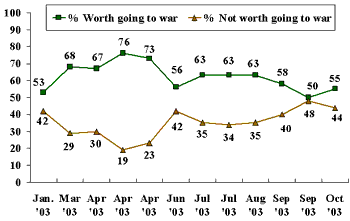
- At the same time, there has been a five-point increase since early September -- almost the same level of change as that seen for Bush approval -- in the percentage of Americans saying that the situation in Iraq was worth going to war over.
| All in all, do you think the situation in Iraq is/was worth going to war over, or not? |
 |
- As for the economy, most of the latest findings do not bode well for Bush. The public's assessment of current economic conditions remains as dismal as it has been for most of this year. In the Oct. 6-8 Gallup Poll, only 22% rated the economy as excellent or good, one of the lowest ratings since Bush took office. The same poll found Bush's approval rating for handling the economy down slightly since early September. But, running contrary to the other findings, the percentage of Americans believing that the economy is getting better rose slightly, from 40% in early September to 45% in early October.
|
Indicators of Public Confidence in the Economy |
|||
|
Selected Trend Since June |
|||
|
% Approving of Bush's Handling of Economy |
% Rating Current Economy as Excellent/Good |
% Saying Economy is Getting Better |
|
|
Oct 6-8 |
42 |
22 |
45 |
|
Sep 8-10 |
45 |
21 |
40 |
|
Jul 7-9 |
48 |
24 |
43 |
|
Jun 12-15 |
48 |
26 |
45 |
So why might Bush's overall approval rating be up, rather than continuing to decline as it had been doing? It could be that out of the confusion of Iraq and economic attitudes being measured -- with some attitudes growing more positive and others more negative -- the net effect is simply more positive for the president. In other words, Americans' increased optimism about the future of the economy and their heightened sense that the situation in Iraq was worth going to war over may be overriding their more negative assessments of current economic conditions and the success of the Iraq mission.
Another possibility is that the combination of the California recall election and the recent public relations blitz launched by the administration to build support for Iraq could both be aiding perceptions of Bush, albeit in different ways.
The California effect is intriguing to consider because it suggests the important role that the media play in the formation of public attitudes. It is possible that the massive amount of media attention directed at the California recall election last week, in which media star Arnold Schwarzenegger was elected the new governor of California, may have distracted Americans from their focus on problems in Iraq, and/or drowned out the critical comments about Bush delivered by the Democratic candidates for president. The popularity of Republican Schwarzenegger in and of itself could have favorably affected opinions about the president.
It is difficult to measure the impact on this rating, if any, of the Bush administration's all-out public relations blitz designed to convince Americans that things in Iraq are not as bad as the news reports about bombings and U.S. soldier deaths might indicate. The campaign did not get underway in earnest until last week, after the majority of the interviews in Gallup's Oct. 6-8 poll were conducted (the poll showed an increase in Bush's job approval to 55%).
Presidential job approval is by its nature a broad summary measure that can be tied to many issues, and these issues will vary, depending on the circumstances at the time of the poll. Sometimes poll data provide clear signals about the public's mood to help explain changes in presidential approval ratings. In this case, however, the available signals are ambiguous, and too many news events have converged to say for sure what is happening. It is impossible to know whether the current uptick in Bush's ratings is a short-term phenomenon that will quickly dissipate, or if this represents a more significant turning point in the generally downward drift of his ratings since the end of major fighting in Iraq last April.
Survey Methods
Results are based on telephone interviews with -- 1,004 -- national adults, aged 18+, conducted Oct.10-12, 2003. For results based on the total sample of national adults, one can say with 95% confidence that the maximum margin of sampling error is ±3 percentage points. In addition to sampling error, question wording and practical difficulties in conducting surveys can introduce error or bias into the findings of public opinion polls.