GALLUP NEWS SERVICE
PRINCETON, NJ -- While a growing percentage of Americans disapprove of how the United States is handling the situation in Iraq since the major fighting ended, support for the war effort is holding steady, with 56% saying the effort was worth it. The latest CNN/USA Today/Gallup poll also finds that Americans lean toward saying the war was the right thing to do, but less than half are very confident in that view. The public believes that order in Iraq and a stable Iraqi government are more likely to be achieved if U.S. troops remain in that country for the next three years, rather than withdrawing all troops in the next six months. However, most Americans believe forces who oppose the United States will grow stronger and that American casualties will continue to occur at least as frequently as they do now if the U.S. military remains in Iraq for three years.
The poll, conducted Nov. 14-16, finds 55% of Americans disapproving and 42% approving of the way the United States has handled the situation in Iraq since the major fighting ended. This is a more negative assessment than the public had in late October, when 50% disapproved and 47% approved. In April -- about two weeks after the fall of Baghdad -- the results were dramatically different, as 80% of Americans approved and only 18% disapproved.
Nevertheless, support for the Iraq war has held steady over the past month. Fifty-six percent of Americans say the situation in Iraq was worth going to war over, while 42% say it was not. Since falling to a low of 50% in mid-September, between 54% and 56% of Americans have said the war effort was worth it. On the night Baghdad fell to coalition forces, 76% of Americans said the war was worth it.
| All in All, Do You Think the Situation in Iraq Is/Was Worth Going to War Over, or Not? |
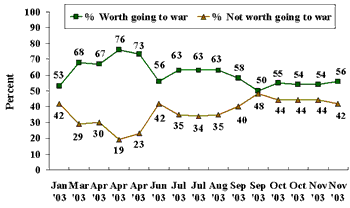 |
Another question in the poll finds that Americans, by a 3-to-2 margin, lean toward saying the war was the right thing (51%) rather than the wrong thing (31%) to do. Eighteen percent say it is too soon to tell or do not express an opinion. But these data also reveal that there is much uncertainty among Americans. In fact, 54% of Americans are less than fully confident in their assessments of the war. Among those who are confident, supporters outnumber detractors by a nearly 2-to-1 margin (30% to 16%).
All in all, which comes closest to describing your view about the United States decision to go to war with Iraq – [ROTATED: you are very confident it was the right thing to do, you are somewhat confident it was the right thing to do, you think it is too soon to tell, you are somewhat confident it was the wrong thing to do, (or) you are very confident it was the wrong thing to do]?
|
|
Some- |
|
Some- |
|
|
|
|
2003 Nov 14-16 |
30% |
21 |
17 |
15 |
16 |
1 |
U.S. Troops in Iraq
The Bush administration recently announced plans to accelerate the transition of power from the United States to the Iraqis, with hopes of establishing Iraqi self-rule by next summer. Whether or not that actually occurs, a key question is how long the United States will maintain a military presence in Iraq. The poll asked a random half of the sample what would happen if all U.S. troops were out of Iraq in six months, and asked the other half what they think would happen if U.S. troops remained in Iraq for the next three years.
Likelihood of Outcomes in Iraq Based on U.S. Troop Presence
|
Outcome |
All troops out in six months |
Troops remain for |
|
% |
% |
|
|
Chaos and civil war in Iraq |
66 |
52 |
|
Iraq establishes stable government |
50 |
64 |
|
Iraqi people view U.S. as friendly nation |
44 |
49 |
|
American military casualties continue at same/higher rate |
-- |
82 |
|
Forces oppose to U.S. involvement grow stronger |
-- |
68 |
Two in three Americans say it is very or somewhat likely that the situation in Iraq will turn into chaos and civil war if all U.S. troops are out of Iraq in six months. Only half think it is likely that Iraq would be able to establish a stable government, and fewer (44%) think that the Iraqi people will view the United States as a friendly nation.
Americans are more likely to believe that positive outcomes are possible if U.S. troops are in Iraq for three more years -- only a slim majority would believe that chaos would ensue under those circumstances, nearly two in three believe a stable government can be established in Iraq, and about half say Iraqis will view the United States in a friendly manner. However, that increased optimism is greatly tempered by the expectation, by 8 in 10 Americans, that American casualties will continue at least at the same rate as now if U.S. troops remained in Iraq for three more years. Additionally, 68% of Americans think it is likely that the forces opposed to U.S. involvement in Iraq would grow stronger during a three-year U.S. commitment.
Survey Methods
These results are based on telephone interviews with a randomly selected national sample of 1,004 adults, aged 18 and older, conducted Nov. 14-16, 2003. For results based on this sample, one can say with 95% confidence that the maximum error attributable to sampling and other random effects is ±3 percentage points. In addition to sampling error, question wording and practical difficulties in conducting surveys can introduce error or bias into the findings of public opinion polls.
Now, we'd like to ask you some questions about Iraq. First,
24. All in all, do you think the situation in Iraq was worth going to war over, or not?
|
Worth |
Not worth |
No |
||
|
% |
% |
% |
||
|
2003 Nov 14-16 |
56 |
42 |
2 |
|
|
2003 Nov 3-5 ^ |
54 |
44 |
2 |
|
|
2003 Oct 24-26 |
54 |
44 |
2 |
|
|
2003 Oct 6-8 ^ |
55 |
44 |
1 |
|
|
2003 Sep 19-21 |
50 |
48 |
2 |
|
|
2003 Sep 8-10 |
58 |
40 |
2 |
|
|
2003 Aug 25-26 |
63 |
35 |
2 |
|
|
2003 Jul 25-27 |
63 |
34 |
3 |
|
|
2003 Jul 18-20 |
63 |
35 |
2 |
|
|
2003 Jun 27-29 |
56 |
42 |
2 |
|
|
2003 Apr 14-16 † |
73 |
23 |
4 |
|
|
2003 Apr 9 †‡ |
76 |
19 |
5 |
|
|
2003 Apr 7-8 † |
67 |
30 |
3 |
|
|
2003 Mar 24-25 ^ † |
68 |
29 |
3 |
|
|
2003 Jan 3-5 ^ † |
53 |
42 |
5 |
|
|
^ |
Asked of a half sample. |
|||
|
† |
WORDING: All in all, do you think the current situation in Iraq is worth going to war over, or not? |
|||
|
‡ |
Polls conducted entirely in one day, such as this one, are subject to additional error or bias not found in polls conducted over several days. |
|||
25. Do you approve or disapprove of the way the U.S. has handled the situation with Iraq since the major fighting ended?
|
Approve |
Disapprove |
No opinion |
||
|
% |
% |
% |
||
|
2003 Nov 14-16 |
42 |
55 |
3 |
|
|
2003 Oct 24-26 |
47 |
50 |
3 |
|
|
2003 Apr 22-23 ^ |
80 |
18 |
2 |
|
|
^ |
Based on a half sample. |
|||
26. Do you think the war with Iraq has made the U.S. safer -- or less safe -- from terrorism?
|
Safer |
Less safe |
NO CHANGE |
No opinion |
||
|
% |
% |
% |
% |
||
|
2003 Nov 14-16 |
48 |
43 |
7 |
2 |
|
|
2003 Oct 24-26 |
45 |
43 |
10 |
2 |
|
|
2003 Apr 22-23 |
58 |
33 |
8 |
1 |
|
|
2003 Apr 10 ^ |
51 |
37 |
9 |
3 |
|
|
^ |
Polls conducted entirely in one day, such as this one, are subject to additional error or bias not found in polls conducted over several days. |
||||
27. Do you think the U.S. actions in Iraq will encourage political and economic reform in other countries in the Middle East, or not?
|
Yes, will |
No, will not |
No opinion |
|
|
2003 Nov 14-16 |
42% |
53 |
5 |
28. If, six months from now, all U.S. troops are out of Iraq, how likely do you think it is that each of the following will happen – very likely, somewhat likely, not too likely, or not at all likely? How about -- [RANDOM ORDER]?
BASED ON –496—NATIONAL ADULTS IN FORM A
A. The situation in Iraq will turn into chaos and civil war
|
Very |
Somewhat |
Not too |
Not at all |
No |
|
|
2003 Nov 14-16 |
25% |
41 |
24 |
8 |
2 |
B. The Iraqi people will be able to establish a stable government
|
Very |
Somewhat |
Not too |
Not at all |
No |
|
|
2003 Nov 14-16 |
9% |
41 |
35 |
14 |
1 |
C. The Iraqi people will view the United States as a friendly nation
|
Very |
Somewhat |
Not too |
Not at all |
No |
|
|
2003 Nov 14-16 |
10% |
34 |
32 |
23 |
1 |
29. Suppose that U.S. troops remain in Iraq for the next three years. How likely do you think it is that each of the following will happen during those three years – very likely, somewhat likely, not too likely, or not at all likely? How about -- [RANDOM ORDER]?
BASED ON –508—NATIONAL ADULTS IN FORM B
A. The situation in Iraq will turn into chaos and civil war
|
Very |
Somewhat |
Not too |
Not at all |
No |
|
|
2003 Nov 14-16 |
23% |
29 |
32 |
14 |
2 |
B. The Iraqi people will be able to establish a stable government
|
Very |
Somewhat |
Not too |
Not at all |
No |
|
|
2003 Nov 14-16 |
18% |
46 |
23 |
12 |
1 |
C. The Iraqi people will view the United States as a friendly nation
|
Very |
Somewhat |
Not too |
Not at all |
No |
|
|
2003 Nov 14-16 |
13% |
36 |
28 |
22 |
1 |
D. Americans military casualties in Iraq will continue at the same rate or a higher rate than now
|
Very |
Somewhat |
Not too |
Not at all |
No |
|
|
2003 Nov 14-16 |
42% |
40 |
13 |
2 |
3 |
E. The forces opposed to the U.S. involvement in Iraq will grow stronger during the next three years
|
Very |
Somewhat |
Not too |
Not at all |
No |
|
|
2003 Nov 14-16 |
29% |
39 |
21 |
8 |
3 |
31. As you may know, when a U.S. soldier dies in Iraq, the military flies the soldier's remains back home. When the plane arrives in the U.S., the coffin is taken off the plane in a brief ceremony. Do you think television cameras should – or should not – be allowed to film the moment the coffin is taken off the plane?
|
Yes, should |
No, should not |
No opinion |
|
|
2003 Nov 14-16 |
40% |
56 |
4 |
32. Do you think it is possible – or not possible—for Muslim countries of the Middle East to ever become democracies like those in Europe and the United States?
BASED ON –496—NATIONAL ADULTS IN FORM A
|
Yes, possible |
No, not possible |
No opinion |
|
|
2003 Nov 14-16 |
55% |
43 |
2 |
33. Do you think the United States does – or does not – have a responsibility to help other countries rid themselves of dictators and become democracies?
BASED ON –508—NATIONAL ADULTS IN FORM B
|
Yes, does |
No, does not |
No opinion |
|
|
2003 Nov 14-16 |
56% |
38 |
6 |
