GALLUP NEWS SERVICE
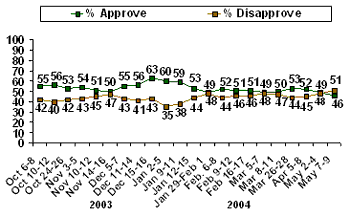
PRINCETON, NJ -- President George W. Bush's job approval rating has dipped to 46% -- the low point of his administration and a drop of three points from last week. He remains tied with Massachusetts Sen. John Kerry in presidential vote preference among likely voters. A new CNN/USA Today/Gallup survey also finds most Americans are following reports of Iraqi prisoner abuse at the hands of American troops closely, are bothered by them, and say such actions are never justified. Still, most Americans believe the actions are isolated events rather than common occurrences. They also believe the actions are serious criminal offenses that violate military policy, and people are not inclined to accept the excuse that the soldiers perpetrating the abuse were just following orders. In the wake of the prisoner abuse scandal, war support has fallen -- with a majority of Americans, for the first time, saying it was not worth going to war in Iraq.
Bush Job Approval
The 46% job approval rating has significant importance for an incumbent president seeking re-election. All five presidents who successfully sought re-election since 1950 have maintained job approval ratings above 50% beginning in February of the election year.
| George W. Bush's Job Approval Rating October 2003 -- Present |
 |
High Salience of Issue; Many Bothered
There is little doubt that the highly visible media coverage of the abuse of Iraqi prisoners by U.S. soldiers is contributing to the decline in Bush's job performance ratings. The latest poll, conducted May 7-9, finds 41% of Americans saying they have followed the news about the abuse of Iraqi prisoners "very closely," and another 39% saying "somewhat closely." These results make this news story rank among the top 10% most salient to the public measured by Gallup since 1991. Another 20% have followed the story -- either "not too closely" (15%) or "not at all" (5%).
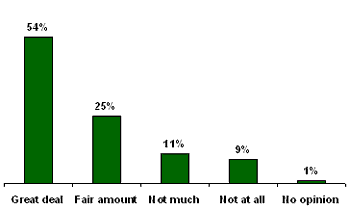
Over half of all Americans, 54%, are bothered "a great deal" about the abuse, and another 25% are bothered a "fair amount." Twenty percent are not bothered, with 11% saying "not much," and 9% saying "not at all."
| Would you say the abuse of Iraqi prisoners by U.S. soldiers bothers you -- a great deal, a fair amount, not much, or not at all? |
 |
| May 7-9, 2004 |
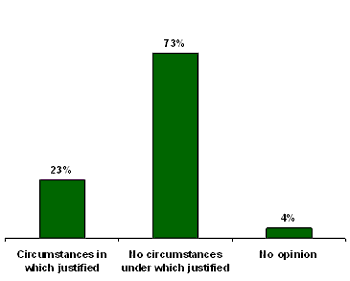
Few Americans (23%) say they can imagine circumstances that justify this type of behavior by U.S. soldiers, while most, 73%, say there are no circumstances that justify this type of behavior.
| Are There Circumstances in Which This Type
of Behavior by U.S. Soldiers Is Justified? |
 |
| May 7-9, 2004 |
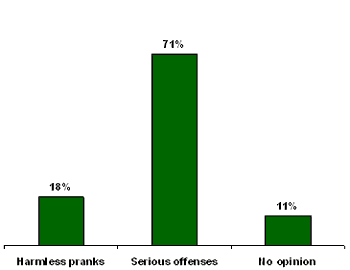
While some commentators have suggested the actions of the U.S. soldiers involved were just "harmless pranks," most Americans reject that characterization. Instead, 71% say the actions are serious offenses that deserve criminal punishment.
| Were Incidents Mostly Harmless Pranks or Serious Offenses That Deserve Criminal Punishment? |
 |
| May 7-9, 2004 |
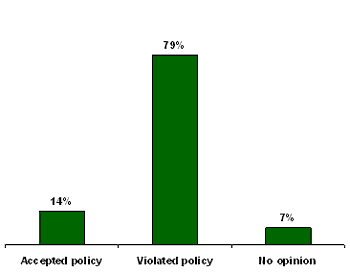
Similarly, most Americans believe the abuse of Iraqi prisoners was not condoned by military policy, saying instead the actions violated policy.
| Were the U.S. Soldiers' Actions Based on Accepted U.S. Military Policy About Dealing With POWs or Did They Violate Accepted U.S. Military Policy? |
 |
| May 7-9, 2004 |
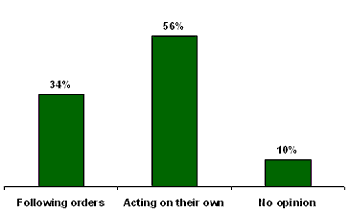
News reports suggest that some soldiers charged with abusing prisoners say they were just following orders. However, a majority of Americans, 56%, do not accept this excuse, while 34% do.
| Do you think the U.S. soldiers who were involved in the photographed incidents of abuse were following orders (or were they) acting on their own? |
 |
| May 7-9, 2004 |
When asked how much blame certain individuals should bear for the abuse, Americans overwhelmingly cite the soldiers who committed the abuse, but also lay much of the blame on the soldiers' direct supervising officers. More than 8 in 10 Americans say both the soldiers and their immediate superiors deserve either a "great deal" or a "fair amount" of the blame.
|
SUMMARY TABLE: BLAME FOR IRAQI PRISONER ABUSE |
|
|
Great deal/ |
|
% |
% |
% |
|
|
The soldiers who carried out the abuse at the prison |
65 |
18 |
83 |
|
The officers who directly supervise the soldiers who carried out the abuse |
60 |
25 |
85 |
|
The U.S. military intelligence officers who interrogated the prisoners |
40 |
32 |
72 |
|
Secretary of Defense Donald Rumsfeld |
26 |
22 |
48 |
|
President Bush |
22 |
20 |
42 |
Some soldiers have said that U.S. military intelligence officers ordered the soldiers to "soften up" prisoners for interrogation. About 7 in 10 Americans also blame these officers.
Almost half of all Americans say Secretary of Defense Donald Rumsfeld deserves a great deal or fair amount of the blame, while 42% say the same about Bush.
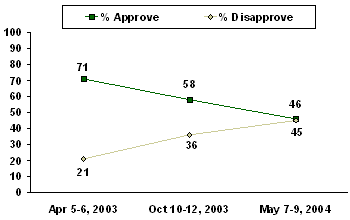
Despite calls from some lawmakers on Capitol Hill for Rumsfeld to resign, 64% of Americans say he should not, while just 31% say he should. Still, Rumsfeld's job approval rating shows Americans evenly divided -- 46% approve, while 45% disapprove. Last October, 58% approved and 36% disapproved.
| Secretary of Defense Donald Rumsfeld's Job Approval Ratings |
 |
Isolated Incidents, but Still a Setback
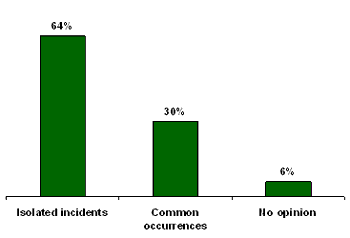
Most Americans believe that prisoner abuses were mostly isolated incidents (64%) rather than common occurrences (30%).
| Do you think the abuse of Iraqi prisoners by
U.S. soldiers are isolated incidents, or do you think they are common occurrences? |
 |
| May 7-9, 2004 |
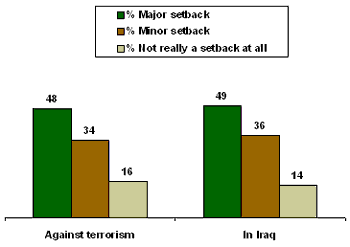
Nevertheless, about half of Americans believe the prisoner abuse scandal is a major setback for the United States in its war on terrorism, and separately in its war in Iraq.
| Do you think the news about the incidents of
abuse represent a major setback for the U.S. in the war against
terrorism/the war in Iraq, a minor setback, or not really a setback at all? |
 |
| May 7-9, 2004 |
Another third or so of Americans believe the setbacks are "minor," while only about 14% to 16% believe the incidents are not a setback at all.
War Support Down by One Measure, Steady by Another
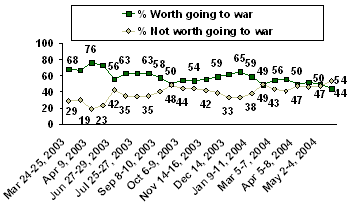
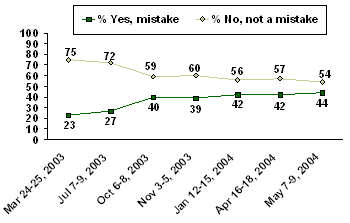
Americans are far less willing to say the war in Iraq was a "mistake" than they are to say it was not worth going to war. The poll shows an increase in the percentage of Americans now saying the war was not worth it, reaching a majority for the first time. The margin, 54% to 44%, represents a 13-point swing in opinion from last week, when 50% of Americans said the war was worth it, and 47% said it was not.
| Worth Going to War in Iraq? |
 |
But the percentage saying the war was a mistake has increased only slightly, with a majority continuing to say the war was not a mistake. Forty-four percent of respondents say it was a mistake, while a majority, 54%, say it was not. Last week the comparable figures were 42% and 57%, respectively.
| Mistake Sending Troops to Iraq? |
 |
Survey Methods
Results are based on telephone interviews with 1,003 national adults, aged 18 and older, conducted May 7-9, 2004. For results based on the total sample of national adults, one can say with 95% confidence that the margin of sampling error is ±3 percentage points.
For results based on the 504 national adults in the Form A half-sample and 499 national adults in the Form B half-sample, the maximum margins of sampling error are ±5 percentage points.
In addition to sampling error, question wording and practical difficulties in conducting surveys can introduce error or bias into the findings of public opinion polls.
2. If Massachusetts Senator John Kerry were the Democratic Party's candidate and George W. Bush were the Republican Party's candidate, who would you be more likely to vote for -- [ROTATED: John Kerry, the Democrat (or) George W. Bush, the Republican]?
2A. As of today, do you lean more toward -- [ROTATED: Kerry, the Democrat (or) Bush, the Republican]?
|
|
|
NEITHER (vol.) |
OTHER |
No |
|
|
% |
% |
% |
% |
% |
|
|
Likely Voters |
|||||
|
2004 May 7-9 |
47 |
48 |
2 |
1 |
2 |
|
2004 May 2-4 |
49 |
48 |
1 |
* |
2 |
|
2004 Apr 16-18 |
46 |
51 |
2 |
* |
1 |
|
2004 Apr 5-8 |
45 |
48 |
4 |
1 |
2 |
|
2004 Mar 26-28 |
47 |
51 |
1 |
-- |
1 |
|
2004 Mar 5-7 |
52 |
44 |
2 |
1 |
1 |
|
2004 Feb 16-17 |
55 |
43 |
1 |
* |
1 |
|
2004 Feb 6-8 |
48 |
49 |
1 |
* |
2 |
|
2004 Jan 29-Feb 1 |
53 |
46 |
* |
-- |
1 |
|
2004 Jan 9-11 |
43 |
55 |
1 |
* |
1 |
|
Registered Voters |
|||||
|
2004 May 7-9 |
50 |
44 |
3 |
* |
3 |
|
2004 May 2-4 |
47 |
47 |
2 |
1 |
3 |
|
2004 Apr 16-18 |
46 |
50 |
2 |
* |
2 |
|
2004 Apr 5-8 |
48 |
46 |
3 |
1 |
3 |
|
2004 Mar 26-28 |
46 |
49 |
2 |
* |
3 |
|
2004 Mar 5-7 |
50 |
45 |
2 |
1 |
2 |
|
2004 Feb 16-17 |
51 |
46 |
2 |
* |
1 |
|
2004 Feb 6-8 |
49 |
48 |
1 |
* |
2 |
|
2004 Jan 29-Feb 1 |
51 |
46 |
1 |
-- |
2 |
|
2004 Jan 9-11 |
40 |
57 |
2 |
-- |
1 |
|
2003 Nov 10-12 |
46 |
52 |
1 |
-- |
1 |
|
2003 Sep 19-21 |
48 |
47 |
2 |
1 |
2 |
|
National Adults |
|||||
|
2004 May 7-9 |
51 |
43 |
3 |
* |
3 |
|
2004 May 2-4 |
47 |
46 |
3 |
1 |
3 |
|
2004 Apr 16-18 |
46 |
49 |
2 |
1 |
2 |
|
2004 Apr 5-8 |
46 |
47 |
3 |
1 |
3 |
|
2004 Mar 26-28 |
46 |
48 |
3 |
* |
3 |
|
2004 Mar 5-7 |
50 |
45 |
3 |
* |
2 |
|
2004 Feb 16-17 |
51 |
44 |
3 |
* |
2 |
|
2004 Feb 6-8 |
48 |
48 |
2 |
* |
2 |
|
2004 Jan 29-Feb 1 |
52 |
44 |
2 |
-- |
2 |
|
2004 Jan 9-11 |
40 |
57 |
2 |
-- |
1 |
|
2003 Nov 10-12 |
44 |
53 |
1 |
-- |
2 |
|
2003 Sep 19-21 |
47 |
48 |
2 |
1 |
2 |
|
(vol.) Volunteered response |
|||||
|
* Less than 0.5% |
|||||
3. Now suppose Ralph Nader runs as an independent candidate, who would you be most likely to vote for -- [ROTATED: Kerry, the Democrat, Bush, the Republican,(or) Nader, the independent]?
3A. As of today, do you lean more toward -- [ROTATED: Kerry, the Democrat, Bush, the Republican,(or) Nader, the independent]?
|
|
|
|
NONE (vol.) |
OTHER |
No |
|
|
% |
% |
% |
% |
% |
% |
|
|
Likely Voters |
||||||
|
2004 May 7-9 |
45 |
47 |
5 |
2 |
-- |
1 |
|
2004 May 2-4 |
47 |
47 |
3 |
1 |
* |
2 |
|
2004 Apr 16-18 |
44 |
50 |
4 |
* |
* |
2 |
|
2004 Apr 5-8 |
43 |
47 |
4 |
2 |
1 |
3 |
|
2004 Mar 26-28 |
45 |
49 |
4 |
1 |
-- |
1 |
|
2004 Mar 5-7 |
50 |
44 |
2 |
1 |
1 |
2 |
|
Registered Voters |
||||||
|
2004 May 7-9 |
46 |
41 |
7 |
3 |
* |
3 |
|
2004 May 2-4 |
44 |
45 |
6 |
1 |
1 |
3 |
|
2004 Apr 16-18 |
44 |
47 |
5 |
1 |
* |
3 |
|
2004 Apr 5-8 |
46 |
45 |
5 |
2 |
* |
2 |
|
2004 Mar 26-28 |
43 |
48 |
5 |
1 |
-- |
3 |
|
2004 Mar 5-7 |
47 |
45 |
5 |
1 |
* |
2 |
|
National Adults |
||||||
|
2004 May 7-9 |
46 |
41 |
8 |
3 |
* |
2 |
|
2004 May 2-4 |
44 |
44 |
7 |
1 |
1 |
3 |
|
2004 Apr 16-18 |
43 |
46 |
7 |
1 |
* |
3 |
|
2004 Apr 5-8 |
45 |
45 |
5 |
2 |
1 |
2 |
|
2004 Mar 26-28 |
44 |
46 |
7 |
1 |
-- |
2 |
|
2004 Mar 5-7 |
47 |
44 |
5 |
1 |
1 |
2 |
|
(vol.) Volunteered response |
||||||
|
* Less than 0.5% |
||||||
4. Do you approve or disapprove of the way George W. Bush is handling his job as president?
|
|
Dis-approve |
No |
|
|
% |
% |
% |
|
|
2004 |
|||
|
2004 May 7-9 |
46 |
51 |
3 |
|
2004 May 2-4 |
49 |
48 |
3 |
|
2004 Apr 16-18 |
52 |
45 |
3 |
|
2004 Apr 5-8 |
52 |
45 |
3 |
|
2004 Mar 26-28 |
53 |
44 |
3 |
|
2004 Mar 8-11 |
50 |
47 |
3 |
|
2004 Mar 5-7 |
49 |
48 |
3 |
|
2004 Feb 16-17 |
51 |
46 |
3 |
|
2004 Feb 9-12 |
51 |
46 |
3 |
|
2004 Feb 6-8 |
52 |
44 |
4 |
|
2004 Jan 29-Feb 1 |
49 |
48 |
3 |
|
2004 Jan 12-15 |
53 |
44 |
3 |
|
2004 Jan 9-11 |
59 |
38 |
3 |
|
2004 Jan 2-5 |
60 |
35 |
5 |
|
|
Dis-approve |
No |
|
|
2003 |
% |
% |
% |
|
2003 Dec 15-16 |
63 |
34 |
3 |
|
2003 Dec 11-14 |
56 |
41 |
3 |
|
2003 Dec 5-7 |
55 |
43 |
2 |
|
2003 Nov 14-16 |
50 |
47 |
3 |
|
2003 Nov 10-12 |
51 |
45 |
4 |
|
2003 Nov 3-5 |
54 |
43 |
3 |
|
2003 Oct 24-26 |
53 |
42 |
5 |
|
2003 Oct 10-12 |
56 |
40 |
4 |
|
2003 Oct 6-8 |
55 |
42 |
3 |
|
2003 Sep 19-21 |
50 |
47 |
3 |
|
2003 Sep 8-10 |
52 |
43 |
5 |
|
2003 Aug 25-26 |
59 |
37 |
4 |
|
2003 Aug 4-6 |
60 |
36 |
4 |
|
2003 Jul 25-27 |
58 |
38 |
4 |
|
2003 Jul 18-20 |
59 |
38 |
3 |
|
2003 Jul 7-9 |
62 |
34 |
4 |
|
2003 Jun 27-29 |
61 |
36 |
3 |
|
2003 Jun 12-15 |
63 |
33 |
4 |
|
2003 Jun 9-10 |
62 |
34 |
4 |
|
2003 May 30-Jun 1 |
64 |
32 |
4 |
|
2003 May 19-21 |
66 |
30 |
4 |
|
2003 May 5-7 |
69 |
28 |
3 |
|
2003 Apr 22-23 |
70 |
26 |
4 |
|
2003 Apr 14-16 |
71 |
24 |
5 |
|
2003 Apr 7-9 |
69 |
26 |
5 |
|
2003 Apr 5-6 |
70 |
27 |
3 |
|
2003 Mar 29-30 |
71 |
26 |
3 |
|
2003 Mar 24-25 |
69 |
27 |
4 |
|
2003 Mar 22-23 |
71 |
25 |
4 |
|
2003 Mar 14-15 |
58 |
38 |
4 |
|
2003 Mar 3-5 |
57 |
37 |
6 |
|
2003 Feb 24-26 |
57 |
37 |
6 |
|
2003 Feb 17-19 |
58 |
37 |
5 |
|
2003 Feb 7-9 |
61 |
34 |
5 |
|
2003 Feb 3-6 |
59 |
35 |
6 |
|
2003 Jan 31-Feb 2 |
61 |
35 |
4 |
|
2003 Jan 23-25 |
60 |
36 |
4 |
|
2003 Jan 20-22 |
58 |
36 |
6 |
|
2003 Jan 20-22 |
58 |
36 |
6 |
|
2003 Jan 13-16 |
61 |
34 |
5 |
|
2003 Jan 10-12 |
58 |
37 |
5 |
|
2003 Jan 3-5 |
63 |
32 |
5 |
|
|
Dis-approve |
No |
|
|
2002 |
% |
% |
% |
|
2002 Dec 19-22 |
61 |
32 |
7 |
|
2002 Dec 16-17 |
63 |
33 |
4 |
|
2002 Dec 9-10 |
63 |
32 |
5 |
|
2002 Dec 5-8 |
64 |
29 |
7 |
|
2002 Nov 22-24 |
65 |
28 |
7 |
|
2002 Nov 11-14 |
66 |
26 |
8 |
|
2002 Nov 8-10 |
68 |
27 |
5 |
|
2002 Oct 31-Nov 3 |
63 |
29 |
8 |
|
2002 Oct 21-22 |
67 |
28 |
5 |
|
2002 Oct 14-17 |
62 |
31 |
7 |
|
2002 Oct 3-6 |
67 |
28 |
5 |
|
2002 Sep 23-26 |
68 |
26 |
6 |
|
2002 Sep 20-22 |
66 |
30 |
4 |
|
2002 Sep 13-16 |
70 |
26 |
4 |
|
2002 Sep 5-8 |
66 |
30 |
4 |
|
2002 Sep 2-4 |
66 |
29 |
5 |
|
2002 Aug 19-21 |
65 |
28 |
7 |
|
2002 Aug 5-8 |
68 |
26 |
6 |
|
2002 Jul 29-31 |
71 |
23 |
6 |
|
2002 Jul 26-28 |
69 |
26 |
5 |
|
2002 Jul 22-24 |
69 |
24 |
7 |
|
2002 Jul 9-11 |
73 |
21 |
6 |
|
2002 Jul 5-8 |
76 |
18 |
6 |
|
2002 Jun 28-30 |
76 |
19 |
5 |
|
2002 Jun 21-23 |
73 |
21 |
6 |
|
2002 Jun 17-19 |
74 |
20 |
6 |
|
2002 Jun 7-8 |
74 |
18 |
8 |
|
2002 Jun 3-6 |
70 |
23 |
7 |
|
2002 May 28-29 |
77 |
17 |
6 |
|
2002 May 20-22 |
76 |
17 |
7 |
|
2002 May 6-9 |
76 |
19 |
5 |
|
2002 Apr 29-May 1 |
77 |
20 |
3 |
|
2002 Apr 22-24 |
77 |
17 |
6 |
|
2002 Apr 8-11 |
75 |
20 |
5 |
|
2002 Apr 5-7 |
76 |
19 |
5 |
|
2002 Mar 22-24 |
79 |
17 |
4 |
|
2002 Mar 18-20 |
79 |
16 |
5 |
|
2002 Mar 8-9 |
80 |
14 |
6 |
|
2002 Mar 4-7 |
77 |
18 |
5 |
|
2002 Mar 1-3 |
81 |
14 |
5 |
|
2002 Feb 8-10 |
82 |
14 |
4 |
|
2002 Feb 4-6 |
82 |
14 |
4 |
|
2002 Jan 25-27 |
84 |
13 |
3 |
|
2002 Jan 11-14 |
83 |
13 |
4 |
|
2002 Jan 7-9 |
84 |
12 |
4 |
|
|
Dis-approve |
No |
|
|
2001 |
% |
% |
% |
|
2001 Dec 14-16 |
86 |
11 |
3 |
|
2001 Dec 6-9 |
86 |
10 |
4 |
|
2001 Nov 26-27 |
87 |
8 |
5 |
|
2001 Nov 8-11 |
87 |
9 |
4 |
|
2001 Nov 2-4 |
87 |
9 |
4 |
|
2001 Oct 19-21 |
88 |
9 |
3 |
|
2001 Oct 11-14 |
89 |
8 |
3 |
|
2001 Oct 5-6 |
87 |
10 |
3 |
|
2001 Sep 21-22 |
90 |
6 |
4 |
|
2001 Sep 14-15 |
86 |
10 |
4 |
|
2001 Sep 7-10 |
51 |
39 |
10 |
|
2001 Aug 24-26 |
55 |
36 |
9 |
|
2001 Aug 16-19 |
57 |
34 |
9 |
|
2001 Aug 10-12 |
57 |
35 |
8 |
|
2001 Aug 3-5 |
55 |
35 |
10 |
|
2001 Jul 19-22 |
56 |
33 |
11 |
|
2001 Jul 10-11 |
57 |
35 |
8 |
|
2001 Jun 28-Jul 1 |
52 |
34 |
14 |
|
2001 Jun 11-17 |
55 |
33 |
12 |
|
2001 Jun 8-10 |
55 |
35 |
10 |
|
2001 May 18-20 |
56 |
36 |
8 |
|
2001 May 10-14 |
56 |
31 |
13 |
|
2001 May 7-9 |
53 |
33 |
14 |
|
2001 Apr 20-22 |
62 |
29 |
9 |
|
2001 Apr 6-8 |
59 |
30 |
11 |
|
2001 Mar 26-28 |
53 |
29 |
18 |
|
2001 Mar 9-11 |
58 |
29 |
13 |
|
2001 Mar 5-7 |
63 |
22 |
15 |
|
2001 Feb 19-21 |
62 |
21 |
17 |
|
2001 Feb 9-11 |
57 |
25 |
18 |
|
2001 Feb 1-4 |
57 |
25 |
18 |
9. All in all, do you think it was worth going to war in Iraq, or not?
BASED ON 504 NATIONAL ADULTS IN FORM A
|
Worth |
Not worth |
No |
||
|
% |
% |
% |
||
|
2004 May 7-9 |
44 |
54 |
2 |
|
|
2004 May 2-4 |
50 |
47 |
3 |
|
|
2004 Apr 16-18 ^ |
52 |
46 |
2 |
|
|
2004 Apr 5-8 |
50 |
47 |
3 |
|
|
2004 Mar 26-28 |
56 |
41 |
3 |
|
|
2004 Mar 5-7 |
55 |
43 |
2 |
|
|
2004 Jan 29-Feb 1 |
49 |
49 |
2 |
|
|
2004 Jan 9-11 |
59 |
38 |
3 |
|
|
2003 Dec 15-16 ^ † |
65 |
33 |
2 |
|
|
2003 Dec 14 †‡? |
62 |
33 |
5 |
|
|
2003 Dec 5-7 † |
59 |
39 |
2 |
|
|
2003 Nov 14-16 † |
56 |
42 |
2 |
|
|
2003 Nov 3-5 † |
54 |
44 |
2 |
|
|
2003 Oct 24-26 † |
54 |
44 |
2 |
|
|
2003 Oct 6-8 † |
55 |
44 |
1 |
|
|
2003 Sep 19-21 † |
50 |
48 |
2 |
|
|
2003 Sep 8-10 † |
58 |
40 |
2 |
|
|
2003 Aug 25-26 † |
63 |
35 |
2 |
|
|
2003 Jul 25-27 † |
63 |
34 |
3 |
|
|
2003 Jul 18-20 † |
63 |
35 |
2 |
|
|
2003 Jun 27-29 † |
56 |
42 |
2 |
|
|
2003 Apr 14-16 †‡ |
73 |
23 |
4 |
|
|
2003 Apr 9 †‡? |
76 |
19 |
5 |
|
|
2003 Apr 7-8 †‡ |
67 |
30 |
3 |
|
|
2003 Mar 24-25 †‡ |
68 |
29 |
3 |
|
|
2003 Jan 3-5 †‡ |
53 |
42 |
5 |
|
|
^ |
Asked of a half sample. |
|||
|
† |
WORDING: All in all, do you think the situation in Iraq was worth going to war over, or not? |
|||
|
‡ |
WORDING: All in all, do you think the current situation in Iraq is worth going to war over, or not? |
|||
|
? |
Polls conducted entirely in one day, such as this one, are subject to additional error or bias not found in polls conducted over several days. |
|||
10. In view of the developments since we first sent our troops to Iraq, do you think the United States made a mistake in sending troops to Iraq, or not?
BASED ON 499 NATIONAL ADULTS IN FORM B
|
|
|
No opinion |
|
|
% |
% |
% |
|
|
Iraq |
|||
|
2004 May 7-9 |
44 |
54 |
2 |
|
2004 Apr 16-18 |
42 |
57 |
1 |
|
2004 Jan 12-15 |
42 |
56 |
2 |
|
2003 Nov 3-5 |
39 |
60 |
1 |
|
2003 Oct 6-8 |
40 |
59 |
1 |
|
2003 Jul 7-9 |
27 |
72 |
1 |
|
2003 Mar 24-25 |
23 |
75 |
2 |
|
Afghanistan |
|||
|
2002 Jan 7-9 |
6 |
93 |
1 |
|
2001 Nov 8-11 |
9 |
89 |
2 |
|
Yugoslavia |
|||
|
1999 Jun 4-5 |
43 |
53 |
4 |
|
1999 Apr 21 |
42 |
51 |
7 |
|
Persian Gulf War |
|||
|
1991 Jul 18-21 |
15 |
82 |
3 |
|
1991 Feb 28-Mar 3 |
10 |
87 |
3 |
|
1991 Feb 7-10 |
21 |
76 |
3 |
|
1991 Jan 30-Feb 2 |
18 |
80 |
2 |
|
1991 Jan 23-26 |
18 |
77 |
5 |
|
1991 Jan 17-20 |
16 |
80 |
4 |
|
1991 Jan 11-13 |
29 |
65 |
6 |
|
1991 Jan 3-6 |
30 |
61 |
9 |
|
1990 Dec 6-9 |
28 |
66 |
6 |
|
1990 Nov 29-Dec 2 |
29 |
66 |
5 |
|
1990 Nov 15-18 |
27 |
65 |
8 |
|
1990 Nov 8-11 |
27 |
68 |
5 |
|
1990 Nov 2-4 |
25 |
67 |
8 |
|
1990 Oct 25-28 |
24 |
71 |
5 |
|
1990 Oct 18-21 |
26 |
67 |
7 |
|
1990 Oct 11-14 |
27 |
68 |
5 |
|
1990 Oct 3-4 |
21 |
71 |
8 |
|
1990 Sep 27-30 |
20 |
73 |
7 |
|
1990 Sep 14-16 |
18 |
73 |
10 |
|
1990 Sep 10-11 |
19 |
76 |
5 |
|
1990 Aug 30-Sep 2 |
16 |
76 |
8 |
|
1990 Aug 23-26 |
18 |
76 |
6 |
|
1990 Aug 16-19 |
17 |
75 |
8 |
|
|
|
No opinion |
|
|
Vietnam War |
% |
% |
% |
|
2000 Nov 13-15 |
69 |
24 |
7 |
|
1995 Apr 21-24 |
71 |
23 |
6 |
|
1990 Mar 15-18 |
74 |
22 |
4 |
|
1973 Jan 12-15 |
60 |
29 |
11 |
|
1971 May 14-17 |
61 |
28 |
11 |
|
1971 Jan 8-11 |
60 |
31 |
9 |
|
1970 May 21-26 |
56 |
36 |
8 |
|
1970 Apr 2-7 |
51 |
34 |
15 |
|
1970 Jan 15-20 |
57 |
32 |
11 |
|
1969 Sep 17-22 |
58 |
32 |
10 |
|
1969 Jan 23-28 |
52 |
39 |
9 |
|
1968 Sep 26-Oct 1 |
54 |
37 |
9 |
|
1968 Aug 7-12 |
53 |
35 |
12 |
|
1968 Apr 4-9 |
48 |
40 |
12 |
|
1968 Feb 22-27 |
49 |
42 |
9 |
|
1968 Feb 1-6 |
46 |
42 |
12 |
|
1967 Dec 7-12 |
45 |
46 |
9 |
|
1967 Oct 6-11 |
47 |
44 |
9 |
|
1967 Jul 13-18 |
41 |
48 |
11 |
|
1967 Apr 19-24 |
37 |
50 |
13 |
|
1967 Jan 26-31 |
32 |
52 |
16 |
|
1966 Nov 10-15 |
31 |
52 |
17 |
|
1966 Sep 8-13 |
35 |
48 |
17 |
|
1966 May 5-10 |
36 |
49 |
15 |
|
1966 Mar 3-8 |
26 |
59 |
15 |
|
1965 Aug 27-Sep 1 |
24 |
60 |
16 |
|
Korean War |
|||
|
2000 Jun 6-7 |
34 |
47 |
19 |
|
1953 Jan 11-16 |
36 |
50 |
14 |
|
1952 Oct 17-22 |
43 |
37 |
19 |
|
1952 Oct 9-14 |
43 |
37 |
20 |
|
1952 Feb 28-Mar 5 |
51 |
35 |
14 |
|
1951 Aug 3-8 |
42 |
48 |
11 |
|
1951 Jun 16-21 |
43 |
40 |
17 |
|
1951 Apr 16-21 |
37 |
45 |
18 |
|
1951 Mar 26-31 |
45 |
43 |
12 |
|
1951 Feb 4-9 |
49 |
41 |
9 |
|
1951 Jan 1-5 |
49 |
38 |
13 |
|
1950 Aug 20-25 |
20 |
65 |
15 |
Q.10 (MISTAKE SENDING TROOPS TO IRAQ) CONTINUED
|
AFGHANISTAN WORDING: Do you think the United States made a mistake in sending military forces to Afghanistan, or not? |
|
YUGOSLAVIA WORDING: In view of the developments since we entered the fighting in Yugoslavia, do you think the United States made a mistake sending military forces to fight in Yugoslavia? |
|
PERSIAN GULF WAR WORDING (Feb. 28-Mar 3, 1991-Jul. 18-21, 1991): In view of the developments since we first sent our troops to the Persian Gulf region, do you think the United States made a mistake in sending troops to the Persian Gulf region, or not? |
|
PERSIAN GULF WAR WORDING (Aug. 16-19, 1990-Feb. 7-10, 1990): In view of the developments since we first sent our troops to Saudi Arabia, do you think the United States made a mistake in sending troops to Saudi Arabia, or not? |
|
VIETNAM WAR WORDING (1990-2000): Looking back, do you think the United States made a mistake sending troops to fight in Vietnam? |
|
VIETNAM WAR WORDING (1965-1973): In view of the developments since we entered the fighting in Vietnam, do you think the U.S. made a mistake sending troops to fight in Vietnam? |
|
KOREAN WAR WORDING (2000): Based on what you have heard or read, do you think the United States made a mistake in going into the war in Korea, or not? |
|
KOREAN WAR WORDING (Feb. 1951-Jan. 1953): Do you think the United States made a mistake in going into the war in Korea, or not? |
|
KOREAN WAR WORDING (Aug. 1950-Jan. 1951): In view of the developments since we entered the fighting in Korea, do you think the United States made a mistake in deciding to defend Korea, or not? |
13. How closely have you been following the news about evidence of U.S. soldiers abusing Iraqi prisoners, including incidents that involve photographs of the abuse -- very closely, somewhat closely, not too closely, or not at all?
|
Very closely |
Somewhat |
Not too |
|
No |
|
|
2004 May 7-9 |
41% |
39 |
15 |
5 |
-- |
14. Would you say the abuse of Iraqi prisoners by U.S. soldiers bothers you -- a great deal, a fair amount, not much, or not at all?
|
A great |
A fair |
Not |
|
No |
|
|
2004 May 7-9 |
54% |
25 |
11 |
9 |
1 |
15. Do you think the abuse of Iraqi prisoners by U.S. soldiers are isolated incidents, or do you think they are common occurrences?
|
Isolated incidents |
Common occurrences |
No opinion |
|
|
2004 May 7-9 |
64% |
30 |
6 |
16. Which comes closer to your view -- [ROTATED: there are circumstances in which you might find this type of behavior by U.S. soldiers justified, (or) there are no circumstances under which this type of behavior by U.S. soldiers would be justified]?
|
Circumstances in which justified |
No circumstances under which justified |
No |
|
|
2004 May 7-9 |
23% |
73 |
4 |
Q.17-18 SPLIT SAMPLED
17. Based on what you have read or heard, which of the following statements about the actions the soldiers took in the abuse cases comes closer to your view -- [ROTATED: they were actions based on accepted U.S. military policy about how to deal with prisoners of war, (or) they were actions that violated accepted U.S. military policy about how to deal with prisoners of war]?
BASED ON 504 NATIONAL ADULTS IN FORM A
|
Accepted policy |
Violated policy |
No opinion |
|
|
2004 May 7-9 |
14% |
79 |
7 |
18. Do you think the U.S. soldiers who were involved in the photographed incidents of abuse were -- [ROTATED: following orders (or were they) acting on their own]?
BASED ON 499 NATIONAL ADULTS IN FORM B
|
Following orders |
Acting on own |
No opinion |
|
|
2004 May 7-9 |
34% |
56 |
10 |
19. Which comes closer to your view about the actions of the U.S. soldiers involved in the photographed incidents of abuse -- [ROTATED: they were mostly harmless pranks that do not deserve any major punishment, (or) they were mostly serious offenses that deserve criminal punishment]?
|
Harmless pranks |
Serious offenses |
No opinion |
|
|
2004 May 7-9 |
18% |
71 |
11 |
20. How much do you blame each of the following for the abuse of prisoners by U.S. soldiers -- a great deal, a fair amount, not much, or not at all? How about -- [ITEMS A-D ROTATED, ITEM E READ LAST]?
A. President Bush
|
A great |
A fair |
Not |
|
No |
|
|
2004 May 7-9 |
22% |
20 |
17 |
39 |
2 |
B. Secretary of Defense Donald Rumsfeld
|
A great |
A fair |
Not |
|
No |
|
|
2004 May 7-9 |
26% |
22 |
21 |
28 |
3 |
C. The officers who directly supervise the soldiers who carried out the abuse
|
A great |
A fair |
Not |
|
No |
|
|
2004 May 7-9 |
60% |
25 |
7 |
5 |
3 |
D. The U.S. military intelligence officers who interrogated the prisoners
|
A great |
A fair |
Not |
|
No |
|
|
2004 May 7-9 |
40% |
32 |
12 |
10 |
6 |
E. The soldiers who carried out the abuse at the prison
|
A great |
A fair |
Not |
|
No |
|
|
2004 May 7-9 |
65% |
18 |
8 |
6 |
3 |
SUMMARY TABLE: BLAME FOR IRAQI PRISONER ABUSE
|
|
|
|
Great deal/ |
|
% |
% |
% |
|
|
The soldiers who carried out the abuse at the prison |
65 |
18 |
83 |
|
The officers who directly supervise the soldiers who carried out the abuse |
60 |
25 |
85 |
|
The U.S. military intelligence officers who interrogated the prisoners |
40 |
32 |
72 |
|
Secretary of Defense Donald Rumsfeld |
26 |
22 |
48 |
|
President Bush |
22 |
20 |
42 |
Q.21-22 SPLIT SAMPLED
21. Do you think Secretary of Defense Donald Rumsfeld should -- or should not -- resign as a result of these incidents?
BASED ON 504 NATIONAL ADULTS IN FORM A
|
Yes, should |
No, should not |
No opinion |
|
|
2004 May 7-9 |
31% |
64 |
5 |
Q.24-25 SPLIT SAMPLED
24. Do you think the news about the incidents of abuse represent a major setback for the U.S. in the war against terrorism, a minor setback, or not really a setback at all?
BASED ON 504 NATIONAL ADULTS IN FORM A
|
Major |
Minor |
Not really a setback at all |
No |
|
|
2004 May 7-9 |
48% |
34 |
16 |
2 |
25. Do you think the news about the incidents of abuse represent a major setback for the U.S. in the war in Iraq, a minor setback, or not really a setback at all?
BASED ON 499 NATIONAL ADULTS IN FORM B
|
Major |
Minor |
Not really a setback at all |
No |
|
|
2004 May 7-9 |
49% |
36 |
14 |
1 |