GALLUP NEWS SERVICE
PRINCETON, NJ -- Other than failing to produce a bounce in voter support for Massachusetts Sen. John Kerry, the Democratic convention looks, on paper, to have been generally well received. According to a post-convention CNN/USA Today/Gallup poll, conducted Friday through Sunday, TV viewership was fairly high, Kerry's speech was at least as well received as other recent convention speeches, and the net effect of the convention on Americans' stated willingness to vote for Kerry was positive. Kerry's choice of North Carolina Sen. John Edwards as his running mate has also proved popular: 58% of Americans say the selection of Edwards makes them more likely to vote for Kerry.
Other than the bounce, in all of these respects, the 2004 Democratic convention generally matches or exceeds the impact of former Vice President Al Gore's convention in 2000, George W. Bush's in 2000, and former Kansas Sen. Bob Dole's in 1996. The gold standard, however, remains the 1992 Democratic convention in New York City at which former President Bill Clinton was nominated for his first term.
Despite positive convention reviews from the general public, Kerry exited Boston no further ahead in the race against Bush than when he arrived. CNN/USA Today/Gallup's latest poll shows the election a dead heat at 48% among registered voters. Among likely voters, Bush enjoys a 51% to 47% lead. By contrast, Kerry had led Bush by four points among registered voters and by two points among likely voters in the July 19-21 survey conducted before the convention.

One in Four Engrossed by Coverage
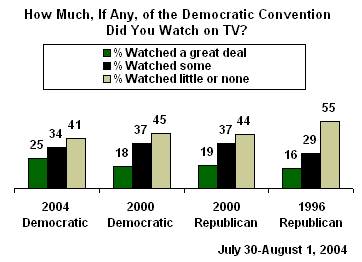
It appears that the reduction in the three major television networks' live coverage of the 2004 Democratic convention compared to previous years was more than offset by the expansive coverage provided by cable news and public television. A quarter of Americans report having watched "a great deal" of the convention on TV, which was higher than the 16% to 19% recorded for both 2000 conventions and for the Republican convention in 1996.
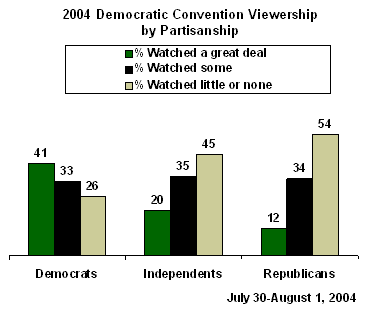
Naturally, Democrats were the most attentive to the coverage this past week, but even close to half of Republicans and a slight majority of independents say they tuned in to at least some of it.
Overall Effect Was Positive
Overall, 44% of Americans say the convention made them more likely to vote for Kerry while 30% say it made them less likely. This net +14 in willingness to support Kerry is fairly typical for recent conventions, with 1992 being the major exception when Clinton received a +45 net increased willingness. Also, former Massachusetts Gov. Michael Dukakis' convention in 1988 yielded him a higher than average result on this question (+35). However, interestingly, unlike Clinton in 1992, Dukakis received only an average convention bounce in 1988.
|
Impact of Conventions on Voter Willingness to Support Nominee for President |
||||
|
More likely |
Less likely |
Net More Likely |
Candidate "Bounce"* |
|
|
% |
% |
|||
|
2004 Dem Convention (Kerry) |
44 |
30 |
+14 |
-1 |
|
2000 Dem Convention (Gore) |
43 |
28 |
+15 |
+9 |
|
2000 GOP Convention |
44 |
27 |
+17 |
+8 |
|
1996 GOP Convention (Dole) |
45 |
34 |
+11 |
+3 |
|
1992 Dem Convention (Clinton) |
60 |
15 |
+45 |
+16 |
|
1988 GOP Convention (Bush) |
43 |
27 |
+16 |
+6 |
|
1988 Dem Convention (Dukakis) |
56 |
21 |
+35 |
+8 |
|
1984 Dem Convention (Mondale) |
45 |
29 |
+16 |
+9 |
|
Average for all candidates |
-- |
-- |
-- |
+6.3 |
|
* Candidate Bounce statistics are based on trial heats of registered voters immediately pre-convention and post-convention for each election. |
||||
Acceptance Speech Went Over Well
Compared to other recent convention speeches, a relatively high proportion of Americans give Kerry's acceptance speech stellar reviews. One in four describe the speech as "excellent," and another 27% call it "good." Only 9% rate it as "poor" or "terrible," while 19% are more noncommittal, saying it was "just okay." One in five Americans could not rate the speech because they did not see it.
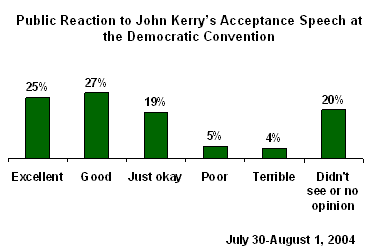
Kerry compares favorably to some of his predecessors on this indicator. The 25% calling his speech excellent beats the 18% received by Gore in 2000, the 19% received by Bush in 2000, and the 20% received by Dole in 1996. Still, the overall rating of Kerry's speech as either excellent or good is about the same as past candidates.
Edwards a Plus
Strictly speaking, Kerry's selection of Edwards as his running mate is not a reflection on the convention. That announcement was made weeks earlier, on July 6. However, given Edwards' prominence at the convention it is worth noting that he appears to be a solid plus for the ticket. Close to 6 in 10 Americans say they are more likely to vote for Kerry because of Edwards; only 23% say they are less likely to vote for Kerry on this basis.
Gallup trends measuring the impact of previous vice presidential selections suggest that Edwards' +35 impact on the ticket is slightly above average. The high bar was set by Clinton's selection of Gore in 1992, which elicited a net +63 willingness to support the ticket. The low bar was set by former President George H.W. Bush's selection of Dan Quayle in 1988, yielding only a net +3. The average net vice presidential impact score across all of Gallup's measures from 1984 through 2000 is +26.
|
Impact of VP Selection on Voter Support for Ticket |
|||
|
More likely |
Less likely |
Net More Likely |
|
|
% |
% |
% |
|
|
2004 Dem (Edwards) |
58 |
23 |
+35 |
|
2000 Dem (Lieberman) |
54 |
22 |
+32 |
|
2000 GOP (Cheney) |
49 |
30 |
+19 |
|
1996 GOP (Kemp) |
60 |
23 |
+37 |
|
1992 Dem (Gore) |
73 |
10 |
+63 |
|
1988 GOP (Quayle) |
36 |
33 |
+3 |
|
1988 Dem (Bentsen) |
48 |
28 |
+20 |
|
1984 Dem (Ferraro) |
26 |
18 |
+8 |
|
Average from 1984-2000 |
49 |
23 |
+26 |
Few Ruffled Feathers
The Democrats promised a civil tone at this convention, insisting they would limit their attacks on Bush in favor of promoting the positive agenda of Kerry. In fact, just less than a third of Americans believe that the Democrats went too far in criticizing Bush and the Republican Party at the convention. The plurality (44%) believe the convention struck the right tone, while 17% feel it did not go far enough in criticizing the opposition.
While Republicans are the most likely to believe the criticism went too far, still only a bare majority (57%) feels this way. Democrats are mostly inclined to believe the level of criticism was about right, but a third felt it could have gone further.
|
2004 Democratic Convention Viewership by Partianship |
|||
|
Democrats |
Independents |
Republicans |
|
|
2004 Jul 30-Aug 1 |
% |
% |
% |
|
Too far |
8 |
27 |
57 |
|
About right |
56 |
47 |
29 |
|
Not far enough |
32 |
16 |
3 |
|
No opinion |
4 |
10 |
11 |
Survey Methods
These results are based on telephone interviews with a randomly selected national sample of 1,518 adults, aged 18 and older, conducted July 30-August 1, 2004. For results based on this sample, one can say with 95% confidence that the maximum error attributable to sampling and other random effects is ±3 percentage points.
For results based on the sample of 1,366 registered voters, the maximum margin of sampling error is ±3 percentage points.
Results based on likely voters are based on the subsample of 1,129 survey respondents deemed most likely to vote in the November 2004 General Election, according to a series of questions measuring current voting intentions and past voting behavior. For results based on the total sample of likely voters, one can say with 95% confidence that the margin of sampling error is ±3 percentage points. The likely voter model assumes a turnout of 55% of national adults. The likely voter sample is weighted down to match this assumption.
In addition to sampling error, question wording and practical difficulties in conducting surveys can introduce error or bias into the findings of public opinion polls.
30. Do you think at this year's Democratic convention, that the Democrats -- [ROTATED: went too far in criticizing George W. Bush and the Republican Party, were about right, or did not go far enough in criticizing George W. Bush and the Republican Party]?
|
Too far |
About right |
Not far enough |
No opinion |
|
|
2004 Jul 30-Aug1 |
% |
% |
% |
% |
|
National Adults |
31 |
44 |
17 |
8 |
|
Registered Voters |
31 |
45 |
16 |
8 |
|
Likely Voters |
32 |
46 |
14 |
8 |
31. From what you have heard or read, how would you rate John Kerry's acceptance speech at the Democratic convention on Thursday night, as -- excellent, good, just okay, poor, or terrible?
|
|
|
|
|
|
DIDN'T SEE (vol.) |
|
|
|
2004 Jul 30-Aug 1 |
% |
% |
% |
% |
% |
% |
% |
|
National Adults |
25 |
27 |
19 |
5 |
4 |
19 |
1 |
|
Registered Voters |
25 |
26 |
20 |
6 |
4 |
18 |
1 |
|
Likely Voters |
27 |
24 |
20 |
7 |
5 |
16 |
1 |
|
(vol.) Volunteered response |
|||||||
32. Please tell me whether each of the following makes you more likely or less likely to vote for John Kerry. How about -- [ITEMS ROTATED]?
A. What you saw or read of this week's Democratic convention in Boston
|
|
|
NO DIFFERENCE (vol.) |
|
|
|
% |
% |
% |
% |
|
|
2004 Jul 30-Aug 1 |
||||
|
National Adults |
44 |
30 |
18 |
8 |
|
Registered Voters |
44 |
32 |
17 |
7 |
|
Likely Voters |
42 |
34 |
18 |
6 |
|
(vol.) Volunteered response |
||||
B. Kerry's choice of John Edwards as his running mate
|
|
|
NO DIFFERENCE (vol.) |
|
|
|
% |
% |
% |
% |
|
|
2004 Jul 30-Aug 1 |
||||
|
National Adults |
58 |
23 |
15 |
4 |
|
Registered Voters |
57 |
25 |
14 |
4 |
|
Likely Voters |
56 |
26 |
15 |
3 |
|
(vol.) Volunteered response |
||||
34. How much, if any, of the Democratic convention did you watch on T.V. this week -- none of it, very little, some of it, or a great deal?
35. Did you happen to see, hear, or read any news coverage of the Democratic convention?
|
|
|
|
Watched none, but saw news coverage |
Watched none, saw no news coverage |
|
|
|
% |
% |
% |
% |
% |
% |
|
|
2004 Jul 30-Aug 1 |
||||||
|
National Adults |
25 |
34 |
25 |
8 |
8 |
* |
|
Registered Voters |
26 |
35 |
23 |
8 |
8 |
* |
|
Likely Voters |
30 |
37 |
20 |
9 |
4 |
0 |
|
* Less than 0.5% |
||||||