GALLUP NEWS SERVICE
PRINCETON, NJ -- Gallup's annual environmental poll finds few signs that environmentalists opposed to President George W. Bush's environmental agenda have had success in persuading the public to see things from their perspective. While the poll indicates that Americans want the U.S. government to do more to protect the environment, ratings of Bush's handling of environmental issues have declined only in proportion to the decline in his overall ratings. And a majority of Americans perceive that the Bush administration has either kept environmental protection the same or strengthened it. There has also been only a slight increase in self-reported participation in environmental organizations. Sympathy for the environmental movement, while high, has also not increased substantially over the past several years.
Public support for the job Bush is doing on environmental protection has declined since he took office, but Americans are still not highly critical of him on this issue. Half of all Americans, up from 38% four years ago, now say Bush is doing a poor job of protecting the nation's environment, but nearly 4 in 10 (39%) still say he is doing a good job.
Furthermore, the 12-point decline since March 2001 in the percentage saying Bush is doing a good job in this area is smaller than the declines seen in the percentages endorsing his work in the areas of energy policy and keeping the country prosperous.
|
Positive Ratings of President Bush |
||||
|
% Saying Bush Is Doing a "Good Job" |
||||
|
Protecting the environment |
Improving energy policy |
Keeping America prosperous |
Overall job approval |
|
|
% |
% |
% |
% |
|
|
2001 Mar 5-7 |
51 |
58 |
66 |
63 |
|
2001 Apr 6-9 |
49 |
54 |
60 |
59 |
|
2002 Mar 4-7 |
50 |
46 |
63 |
77 |
|
2003 Mar 3-5 |
44 |
39 |
44 |
57 |
|
2004 Mar 8-11 |
41 |
34 |
41 |
50 |
|
2005 Mar 7-10 |
39 |
32 |
47 |
52 |
|
Change since March 2001 |
-12 |
-26 |
-19 |
-11 |
Given that Bush's overall job approval rating was 11 points lower at the time of the 2005 environment poll than it was near the start of his first term, in March 2001, it is not clear how much of the 12-point drop in his environmental protection score is specifically tied to perceptions of his performance on environmental issues, and how much to that of his overall job performance.
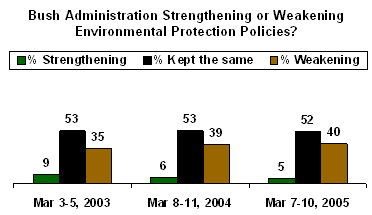
An item focusing more explicitly on the Bush administration's environmental policies suggests that environmentalists (many of whom opposed Bush in both 2000 and 2004) have not been successful in highlighting what they allege to be Bush's poor record on the environment. There has been little change since 2003 in Americans' views of how the Bush administration has affected the nation's environmental policies. For each of the last three years, the majority of Americans -- either 52% or 53% -- have said those policies are being kept about the same. An additional 40% now say environmental protection has been weakened under Bush, while only 5% say it has been strengthened.
While some environmental advocates might take comfort in the fact that the public is eight times as likely to describe the administration as weakening rather than strengthening environmental protection, many of the environmentalists who oppose Bush's policies cannot be pleased that there has been only a five percentage-point increase in those choosing "weakening" since 2003, despite their consistent efforts to publicize this claim.
Finally, in reviewing the Bush administration's ratings on the environment, it is interesting to note that Bush's job approval ratings on the environment are fairly typical for a Republican president -- and no worse. In fact, his average approval rating on the environment since 2001 (49%) is slightly higher than what his father received as president (47%), and quite a bit higher than what Ronald Reagan received (36%). (Given the limited measurement of environmental job approval, however, these figures are only suggestive of the pattern of public support for each president's environmental policies.)
|
Average Approval Scores for Handling of the Environment |
||||
|
Approve |
Disapprove |
No opinion |
||
|
Data span (in years) |
% |
% |
% |
|
|
George W. Bush |
2001-2005 |
49 |
41 |
10 |
|
Bill Clinton |
1993-1999 |
58 |
29 |
13 |
|
George Bush |
1989-1992 |
47 |
42 |
11 |
|
Ronald Reagan |
1981-1983 |
36 |
41 |
24 |
Public Says, "Do More"
It might be tempting to interpret these results as suggesting that Americans really don't care much one way or the other whether the government is protecting the environment, but such a conclusion would be misleading. Responses to another item in this year's poll suggest that the public is supportive of a stronger government role in protecting the environment. When asked if they "think the U.S. government is doing too much, too little, or about the right amount in terms of protecting the environment" a clear majority of Americans (58%) say "too little" and only a small minority (5%) say "too much." These figures represent the highest ratio of "too little" to "too much" observed since 1992, and a continuing increase in support for governmental action since a low point in March 2003 when 51% held the former view.
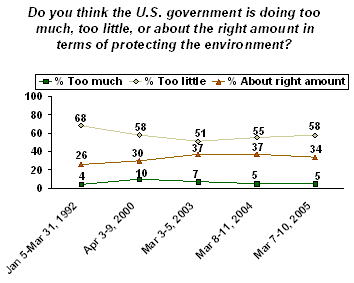
Such results demonstrate that the vast majority of Americans do not want to see a reduction in the government's environmental protection efforts (because 92% respond that it is doing "too little" or "about the right amount").
Similarly, Americans continue to favor the environment when asked to choose between environmental protection and economic growth. After dipping slightly below 50% last year and the year before, a majority (53%) once again says that protection of the environment should be given priority, when environmental protection conflicts with economic growth.
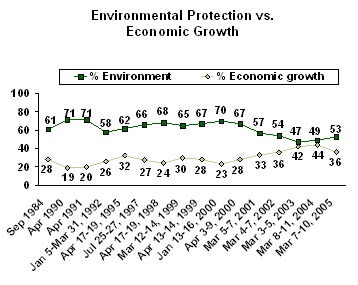
Yet, the allegations on the part of some environmentalists that the Bush administration's policies on the environment are deficient have clearly not produced a major backlash from what continues to be an environmentally concerned public.
This again suggests that, in a post-9/11 world, environmental issues are simply not salient enough to generate a public backlash comparable, for example, to that seen in Reagan's first term. Gallup trends show that public approval of Reagan's handling of the environment fell from a +6 net positive score (39% approve, 33% disapprove) in June 1981 to a -16 net negative score (33% approve, 49% disapprove) by April 1983.
Not only did expressions of public support for environmental protection increase dramatically in response to criticisms of Reagan's policies, but environmental activism was given a huge boost by the mobilizing efforts against his administration of the Sierra Club and other environmental organizations. There is, however, little evidence from this year's poll that reaction to the Bush administration is likewise stimulating major growth in environmental activism.
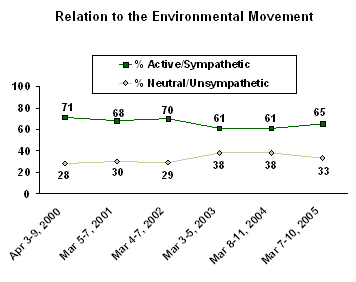
When asked to indicate their relationship to the environmental movement, 16% of Americans identify themselves as an "active participant" and another 49% as "sympathetic, but not active," both of which are a two percentage-point increase over the past two years. However, such small increases are within the range of sampling error, and the combined 65% of Americans who see themselves as active or sympathetic to the environmental movement still ranks below the levels observed from 2000 through 2002.
Equally small changes are recorded in two related items that ask specifically about membership in environmental organizations, both at the national/international level and at a regional/local level. Today, 7% (up from 5% in 2000) report belonging to "any large national or international environmental organizations." A slightly higher number, 12%, now belong to an environmental group or organization at the local or regional level -- up from 9% in 2000.
While such small changes can easily be due to sampling error, if they are accurate this would represent a substantial swelling of membership rolls among environmental organizations since 2000 -- as a single percent statistically represents over a million adults.
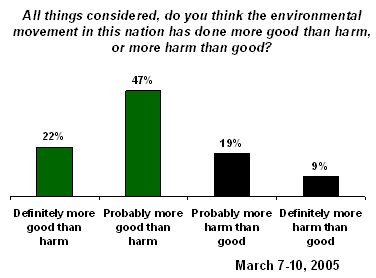
More generally, Gallup does find that Americans broadly support the environmental movement. About two-thirds of Americans tend to believe that the environmental movement has done more good than harm, while only 28% say it has done more harm than good.
Also, when given the opportunity to rate the trust they have in 10 different entities that play a role in environmental protection, Americans express the highest levels of trust in local and national environmental organizations. These rank slightly ahead of federal environmental agencies, and well ahead of the U.S. Congress, state environmental agencies, and local governmental agencies. Americans have the least trust in large corporations to protect environmental quality.
|
How Much Trust in Each to Protect Nation's Environment? |
|||
|
|
|
|
Slight amount/ |
|
% |
% |
% |
|
|
Local environmental organizations |
26 |
43 |
28 |
|
National environmental organizations |
25 |
42 |
30 |
|
Federal environmental agencies like the EPA |
22 |
42 |
32 |
|
State environmental agencies |
16 |
48 |
34 |
|
The Democratic Party |
15 |
37 |
45 |
|
Small businesses |
15 |
30 |
53 |
|
Local government agencies |
11 |
40 |
47 |
|
The U.S. Congress |
11 |
34 |
53 |
|
The Republican Party |
9 |
32 |
56 |
|
Large corporations |
7 |
17 |
75 |
Environmentalism at a Standstill?
Many environmentalists have been put on the defensive by the combination of an administration that they perceive as pursuing policies they strongly oppose, and a Congress that typically supports those policies. In the past, one way that interest groups proceeded in such situations was to mobilize strong public opposition to an administration's policies, but this year's poll suggests that environmentalists opposed to Bush administration polices are apparently facing an uphill battle.
Unlike the 1980s, when environmentalists did succeed in generating a significant backlash against the Reagan administration's environmental agenda, forcing it to ease its efforts at deregulation, currently environmentalists are finding it extremely difficult to get their concerns into the media spotlight.
While a slowly growing percentage of the public gives the president negative ratings on the environment, such perceptions do not appear to be leading to a dramatic upsurge in support for environmentalism. Barring a major catastrophe that raises the salience of environmental problems, it appears that concerns over terrorism, Iraq, Social Security, and from time to time the economy, will continue to overshadow Americans' concerns about the environment.
Riley E. Dunlap, Gallup Scholar for the Environment, is Professor of Sociology at the University of Central Florida.
Lydia Saad, Gallup Poll Senior Editor, contributed to this article.
Survey Methods
These results are based on telephone interviews with a randomly selected national sample of 1,004 adults, aged 18 and older, conducted March 7-10, 2005. For results based on this sample, one can say with 95% confidence that the maximum error attributable to sampling and other random effects is ±3 percentage points. For results based on the 494 national adults in the Form A half-sample and 510 national adults in the Form B half-sample, the maximum margins of sampling error are ±5 percentage points. In addition to sampling error, question wording and practical difficulties in conducting surveys can introduce error or bias into the findings of public opinion polls.