GALLUP NEWS SERVICE
PRINCETON, NJ -- As the Chinese and U.S. authorities deal with the tense situation surrounding Sunday's collision between a U.S. Navy spy plane and a Chinese fighter plane, a review of past Gallup polls about China suggests that the American public is currently divided between positive and negative views of that country. About a fifth of Americans consider the most populous country in the world to be an "enemy" of the United States, while about three in 10 consider it friendly, and another fifth have little idea how to characterize relations between the two countries. A recent Gallup poll also shows that a little less than half of the U.S. public has a favorable opinion of China, putting it into the bottom third of a list of countries that Americans were asked to rate in the poll. In the past several years, Americans have expressed support for increased trade with China, but at the same time they have given its human rights record a very low rating.
The latest incident between the United States and China involves the collision of an American intelligence plane and a Chinese fighter plane off the southeast coast of China. Although all 24 Americans aboard were apparently unhurt in the collision, the pilot of the Chinese plane has not yet been found. Without permission from China, the American plane force-landed on the Chinese island of Hainan, thus violating Chinese territorial limits. While President George W. Bush has demanded an immediate return of the Americans and the plane, Chinese authorities thus far have indicated that they retain the right to investigate the matter further, as they blame the U.S. plane for causing the collision.
The last time the United States and China were involved in a military incident occurred in March 1999, when U.S. planes accidentally bombed the Chinese embassy in Belgrade. The United States apologized for its mistake, but a poll taken shortly after the bombing suggests that the controversy surrounding the incident may have led to a slight decline in the public's view of China. At that time, only 34% of Americans said they had a favorable opinion of China and 59% had an unfavorable view, moderately worse than the 39% favorable and 50% unfavorable views measured in a Gallup poll a month earlier.
Over the past two decades, Americans have generally expressed more unfavorable than favorable views about China, with two major exceptions. In 1979, President Jimmy Carter officially recognized the People's Republic of China and "de-recognized" Taiwan as the legitimate government of the Chinese people. That action was made possible by a thaw in U.S.-China relations, which was initiated by President Richard Nixon in his 1972 visit to China. A Gallup poll in September 1979, found 64% of Americans with a favorable view of China, and just 25% an unfavorable view.
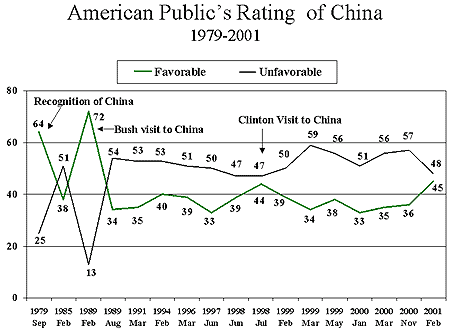
By 1985, with President Ronald Reagan in office, American opinion had dropped to 38% favorable and 51% unfavorable. Four years later, following a visit to China by President George H.W. Bush, American opinion jumped up to its most positive ratio measured by Gallup over the entire period from 1979 through 2001 -- 72% favorable to just 13% unfavorable. But in June 1989, with the crackdown by Chinese authorities on dissidents within their own country, symbolized by the lone Chinese man stopping a line of tanks in Tiananmen Square, the public's favorability rating of China dropped again, to 34% favorable and 54% unfavorable.
China's favorability rating fluctuated over the next several years, and achieved an intermediate high point after President Bill Clinton's 1998 visit, but still more people rated the country unfavorably (47%) than favorably (44%). One reason why Clinton's visit may not have had a greater positive impact on public opinion is that it was undertaken at the same time Republican leaders in the Senate had initiated an investigation into possible illegal Chinese activities in the United States. They were investigating allegations, all denied by China, that the country had gained missile technology by launching a U.S. satellite and that the Chinese military had illegally contributed to the Democrats' 1996 election campaign. The most recent rating, taken in February of this year, shortly after President George W. Bush assumed office, showed 45% of Americans holding a favorable opinion of China, while 48% had an unfavorable opinion.
China Not Viewed Positively, But Few Americans Say It Is
an "Enemy"
The most recent February poll finds that one in seven Americans --
14% -- identify China as the country representing "America's
greatest enemy today," putting China in second place behind Iraq
(identified by 38% of the public as the "greatest" enemy). A March,
2000 Gallup poll provides another perspective. It found that just
over half of Americans -- 53% -- viewed the relationship between
the United States and China in negative terms, as 21% characterized
China as an "enemy," while another 32% said China was "unfriendly"
toward the United States, although not an enemy. By contrast, just
4% said China was an "ally," and another 24% said that China was
"friendly." Overall, almost twice as many Americans have a
negative, rather than positive, view of China, with about a fifth
-- 19% -- expressing no opinion.
In a 1999 poll, Americans gave China a dismal rating on its treatment of Chinese citizens. Almost seven in 10 (69%) rated the country as "bad" in respecting human rights, with 34% saying "very" bad and 35% saying "mostly" bad. Only 21% gave China a good rating -- 3% "very" good, and 18% "mostly" good.
Public Not Closely Following News About China
In general, the public does not follow the news about China very
closely. A review of the public's reaction to several recent events
involving China shows that just 13% said they had closely followed
the incident involving China's launching of a U.S. satellite, and
only half that number -- 7% -- said they had closely followed the
news about China's efforts to join the World Trade Organization.
Overall, 45% of Americans said they followed the satellite incident
at least "somewhat" closely, while 29% followed the China World
Trade Organization story. Compared with 89 other news stories
measured by Gallup over the past 20 years, these two China stories
ranked 54th and 84th respectively.
This lack of attention to such stories may help to explain why many Americans have little to say about China when they are explicitly given that option in a survey. According to a CBS News poll conducted in May 1999, 18% of Americans said they had a "generally favorable" view of China, 24% a "generally unfavorable" view, but over half -- 53% -- said their view of China was "neutral." Similarly, in a May 2000, Gallup poll, 25% of Americans expressed support for a new law that would normalize trade relations between the United States and China, while 19% opposed it, and a majority -- 56% -- said they had no opinion.
Survey Methods
The most recent results are based on telephone interviews with 1,003 national adults, aged 18+, conducted February 1-4, 2001. For results based on the total sample of national adults, one can say with 95% confidence that the margin of sampling error is +/- 3 percentage points. In addition to sampling error, question wording and practical difficulties in conducting surveys can introduce error or bias into the findings of public opinion polls.
Next, I'd like your overall opinion of some foreign
countries. First, is your overall opinion of [RANDOM ORDER]very
favorable, mostly favorable, mostly unfavorable, or very
unfavorable? (How about…)
BASED ON -- 494 -- NATIONAL ADULTS IN FORM A; ±5 PCT. PTS.
|
2001 Feb 1-4 |
Very favor- |
Mostly favor- |
Mostly unfavor- |
Very unfavor- |
No |
Total favor- |
Total unfavor- |
|
% |
% |
% |
% |
% |
% |
% |
|
|
Canada |
51 |
39 |
4 |
3 |
3 |
90 |
7 |
|
Australia |
43 |
42 |
4 |
4 |
7 |
85 |
8 |
|
Great Britain |
41 |
44 |
6 |
3 |
6 |
85 |
9 |
|
Italy |
24 |
54 |
8 |
4 |
10 |
78 |
12 |
|
France |
22 |
55 |
12 |
5 |
6 |
77 |
17 |
|
Germany |
20 |
55 |
9 |
7 |
9 |
75 |
16 |
|
Israel |
18 |
45 |
20 |
12 |
5 |
63 |
32 |
|
Japan |
17 |
56 |
14 |
7 |
6 |
73 |
21 |
|
Mexico |
17 |
50 |
17 |
9 |
7 |
67 |
26 |
|
Brazil |
13 |
56 |
12 |
5 |
14 |
69 |
17 |
|
The Philippines |
12 |
51 |
19 |
6 |
12 |
63 |
25 |
|
Egypt |
11 |
54 |
19 |
4 |
12 |
65 |
23 |
|
South Africa |
11 |
46 |
24 |
9 |
10 |
57 |
33 |
|
Taiwan |
11 |
52 |
14 |
8 |
15 |
63 |
22 |
|
India |
8 |
50 |
24 |
6 |
12 |
58 |
30 |
|
Colombia |
7 |
23 |
38 |
21 |
11 |
30 |
59 |
|
Saudi Arabia |
7 |
40 |
28 |
18 |
7 |
47 |
46 |
|
Vietnam |
7 |
39 |
30 |
14 |
10 |
46 |
44 |
|
Russia |
6 |
46 |
27 |
15 |
6 |
52 |
42 |
|
China |
5 |
40 |
31 |
17 |
7 |
45 |
48 |
|
Cuba |
4 |
23 |
41 |
27 |
5 |
27 |
68 |
|
The Palestine Authority |
4 |
18 |
39 |
24 |
15 |
22 |
63 |
|
North Korea |
3 |
28 |
37 |
22 |
10 |
31 |
59 |
|
Iran |
2 |
10 |
45 |
38 |
5 |
12 |
83 |
|
Iraq |
2 |
7 |
34 |
51 |
6 |
9 |
85 |
|
Libya |
2 |
9 |
40 |
35 |
14 |
11 |
75 |
China Trend
|
Very favor- |
Mostly favor- |
Mostly unfavor- |
Very unfavor- |
No |
Total favor- |
Total unfavor- |
|
|
% |
% |
% |
% |
% |
% |
% |
|
|
2001 Feb 1-4 |
5 |
40 |
31 |
17 |
7 |
45 |
48 |
|
2000 Nov 13-15 |
5 |
31 |
39 |
18 |
7 |
36 |
57 |
|
2000 Mar 17-19 |
6 |
29 |
40 |
16 |
9 |
35 |
56 |
|
2000 Jan 25-26 |
4 |
29 |
33 |
18 |
16 |
33 |
51 |
|
1999 May 7-9 |
5 |
33 |
38 |
18 |
6 |
38 |
56 |
|
1999 Mar 12-14 ^ |
2 |
32 |
39 |
20 |
7 |
34 |
59 |
|
1999 Feb 8-9 |
8 |
31 |
34 |
16 |
11 |
39 |
50 |
|
1998 Jul 7-8 |
6 |
38 |
36 |
11 |
9 |
44 |
47 |
|
1998 Jun 22-23 |
5 |
34 |
42 |
9 |
10 |
39 |
47 |
|
1997 Jun 26-29 |
5 |
28 |
36 |
14 |
17 |
33 |
50 |
|
1996 Mar 8-10 |
6 |
33 |
35 |
16 |
10 |
39 |
51 |
|
1994 Feb 26-28 |
4 |
36 |
38 |
15 |
7 |
40 |
53 |
|
1991 Mar 14-17 |
5 |
30 |
35 |
18 |
12 |
35 |
53 |
|
1989 Aug 10-13 |
5 |
29 |
32 |
22 |
12 |
34 |
54 |
|
1989 Feb 28-Mar 2 |
12 |
60 |
10 |
3 |
15 |
72 |
13 |
|
1985 Feb 22-Mar 3 |
5 |
33 |
35 |
16 |
11 |
38 |
51 |
|
1979 Sep |
18 |
46 |
18 |
7 |
10 |
64 |
25 |
|
^ Based on half sample |
|||||||
What one country anywhere in the world do you consider to be America's greatest enemy today? [Open-ended]
|
2001 Feb 1-4 |
|
|
% |
|
|
Iraq |
38 |
|
China |
14 |
|
Iran |
8 |
|
Russia |
6 |
|
Libya |
4 |
|
Saudi Arabia |
4 |
|
North Korea |
2 |
|
Middle East |
2 |
|
Cuba |
2 |
|
US |
1 |
|
Japan |
1 |
|
Palestine |
1 |
|
Israel |
* |
|
Afghanistan |
* |
|
None |
2 |
|
Other |
4 |
|
No opinion |
11 |
*Less than 0.5%