GALLUP NEWS SERVICE
PRINCETON, NJ -- Despite campaigning on a promise to increase defense spending significantly over the next several years, President George W. Bush announced recently that there would be no new spending on defense, at least for the present time. A review of recent polls taken by Gallup and other organizations shows that the president is not likely to find much of an outcry in reaction to his decision, as the issue itself is of relatively low salience to the public and there is no general consensus about either increasing or cutting defense expenditures.
Public Support for Increased Defense Spending at
Relatively High Level, But Still Less Than a Majority
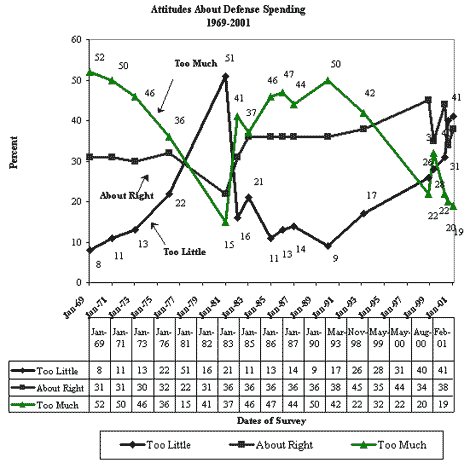
The most recent Gallup poll, conducted February 1-4 of this year,
shows that 41% of Americans say the country is spending too little
on national defense and the military, 19% say too much, and 38% say
about the right amount. These numbers are similar to those measured
in a CNN/USA Today/Gallup poll last August, when 40% said too
little was being spent, 20% said too much, and 34% said about
right.
A poll last August-September by the People and the Press, containing question wording different from that of the Gallup poll taken in the same time period, showed somewhat less support for additional military spending: 34% said defense spending should be increased, 14% said it should be cut back, and 48% said it should remain the same. A more recent CBS News/New York Times poll, conducted in late October of last year, showed 45% in favor of increasing defense spending, 42% for keeping spending at the same level, and just 8% for cutting spending. When a different question was posed to the public in a December 2000 CBS News/New York Times poll, the public again seemed about evenly divided on the issue: 43% of registered voters said they favored and 45% opposed "increasing defense spending by at least $20 billion by the year 2006." Another 12% said they were unsure.
All in all, a review of all of these polling results suggests that -- no matter how the question is put to the public -- less than a majority of Americans feel that defense spending needs to be increased.
As an indication of how weakly held are American attitudes about defense, however, a survey by the University of Maryland last year asked respondents if they would support a 10% cut in defense spending to improve education, strengthen Social Security, and pay down the national debt. The poll was conducted September 21-25, 2000, about a month after the Gallup and the People and the Press surveys, which separately showed only a small number of Americans believing spending should be cut or that too much was being spent on defense. But given the wording of the University of Maryland survey, 63% of Americans supported the cut in defense, while just 31% were opposed.
A review of Gallup trends on this question over the past three decades shows that rarely has there been a majority who felt that spending was either too little or too much. For most of the time, the number who say defense spending is "about right" has varied in the 30% to 40% range, with the rest of the public divided between a pro- and an anti-spending stance. During this time, in general more people have said there was too much rather than too little spending, but there have been two major exceptions. Both occurred in the context of presidential elections when the two major candidates favored increased spending. One of these exceptions was in 1981, following Ronald Reagan's first successful campaign for the presidency, when he argued for the need to increase defense spending, at the same time that President Jimmy Carter was actually proposing increases to Congress. The second exception to the general rule -- that more people say too much is being spent on defense rather than too little -- is the present. As in 1981, opinion today is being measured in the wake of a presidential campaign in which both candidates supported significant increases in defense spending.
The trend line in the accompanying graph shows that Americans were most likely to say there was too much defense spending in the wake of the Vietnam War, with the highest numbers in 1969, the first year the question was asked, but with the percentage declining as spending actually declined. The number who said there was too much spending remained at high levels during most of the '80s and into 1990, during the recession, when it reached the 50% level again, but then declined to 42% in the early 1990s. In the past couple of years, Republicans have generally been more vocal than Democrats in calling for increased defense spending, but the election campaign witnessed the unusual situation in which the Democratic candidate was calling for higher increases in defense spending than the Republican. Given that both candidates proposed higher spending, it is not surprising that the percentage of Americans saying too much is being devoted to defense is now at its second-lowest level in 30 years.
A related question asks Americans how they view the strength of our national defense. As the table below indicates, Gallup has asked the question only a few times, the latest in the February 1-4, 2001, poll. Note that 44% say not strong enough, similar to the 41% who say defense spending is too little. But people are apparently very reluctant to say that our defense is "stronger than it needs to be." Each time that the question has been asked, the greatest number of people respond that the national defense is "about right": from 48% to 55% take that position in the four polls asked in the past two years, while 64% opted for that description in 1990, during the recession. In 1984, during the last year of Reagan's first term, following significant increases in defense spending, only 36% said the national defense was not strong enough, while 61% said about right or stronger than it needed to be.
|
Do you, yourself, feel that our national defense is stronger now than it needs to be, not strong enough, or about right at the present time?
|
|||||
|
Stronger than needs to be |
Not strong enough |
About |
No |
||
|
% |
% |
% |
% |
||
|
2001 Feb 1-4 |
7 |
44 |
48 |
1 |
|
|
2000 May 18-21 |
6 |
38 |
55 |
1 |
|
|
2000 Jan 13-16 |
6 |
39 |
52 |
3 |
|
|
1999 May 7-9 |
7 |
42 |
48 |
3 |
|
|
1990 Jan 4-7 |
16 |
17 |
64 |
3 |
|
|
1984 ^ |
15 |
36 |
46 |
3 |
|
|
^ |
Gallup/Newsweek |
||||
Different polling organizations have obtained different results, depending on the way the question is worded. A Newsweek poll in August of last year, for example, found results quite similar to the current Gallup poll results when it used the same wording: 43% of respondents said the national defense was not strong enough, 44% said about right, and 9% said stronger than needed. A month later, in mid-September, a Washington Post poll asked a different question and found 66% of all Americans either very satisfied (21%) or somewhat satisfied (45%) with the national defense. That same month, an NBC/Wall Street Journal poll seemed to find a more dissatisfied public, as a majority -- 52% -- said the military was not as strong as it needed to be, while just 42% said it was.
These contradictory results reflect the general lack of attention that Americans pay to the defense issue and thus their susceptibility to being influenced by the question wording and the placement of the question in the survey -- before or after other similar questions about defense, for example. Essentially, as suggested in the previous section, Americans take their cue on this matter from the political leaders with whom they most closely identify. This is clearly an area where the public follows the leader, rather than the reverse.
Salience of Defense Spending to the Public Is
Low
Although Americans are quite willing to answer questions about this
issue, generally they pay very little attention to it and, at least
for the past year or so, have considered the issue of minor
importance. In a CNN/USA Today/Gallup poll conducted this past
December, only 2% of Americans mentioned defense as the top
priority for the Bush administration in its first 100 days. A
similar finding was obtained in a Gallup poll last month, when
Americans were asked to cite the most important problems facing the
country. Just 2% cited anything to do with the military or national
defense as one of the three most important problems. And during the
election, when asked to rate the importance of national defense
among the issues that would influence their presidential choice,
voters ranked that issue eighth among the 11 that were rated.
These findings from Gallup polls are consistent with the findings of other polls on the issue. In mid-October of last year, the Washington Post asked voters to cite the two most important issues that would influence their vote. Less than half of one percent mentioned national defense. The Washington Post then listed five items and asked Americans which one would be their top priority for any surplus money in the federal budget. National defense came in last with 1% of the vote, compared with 44% for strengthening Social Security and Medicare, 24% for reducing the federal debt, 20% for cutting federal income taxes and 9% for increasing spending on other domestic programs. Similarly, an NBC/Wall Street Journal poll in early September of last year asked voters to identify the three most important issues that would influence their vote choice. National defense ranked seventh among the eight issues that were listed, getting more support than the environment, but less support than the economy, moral standards and ethics, education, health care, Social Security and taxes.
Republicans More Supportive of Defense Spending Than
Democrats
Ironically, Bush's decision to hold off on any military spending
increases for the time being runs counter more to the preferences
of his own natural supporters than to those of his opponents. The
current poll shows that a solid majority of Republicans -- 58% --
feel there is too little spending, compared with just 35% of
independents and 30% of Democrats who feel that way. Similarly, 61%
of Republicans say that our national defense is not as strong as it
should be, while 40% of independents and just 31% of Democrats
express that view.
Survey Methods
Current results from the Gallup poll are based on telephone interviews with -- 1,003 -- national adults, aged 18+, conducted February 1-4, 2001. For results based on the total sample of national adults, one can say with 95% confidence that the margin of sampling error is +/- 3 percentage points.
In addition to sampling error, question wording and practical difficulties in conducting surveys can introduce error or bias into the findings of public opinion polls.