GALLUP NEWS SERVICE
PRINCETON, NJ -- Increased optimism that the Federal Reserve Board is approaching the end of its efforts to increase interest rates, as well as good earnings reports, have the stock market at a six-year high. Even a surge in the price of oil above $70 a barrel and gas prices at the pump approaching $3 a gallon have not slowed the "bull run" on Wall Street.
In sharp contrast to Wall Street's exuberance, the April UBS/Gallup Index of Investor Optimism shows investor optimism continuing to tumble. So, how can investor optimism be declining as the Dow remains at a six-year high?
Investor Optimism Continues Its Decline in April
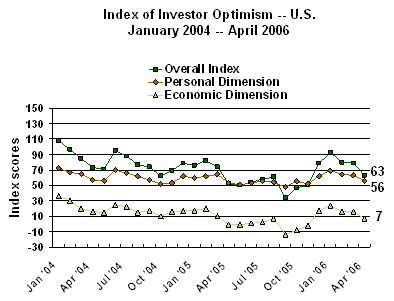
Investor optimism is now at its lowest point since November 2005. The Index of Investor Optimism fell 16 points in April and now stands at 63. This is down from 79 in March, and February's 80. The Index has now fallen three months in a row and is 30 points below its January level of 93. It is 11 points higher than it was a year ago (52), but 10 points lower than two years ago (73).
The Personal Dimension is at 56 -- down seven points from March. The Economic Dimension stands at 7 -- down nine points from March.
Substantial Investor Optimism Has Fallen Sharply This Year
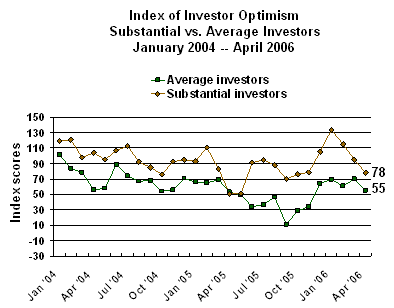
Substantial investor optimism (based on those having $100,000 or more of investable assets) fell for the third consecutive month in April and now stands at 78. The Substantial Investor Index is down from 95 in March and 115 in February. It is now 56 points below its January level of 134. The Substantial Investor Index is 27 points higher than it was a year ago (51) but 26 points lower than two years ago (104).
Average investor optimism (based on those having at least $10,000 but less than $100,000 of investable assets) also fell in April. The Average Investor Index is 55 -- down 15 points from March. The April reading is 14 points below its January level (69) and about equal to its levels of a year ago (53) and two years ago (56).
Investor Optimism Among Men and Women Has Fallen This Year
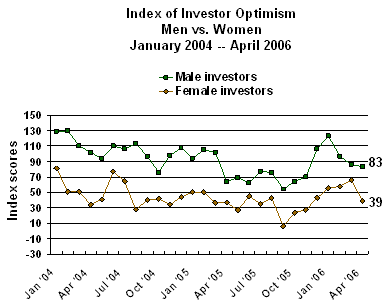
Optimism among female investors fell 27 points, to 39, from 66 in March. The Female Investor Index is down from 58 in February and 55 in January. It is now just about where it was a year ago (37).
Optimism among male investors was just about unchanged from last month, with the Male Investor Index at 83 in April and 86 in March. The Male Investor Index is down 14 points from February and 40 points from January (123). It is 19 points above where it was a year ago (64) but 19 points below where it was two years ago (102).
Which Hurts More: Higher Interest Rates or Higher Energy Prices?
Comments at the last Federal Open Market Committee (FOMC) meeting and from some individual Fed members raised investor expectations that the steady increase in interest rates may be ending soon. Many on Wall Street see this as a highly positive event. In fact, some observers consider interest rates a bigger danger to U.S. business than surging energy prices. They also argue that most companies have greatly reduced their dependence on energy over the past decade. At the same time, they note that a significant amount of U.S. manufacturing has been outsourced, leaving the United States as much more of a service economy. As a result, they maintain that rising interest rates increase business operating costs more significantly than do higher energy prices, which means stock prices can soar as energy costs surge.
The problem with this analysis is that it assumes the American consumer can and will continue to spend even as gas prices at the pump climb to $3 a gallon or more. The idea seems to be that although consumers may buy fewer SUVs, they'll not only continue to spend, but will do so by purchasing more fuel-efficient vehicles.
While the "money" on Wall Street may persist in this view in the short term and may keep the stock market soaring, the decline of investor optimism over the past several months suggests that continued spending may be only a temporary phenomenon. Surging gas prices at the pump will intensify the real disposable-income squeeze that low- and moderate-income households are now experiencing. The pullback in consumer spending that results as this squeeze intensifies may indeed more than offset the benefits of more stable interest rates for much of corporate America in the months ahead.
Survey Methods
Results for the Index of Investor Optimism poll are based on telephone interviews with 802 investors, aged 18 and older, conducted April 1-16, 2006. For results based on the total sample of investors, one can say with 95% confidence that the margin of sampling error is ±4 percentage points. In addition to sampling error, question wording and practical difficulties in conducting surveys can introduce error or bias into the findings of public opinion polls.
