GALLUP NEWS SERVICE
PRINCETON, NJ -- While many on Wall Street argue that higher energy prices have done little to slow consumer spending or the economy, the American consumer tells a much different story. Seven in 10 Americans say the country's energy situation is having a major impact on the U.S. economy. More than half say it is causing them financial hardship, while 6 in 10 report cutting back on their discretionary spending as a result of higher gasoline and energy prices.
Given these perceptions, it is not surprising that consumers remain less than enthusiastic about the current credit situation, as reflected by the new Experian/Gallup Personal Credit Index. The Index is unchanged for the latest month and remains tied with its lowest level since its inception in March 2005. The new PCI survey was conducted between May 15 and May 21, 2006.
Causing Financial Hardship
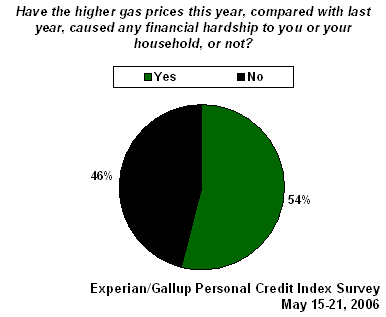
Although retail gas prices have leveled off during recent weeks, they remain about $0.75 above those of a year ago according to the Energy Information Administration (EIA). Most consumers are feeling the pinch, as 54% of consumers say higher gas prices this year compared to those of last year are causing them financial hardship. In fact, nearly one in three of those experiencing hardship say higher gas prices are causing them "a great deal" of financial hardship.
Consumers Cutting Back
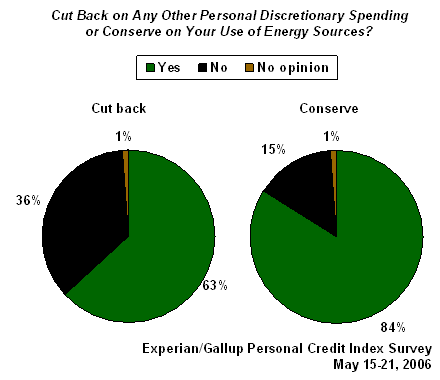
Eighty-four percent of consumers say they feel the need to conserve energy in response to the high cost of gas, electricity, and other energy sources. Sixty-three percent say they have felt the need to reduce their personal discretionary spending as a result of the rise in energy prices.
Spending Cuts Affect Many Areas
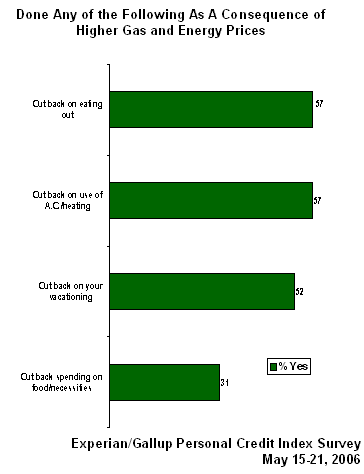
At the top of the list of consumer spending cutbacks in response to higher energy prices are the use of air conditioning or heating and eating out, with 57% of consumers saying they have reduced spending in these areas. Cutting back on vacation plans comes next, with 52% saying they have reduced their planned spending. Notably, 31% of consumers say they have had to reduce their spending on food and other necessities as a result of higher gasoline and other energy prices.
The Personal Credit Index Declines Again
Consumers continue to be much less optimistic about their credit situations according to the most recent Experian/Gallup Personal Credit Index, which remains at 74. Last month the PCI fell to 74 -- tying with the November 2005 measure, its lowest level since its inception in March 2005. The PCI was set at 100 when it first began.

The Lagged Impact of High Gas Prices
The impact of higher gas prices on the overall economy depends not only on how high prices go but also on how long prices remain high. For example, during the period between March 27 and April 24, 2006, gas prices at the pump increased from an average of about $2.50 a gallon to $2.91 a gallon according to the EIA. Gasoline prices have remained close to that same level ever since averaging $2.88 per gallon during the week of May 22, 2006. At this point, three in four consumers believe that the increase in gas prices is more of a permanent change than a temporary fluctuation in prices.
If gas prices at the pump remain near $3.00 a gallon, or worse yet, increase during the summer driving season, those consumers who have not adjusted their spending in response to higher prices will be forced to do so. And, many of those who have made only temporary adjustments will have to consider more permanent alternatives. As this process unfolds, the full delayed effect of higher gasoline and energy prices will be felt by the economy both in terms of reduced consumer spending and increased inflation. The impact of this lagged effect may be intensified as the global liquidity excesses of recent years are reduced and interest rates increase. This could make for a much sharper slowdown in economic activity during the second half of this year than many currently anticipate.
The recent PCI survey suggests that consumers are not only being greatly influenced by high gasoline and energy prices, but are also making significant spending adjustments in response to them. If gas prices remain high, we will soon learn whether the consumer or Wall Street has a better understanding of how prices at the pump influence the U.S. economy.
Survey Methods
Results for the Experian/Gallup Personal Credit Index Poll are based on telephone interviews with 1,008 adults, aged 18 and older, conducted May 15-21, 2006. For results based on the total sample of investors, one can say with 95% confidence that the maximum error due to sampling and other random effects is ±3 percentage points. In addition to sampling error, question wording and practical difficulties in conducting surveys can introduce error or bias into the findings of public opinion polls.