GALLUP NEWS SERVICE
PRINCETON, NJ -- Over the past couple of weeks, the global credit markets have avoided what can only be described as a liquidity crisis as the European Central Bank (ECB) and the Federal Reserve flooded the financial system with liquidity and psychological support. As a result, it appears the Fed has successfully bolstered worldwide investor confidence that it will do whatever is necessary to keep the credit markets operating in an orderly fashion -- an essential achievement for the Fed under Chairman Ben Bernanke. Still, the panic on Wall Street and in the financial markets is likely to have a negative impact on Main Street, while the resolution of that liquidity crisis is unlikely to do anything to moderate the continued deterioration of the residential real estate market and its impact on consumer credit.
As a result, it should not be surprising that two in three investors (65%) describe the current U.S. economy as being in a slowdown or recession in the August UBS/Gallup Index of Investor Optimism poll. Nor should it be hard to believe that investor optimism plunged, falling for the third consecutive month as investors became increasingly concerned about the fallout from the subprime mortgage and residential real estate debacles. What is troubling, however, is the investor perception that consumers are already finding it harder to obtain credit.
Investor Optimism Takes a Tumble
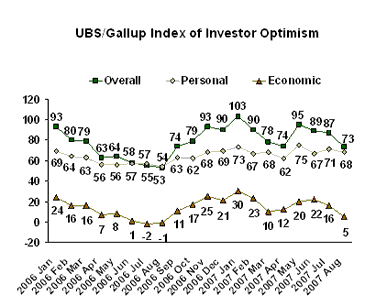
Investor optimism plunged 14 points in August -- the third consecutive monthly decline -- and now stands at 73, according to the UBS/Gallup Index of Investor Optimism. This puts the Index at its lowest point since August 2006, when it stood at 53. The Index is conducted monthly and had a baseline score of 124 when it was established in October 1996. The Index peaked at 178 in January 2000 and hit its low of 5 in March 2003.
The decline in the overall Index was primarily driven by an 11-point plunge in its Economic Dimension that reflects deteriorating investor optimism about the direction of the overall U.S. economy over the next 12 months. The Economic Dimension is at 5 in August -- the lowest level for this dimension since August 2006, when it stood at -1.
In contrast, the Personal Dimension of the Index, which reflects investors' optimism about their personal investment portfolios, declined by only 3 points in August, to 68. While lower than the 71 of July, this places the Personal Dimension at essentially its June level (67) and suggests many investors believe they will be able to maintain their investment portfolio returns over the next year even as the U.S. economy weakens.
Residential Real Estate Continues to Deteriorate
Eight in 10 investors now say they perceive residential real estate conditions nationwide to be getting worse, not better. This is up from the 71% of investors who felt this way in July and is the most pessimistic investor view of housing market conditions since the Index of Investor Optimism began polling on this topic in June 2006. At the same time, 62% of investors say economic conditions in their local community's residential real estate market are getting worse, not better.
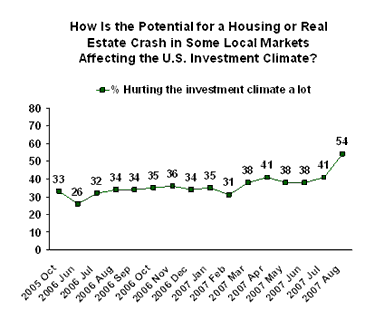
In fact, 54% of investors currently believe that the potential for a housing or real estate crash in some local markets is hurting the U.S. investment climate "a lot" -- up sharply from the 41% who felt this way in July and the 34% holding this view a year ago. As a result, concerns about conditions in the nation's housing markets rank second only to energy prices among major investor worries.
Consumer Credit Risk Standards Being Re-Established
The events of the past couple of weeks and those that can be expected during the months ahead are teaching investors and lenders that the underwriting standards of the past -- those that have been so routinely ignored in the new world of global finance -- are ignored only at great financial peril. As a result, investors are setting about the process of re-evaluating the potential risk-reward ratios associated with a wide range of investment vehicles in the marketplace. At the same time, financial services firms and their regulators are going about a similar process as they re-establish more traditional consumer credit underwriting standards.
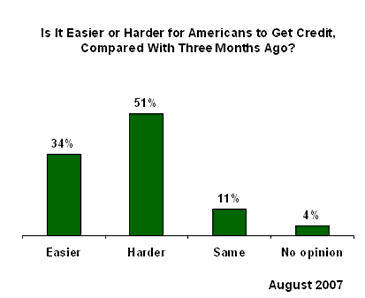
The immediate impact of this readjustment process on consumer psychology as well as Main Street should not be underestimated. For example, 51% of investors currently believe it is harder for Americans to get credit now than it was just three months ago. The odds are in favor of this investor assessment of the consumer credit market, as financial firms not only eliminate the most egregious lending practices in the mortgage market, but also re-establish more traditional lending standards for home equity loans/lines and consumer credit cards.
While in a real financial sense, a return to more traditional lending standards might not fully qualify as a traditional "consumer credit crunch," the reality is that its practical effect will be essentially the same. Many consumers who have found various forms of credit being pushed on them in the recent past may come to experience a new financial environment in which credit is much less available. For many Americans, this new financial environment is likely to feel a lot like a traditional credit crunch, with many consumers learning that credit is no longer available to them.
Investors' Optimism About Their Investment Portfolios
One of the most striking aspects of the new investor poll is the way investors seem to be separating their expected portfolio returns from their expectations for the U.S. economy. Clearly, the continued deterioration of the housing market coupled with growing perceptions of a consumer credit crunch suggest that the probability of a U.S. recession is much greater now than it was just a few weeks ago. Add the persistence of relatively high oil and gas prices even as fears of recession grow, and investor pessimism about the course of the economy during the next 12 months seems highly justified.
Can the U.S. investor continue to do well even as the U.S. economy worsens? In order for this to be the case, one must believe that the global economy can continue to prosper even as the U.S. economy approaches or actually experiences recession. Although more about this potentiality will be seen when the ECB meets next month, its recent actions suggest that such a development may not be likely. Further, investors' optimism about their investment portfolios seems to suggest that many investors think the fallout from recent financial events has already been realized. Unfortunately, past experience suggests there may be a lot more fallout to come.
Barring a Fed bailout in the months ahead, this ray of optimism on the part of investors as they think about their investment portfolios may end up being more of chimera than a reality.
Survey Methods
Investor results are based on telephone interviews with 804 investors, aged 18 and older, conducted Aug. 1-15, 2007. For results based on the total sample of investors, one can say with 95% confidence that the maximum margin of sampling error is ±4 percentage points. In addition to sampling error, question wording and practical difficulties in conducting surveys can introduce error or bias into the findings of public opinion polls.