LONDON — More than four years after Russia’s full-scale invasion of their country, Ukrainians’ approval of U.S. leadership continues to sink as attitudes toward the war itself remain stable.
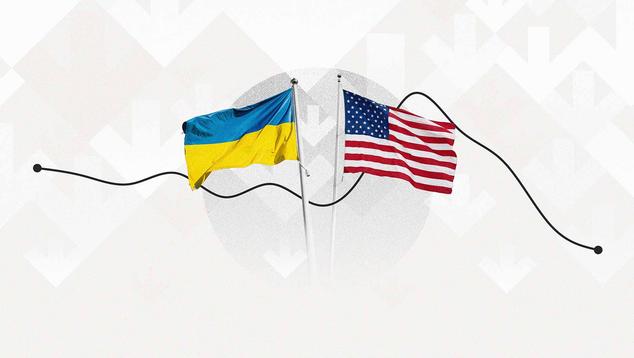
Just 7% of Ukrainians surveyed in April say they approve of the leadership of the U.S., while 79% disapprove. Approval has fallen by nine percentage points since 2025, when it was a then-record low of 16%.
Before Russia’s invasion in February 2022, Ukrainian attitudes toward the U.S. had been mixed, with generally similar levels of approval and disapproval going back to 2014. Ukrainian approval of Washington jumped from 37% in 2021 to 66% in the early months of the conflict as the U.S. stepped in to provide Kyiv with significant military and financial support. No other country in the world recorded a bigger jump in U.S. approval between 2021 and 2022.
By 2024, President Joe Biden’s final year in office, approval was down again, and almost as many Ukrainians disapproved (37%) as approved (40%) of U.S. leadership. Approval ratings continued to slide after President Donald Trump’s return to the White House in 2025.
Largest-Ever Five-Year Decline in U.S. Leadership Approval
U.S. approval in Ukraine has declined by 59 points from its peak in 2022. In the past two decades of Gallup polling across more than 140 countries, no other country has seen a larger drop in U.S. approval over any five-year period.
Approval of the U.S. among several advanced economies and long-standing U.S. allies fell sharply over different five-year periods spanning the transition in administrations from President Barack Obama to Trump. These include Belgium (2016-2020: -52 points), Portugal (2016-2020: -51 points), New Zealand (2013-2017: -47 points), Canada (2013-2017: -46 points) and the Netherlands (2014-2018: -45 points). However, in each case, most of the five-year decline took place between 2016 and 2017, as control of the White House changed hands.
The U.S. also saw sharp reductions in approval in Mozambique (-56 points), Liberia (-51 points) and Zambia (-50 points) between Obama’s first and second terms in office. Yet none of these declines is as large as that in Ukraine in 2026.
Few countries have recorded lower levels of U.S. approval than Ukraine’s this year. Russia in 2015 (1%), Syria in 2008 (4%), Iceland in 2020 (5%) and the State of Palestine in 2024 (5%) are the only countries where approval of U.S. leadership has dipped to 5% or below. In Egypt, Germany, Iran, Spain, Algeria, Belarus, Cyprus, Pakistan, Tunisia and the United Arab Emirates, approval has reached levels similar to Ukraine’s 2026 figure over the past two decades.
Attitudes Toward War Stabilize for First Time
In 2026, nearly one in four adults (24%) say Ukraine should continue fighting until it wins the war, while 66% say it should seek to negotiate an end to the war as soon as possible.
These attitudes are on par with 2025, which itself represented a nearly complete reversal in public opinion compared with the early days of the conflict in 2022, when 73% favored continuing to fight and 22% favored a negotiated end as soon as possible. More Ukrainians have favored a negotiated end over a continued fight since 2024.
The front lines in Ukraine’s East, where 63% currently favor a quick end to the war, have moved little over the past year as fighting is increasingly dominated by drones. Russia has advanced at historically slow rates on the battlefield and suffered a huge number of fatalities, according to the Center for Strategic and International Studies, with Ukraine recently retaking some lost territory.
Most Think a Quick End to Fighting Is Unlikely
For the past two years, Gallup has also asked Ukrainians how likely they think it is that active fighting will come to a lasting end within the next 12 months. Again, there is a great deal of stability on this measure, and a relatively slim minority believe they will soon see an end to the war.
In 2026, 5% say it is “very” likely and 18% “somewhat” likely that active fighting will soon come to a lasting end. On the other hand, the percentage saying it is very (36%) or somewhat (34%) unlikely to end soon is far higher and broadly on par with opinions in 2025.
There has been a similar plateau in Ukrainians’ views of their future with Western international alliances, long seen by many as crucial to their future success and security. In 2026, 30% say they think Ukraine will join NATO within the next decade, in line with the figure from last year (32%). A higher percentage (38%) think Ukraine will never be a NATO member.
Nearly half (49%) say they think Ukraine will be an EU member in the next 10 years, similar to the figure from last year (52%) and also significantly lower than in the first few years after the invasion.
Bottom Line
After years of grinding conflict, the war in Ukraine has somewhat receded from the top of the global agenda, displaced by the war in Iran and wider instability in the Middle East. Yet over the past 12 months, Ukrainians’ attitudes toward the war have mostly stabilized after several years of significant change.
Peace efforts have stalled in recent weeks, though the Kremlin has signaled that it expects talks to resume. Ukraine's European allies, including the United Kingdom, France and Germany, recently set out conditions for a just and lasting deal, stressing that U.S. involvement is essential.
This highlights a dilemma in public opinion: Ukrainians broadly want to negotiate an end to the war as soon as possible, yet hold historically low approval of the country that would need to play a key role in any deal.
Stay up to date with the latest insights by following @Gallup on X and on Instagram.
For complete methodology and specific survey dates, please review Gallup's Country Data Set details. Learn more about how the Gallup World Poll works.