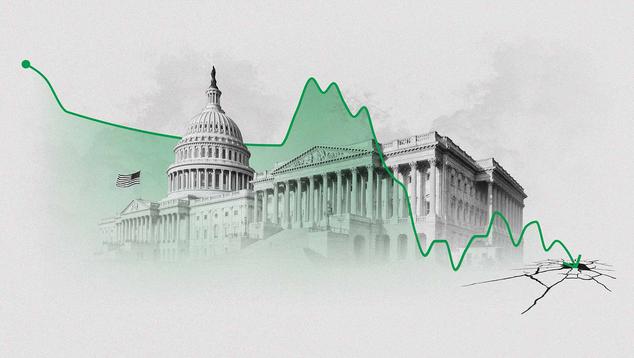
WASHINGTON, D.C. — Five measures of trust in the federal government are at low points in Gallup’s trends. One-third or less of U.S. adults have a great deal or fair amount of trust in the executive (33%) and legislative branches (28%) and the federal government’s ability to handle both international and domestic problems (both at 33%). More, 46%, trust the judicial branch, but its trust has never been lower than now.
These results are from Gallup’s annual Governance poll, conducted Sept. 1-17. Gallup has asked Americans about trust in government institutions since 1972, including every year since 2000.
Public trust in government has been trending downward for the past two decades, but this year brings steeper declines in some measures. Trust in the federal government’s ability to handle international problems is down 12 percentage points from last year, and trust in the executive branch is down eight points. Trust in the federal government to deal with domestic problems is five points below last year’s level.
The drop in trust in the executive branch leaves it seven points below its prior low of 40%, recorded twice. The first was in 1974 during the Watergate era that ultimately led to President Richard Nixon's resignation from office. The second was in 2024, after President Joe Biden ended his reelection campaign following a poor performance in a presidential candidate debate.
Meanwhile, trust in the government’s ability to handle international problems is six points below its prior low (39% in 2021), after the United States’ troubled military withdrawal from Afghanistan.
Trust levels in the legislative branch, the judicial branch and the federal government’s ability to handle domestic problems are either tied for the lowest in Gallup’s trend or lower by a percentage point or two. Those prior lows include 28% for the legislative branch in 2014, 47% for the judicial branch in 2022 after the Supreme Court’s Dobbs decision overturned Roe v. Wade, and 35% for handling domestic problems in January 2019, during a partial government shutdown.
Trust in Handling International Matters Down Similarly Among All Party Groups
Patterns of change in trust in the federal government by party vary across measures. On international problems, Democrats, independents and Republicans show roughly equal declines, all around 10 points. On domestic problems, most of the change is seen among political independents, whose trust is seven points lower than a year ago.
Republicans and independents show double-digit declines in trust in the executive branch, while Democrats, whose trust was in the single digits a year ago, didn’t change materially. Trust levels in the legislative and judicial branches show more modest changes, if any.
Gallup’s 2025 analysis of long-term declines in government trust found that much of the drop has been driven by “out-party” supporters — Democrats when a Republican is president and Republicans when a Democrat is president. Consistent with that, at a time when Republicans control all three branches of the federal government, trust among Democrats this year is exceedingly low — no higher than 23% for any federal government entity and in the single digits for the executive branch and international problems.
Trust among independents has also been declining in recent decades, and the group’s trust on all five federal government measures this year is the lowest for the group in Gallup’s trends.
As trust among independents and out-party supporters has been declining in recent decades, those who identify with the president’s party have maintained relatively healthy trust. Even with some declines this year, at least seven in 10 Republicans trust the federal government, except for the legislative branch.
Barely Half in the U.S. Trust the American People
In addition to asking about trust in federal government institutions, the Governance survey asks Americans to indicate how much they trust major actors in the political process — namely, politicians, the American people and the media.
Gallup previously reported on trust in the mass media, finding a slight uptick to 33% from its historical low point measured last year. Forty-two percent of U.S. adults trust “men and women in political life in this country who either hold or are running for public office,” slightly above its 2023 low of 40%.
The 51% who trust “the American people as a whole” is the lowest Gallup has measured to date, though not significantly different from last year’s 53%. Trust in the American public has been below 60% each year since 2018, after never having been below that level until 2014.
Partisan subgroups have similar levels of trust in the American people, as they typically do. Currently, 53% of Democrats, 51% of Republicans and 49% of independents trust the public’s ability to make democratic decisions.
As might be expected, political independents (38%) are less likely than Republicans (47%) and Democrats (45%) to trust politicians. However, Republicans and Democrats usually don’t have similar trust in politicians. In most years since 2009, more Democrats than Republicans and independents have trusted politicians. But Republicans’ trust in political leaders has increased since Donald Trump was reelected president, while Democrats’ has slumped.
Local Government Most Trusted
Americans express more trust in local government than in any other government institution or civic group. Sixty-seven percent of U.S. adults currently trust their local government a great deal or fair amount. The trend in local trust has generally been stable, ranging between 63% and 77% since 1972.
Americans are somewhat less likely to trust their state government than their local government, with 55% saying they trust their state government. Trust in state government is on the low end of Gallup’s trend, but it was lower just after the Great Recession in 2009 (51%) and 2010 (52%), when many states faced significant budget challenges.
Democrats are more likely than Republicans and independents to trust both local and state governments. Current party differences are modest for local government, with 74% of Democrats and 64% of both Republicans and independents trusting their local government.
Meanwhile, 67% of Democrats, 49% of Republicans and 53% of independents trust their state government. The 18-point party gap in trust in state government is larger than usual; in fact, it ties 2023 as the largest in Gallup’s trend. Historically, the difference in partisans’ trust in state government has averaged seven percentage points (the same as the average party gap in trust in local government).
Bottom Line
Americans’ trust in the federal government across the board is the lowest in Gallup’s records. Though trust has been declining for about two decades, this year saw sharper drops in trust in the federal government to handle international problems and in trust in the executive branch, sending both well below their prior lows. Both declines may be a response to the U.S. war with Iran, which lacks public support and has lasted much longer than the Trump administration promised. Ongoing conflicts in Ukraine and Gaza may also contribute to those lower ratings.
Republicans still largely retain trust in the federal government, albeit somewhat less than a year ago. As is increasingly the case, trust in government has not disappeared but is mainly found among those whose preferred party is in power.
Stay up to date with the latest insights by following @Gallup on X and on Instagram.
Learn more about how the Gallup Poll Social Series works. View complete question responses and trends (PDF download).